

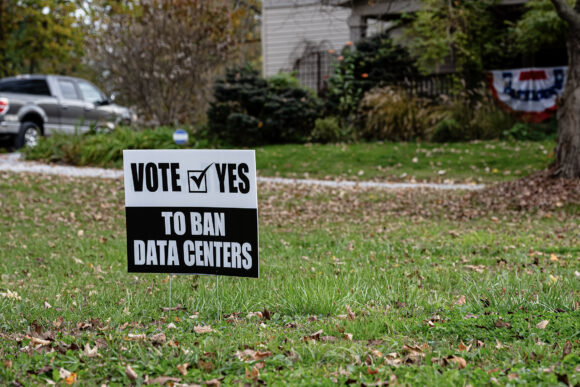
Data center opposition had been building across the country, one moratorium or blocked project at a time. Then, virtually overnight, the midterm election tilted a broad swath of the regulatory map against the AI buildout.
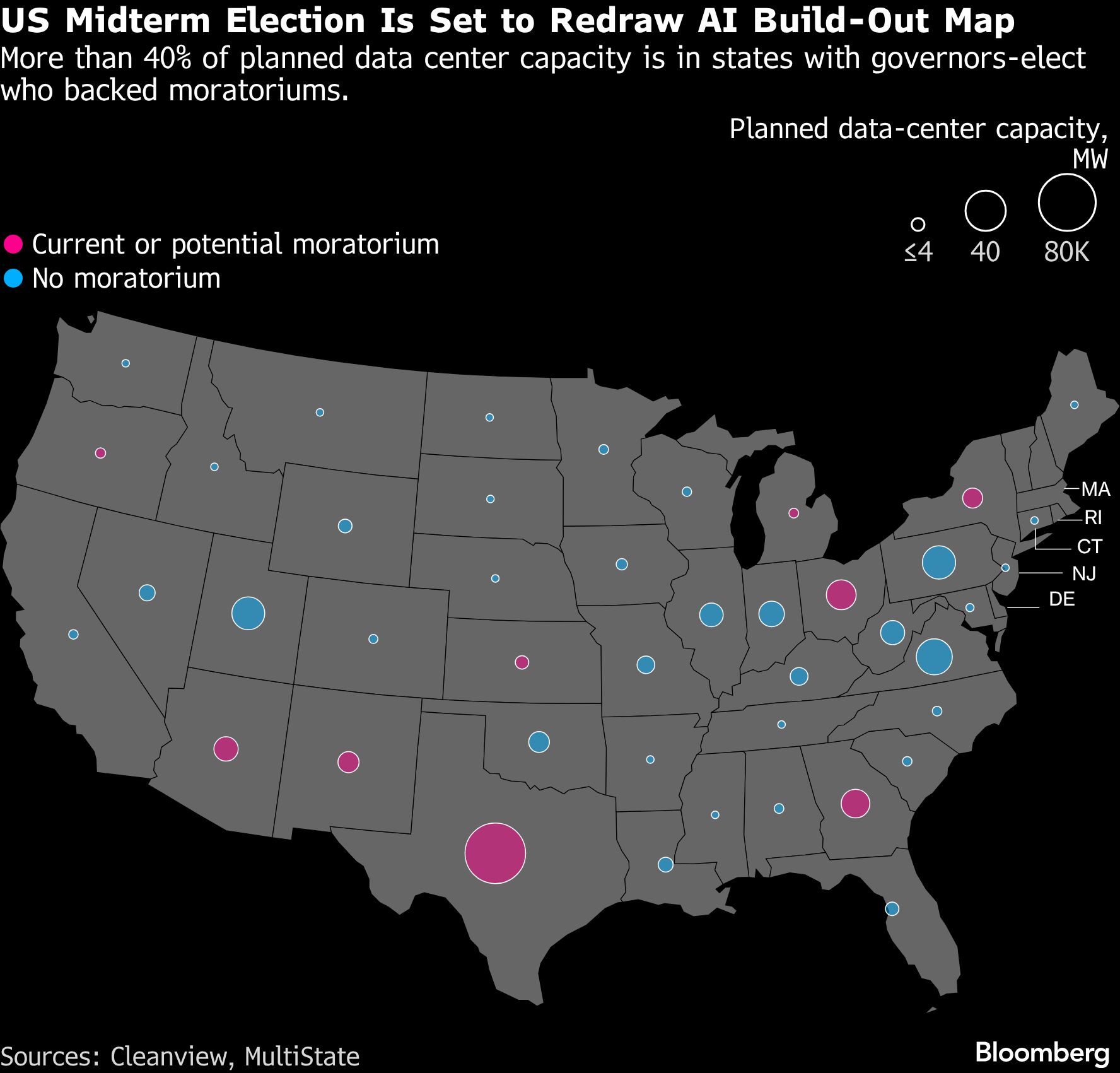
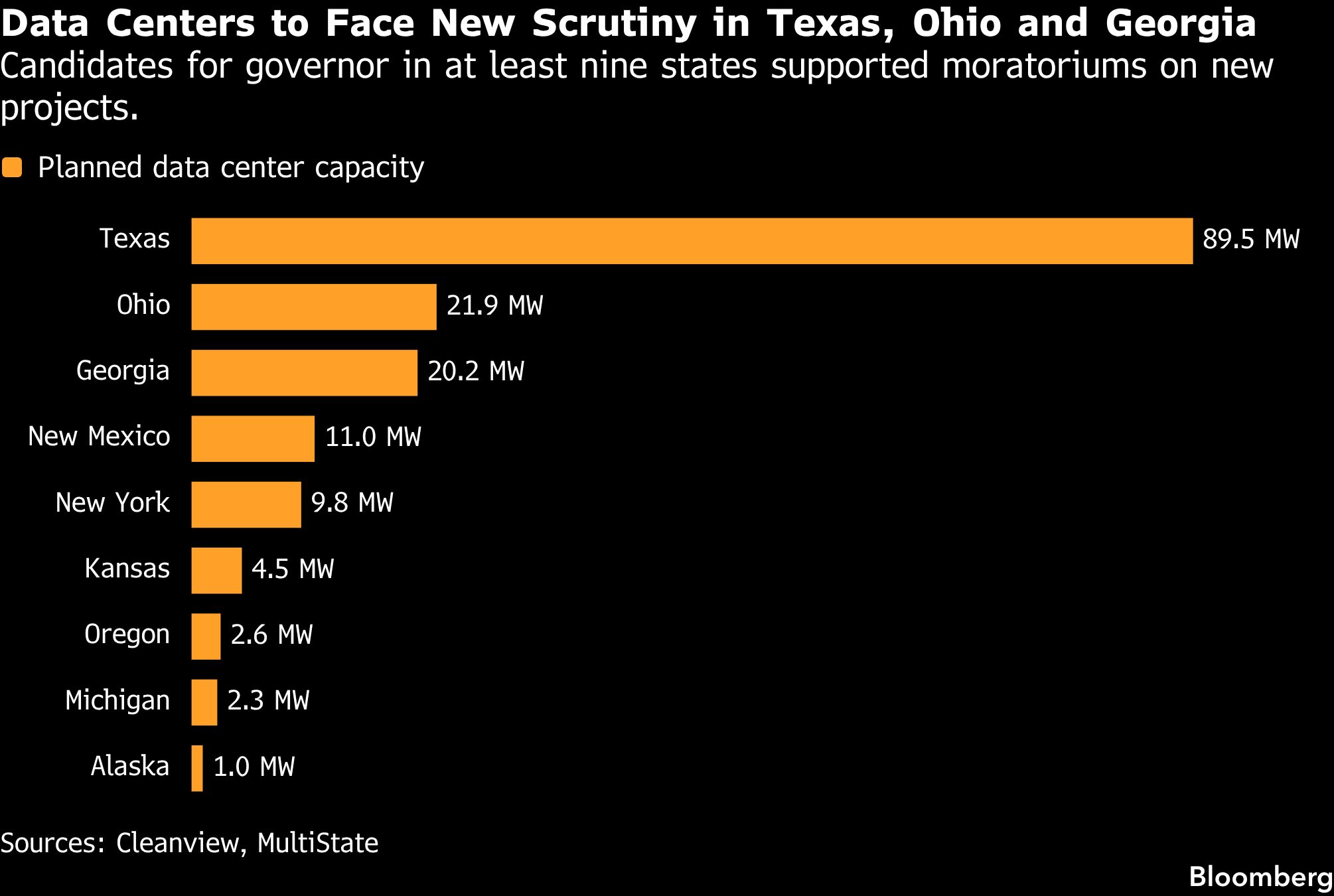
Newly elected governors in Ohio, Georgia, Michigan, New Mexico and Texas campaigned on a promise to stop — or at least pause — data center construction statewide, while those in New York and Oregon pledged to prolong pauses already in place. Gubernatorial candidates calling for a moratorium on data centers also lead in Alaska and Kansas, though those races have not been called.
All told, about 40% of pending data center capacity in the US is planned to be built in states where newly elected governors have promised to stop or pause such construction, according to data from Cleanview, a market intelligence company. That’s on top of 46 local ballot measures approved or on track to pass that also stall development, according to Bloomberg Economics; at least 17 of those are outright bans on large-scale data centers.
“It was obviously not a very good night if you’re a data center developer,” said Justin Teresi, a Bloomberg Intelligence policy analyst.
The political victories underscore the growing voter backlash against the massive industrial warehouses crunching ChatGPT and Claude queries. The potential moratoriums threaten development plans for a host of tech giants frantically trying to build more of that computing capacity.
Investors braced for the fallout. Tech stocks plummeted Thursday in expectation of tighter regulation, with the S&P 500 Index dropping more than 4% and the technology-centric Nasdaq 100 falling 6.4%, erasing $2.3 trillion in market value.
Since 2022, when OpenAI publicly released ChatGPT, technology stocks have fueled a bull run in US equities, with the S&P 500 more than doubling in the four-year period through Wednesday’s close. Technology now accounts for more than half the value of the benchmark index.
The election results are adding to the pressure AI data center developers and their customers were already facing as investors and lenders grow wary of the heavy borrowing and the hundreds of billions of dollars being poured into the boom.
Local opposition efforts, meanwhile, had already hampered at least 45 projects in the second quarter of 2026, according to Data Center Watch, a research group.

Though data center oversight has become an increasingly bipartisan issue, this week’s blue wave election means much of the tough campaign talk on AI might be reflected in state policy. Democrats now control key branches of state government in some of the country’s data center hotbeds, including Virginia, Pennsylvania and Arizona, and are likely to pursue utility and permitting policies that stall construction, according to a new report from BloombergNEF.
Dan Diorio, executive vice president of state policy and government affairs for the Data Center Coalition, an industry alliance, said communities that prohibit data centers risk seeing investment, jobs and tax revenue move elsewhere.
“That’s going to go to other communities that have not shut themselves off,” Diorio said, “or to states that have not shut themselves off.”
Hyperscalers, the largest cloud-computing providers, are expected to overhaul and shift development plans in response. Tuesday’s results stand to shrink the $1.4 trillion that technology companies were expected to spend on AI infrastructure by roughly 5% to 7% in 2027, according to Bloomberg Intelligence technology analyst Mandeep Singh. That includes spending on chips, networking equipment, land and other materials for data center construction.
Those cuts and the anticipated slowdown in approvals may translate into as many as 10 gigawatts of data center capacity failing to come online next year as planned, Singh said.
“We’ve gone from the question of who is going to pass a moratorium to where can I even construct one of these things now?” Teresi, also with Bloomberg Intelligence, said.
Gordon Johnson of GLJ Research said in a note late Tuesday that Texas data center projects that don’t already have electricity and environmental permits lined up will “probably go to Louisiana, Oklahoma or nowhere.”
From a political perspective, candidate promises to freeze the AI build-out appeared to be a no-brainer. Nearly three in four Americans now oppose a data center in their community, up from about two-thirds in March, according to a September Quinnipiac poll. An October poll from Ohio Northern University found that 57% of respondents in the state would vote “yes” on a total ban on large-scale data centers.
Nearly half of the country’s 46 ballot measures to restrict data center construction were in Ohio and nearly all of them passed easily. Some rejected specific projects, such as EdgeConneX’s complex in Ashville, or required financial guarantees, while others set limits on data center power and water use; some 11 Ohio towns passed total or near-bans.
The state has been “the Wild West” of data center construction, said David Niven, a political scientist at the University of Cincinnati. Thanks to relatively cheap land and sales tax exemptions extending for decades, Ohio already has about 200 data centers, the fifth-most in the country.
“The practical consequences of the backlash really only took off within the last few months,” said Niven. “Data centers played a key part in the sort of general dissatisfaction that Ohio voters felt.”
Local ballot measures will have a more direct and immediate effect than any gubernatorial action, as cities and townships control zoning and property taxes, said Joshua Basseches, an energy public policy expert at Case Western Reserve University in Cleveland.
Still, once Ohio Governor-elect Amy Acton takes office in January, she can issue executive orders halting state data center permitting, or dial up scrutiny over their operations through her appointments to key state agencies, such as the public utilities commission. Ahead of the election, Acton’s stump mantra was: “Ohio is open for business, but we are not up for sale.”
More permanent changes, such as extending the temporary tax credit freeze rolled out by her predecessor, would require legislative buy-in.
Even if states don’t impose outright moratoriums or bans, the landscape for hyperscalers looks increasingly hostile given state and local power over many land-use decisions.

“We expect to see a lot more sand in the gears of the AI build-out regardless — with more time required to secure permits and other approvals, as well as more concessions that data center developers will have to make,” said Libby Cantrill, PIMCO’s head of public policy.
Incoming governors in Iowa and Nevada pledged to stop AI tax breaks. Byron Donalds, the next governor of Florida, has promised a measure that would require data centers to source their own electricity, rather than plugging into the grid.
Politicians who once championed the artificial intelligence expansion veered to more critical stances in the final stretch of the recent election. Republican Vivek Ramaswamy, Acton’s challenger in Ohio, floated a plan that would require data centers to provide free electricity for nearby residents.
“If one gubernatorial candidate went further, the other would follow,” said Morgan Scarboro, vice president at MultiState, a state and local government consulting firm. “This is an issue where it’s very difficult to just look at a quote and know which party is speaking.”
Sarah Adkisson, an attorney at business advisory firm EisnerAmper, said governments may shift toward a “prove it first, then you get” model, awarding tax breaks after developers deliver on jobs, investment or revenue.
Even before the election, tech companies were already coming up with strategies to improve relations in the communities where they wanted to build. OpenAI, for example, said Thursday it will avoid nondisclosure agreements when it negotiates data center deals and ensure residents don’t pay for the electricity to power those projects.
Topics USA
Was this article valuable?
Here are more articles you may enjoy.
 WSJ Wins Dismissal of Trump’s $10 Billion Defamation Suit
 When the Meter Says Wet but the Ceiling Is Dry: A Guide for Adjusters and Inspectors
 Erie CEO NeCastro Steps Down Early; Bolash Named Interim Leader
 Binance’s $6.3 Billion Hack: How Crypto Insurance Works


