

China is mulling the sale of hundreds of billions of yuan in special government bonds to recapitalize some of its largest insurers, according to people familiar with the matter, strengthening the biggest players in a sector that is under pressure to consolidate.
The sale would raise about 200 billion yuan ($29 billion) to help recapitalize the insurers, said one of the people, declining to be identified as the matter is private. The proceeds will be injected into state-controlled firms including China Life Insurance Group Co., the People’s Insurance Co. Group of China Ltd., and China Taiping Insurance Group Co., the people said.
It would be the first time Beijing has used special bonds to inject capital into insurers, expanding a channel the government has previously used to capitalize big state-owned banks. The plan could be announced as early as the first quarter, one of the people said.
The government also plans to inject 300 billion yuan into Industrial and Commercial Bank of China Ltd. and Agricultural Bank of China Ltd., one of the people said. The moves would add to a similar bond sale last year that helped recapitalize several major state-owned lenders, including Bank of China Ltd. and Bank of Communications Co.
The National Financial Regulatory Administration, PICC, Taiping, ICBC and AgriBank didn’t immediately respond to requests for comment. China Life declined to comment.
The proposal marks an expansion in China’s use of special government debt to strengthen the largest insurers, who are now expected to assist regulators in dealing with riskier small peers, the people said. It will also bolster the capital of firms that were pushed to buy stocks when Beijing was attempting to stabilize markets last year.
The plan is still under discussion and could change, the people added.
More than two-thirds of the 173 insurers that disclosed third-quarter numbers reported a drop in solvency ratios from the previous quarter, the China Banking and Insurance News reported in November. The sector’s profitability has been hit by low interest rates and competition.
While the top state-backed insurers remain adequately capitalized, they’ve come under pressure to boost stock holdings just as new accounting rules amplify the impact of market volatility on profitability, and falling interest rates weigh on investment returns. The insurers are preparing to report their capital requirements plans to the finance ministry, the people familiar added.
The government said a year ago that it would guide state-backed large insurers to invest 30% of new premiums into domestic shares, part of a bid to usher in more long-term capital to the stock market. That suggests the firms would inject an estimated 1.2 trillion yuan in additional cash into the market over three years, according to a Guotai Junan Securities Co. report in February.
China’s benchmark CSI 300 Index has rallied for the past two calendar years after tumbling for three straight. Insurance stocks have joined the rebound, with China Life’s listed unit trading around a 10-year high in Hong Kong, while China Taiping’s listed entity is close to a seven-year high.
Chinese banks including ICBC and AgriBank have been battling with eroding profits in recent years, as Beijing’s request for cheap lending to shore up the economy puts pressure on net interest margins. Although the top state banks have capital levels that exceed regulatory requirements, stronger buffers would allow them to make more loans and beef up provisions for bad debt.
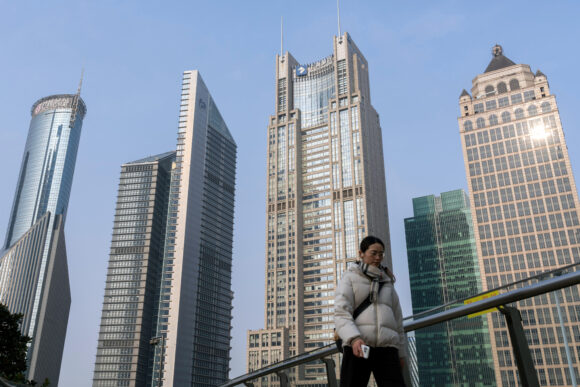
Photograph: A pedestrian in front of buildings in the Lujiazui financial district in Shanghai, China; photo credit: Raul Ariano/Bloomberg
Was this article valuable?
Here are more articles you may enjoy.
 Broad AI Exclusions in Insurance Policies Could Create Uncertainty, Marsh CEO Says
  All in the Family: Husband, Wife and Daughter Indicted for Insurance Fraud and Bribery
  How One Hacker Used AI Agents, a Few Thousand Dollars to Break Into Websites
  World’s Largest Retirement Community Set to Borrow $180 Million for More Homes

