

European countries are taking their broadest swipe yet at social media, with a growing number weighing bans of the services for minors and setting the stage for a new showdown with some of the biggest US companies.
The policy was first implemented in Australia, encompassing Meta Platforms Inc.’s Instagram and Facebook, Snap Inc., Elon Musk’s X, TikTok and Google’s YouTube. Now it’s catching on in Europe, threatening to cut off access to millions of young users from services regulators call harmful and addictive — and the critical advertising dollars that come with them.
It took a pointedly political, ideological and personal turn when Spain became the latest country to propose a ban on services with the country’s Socialist leader and Musk, who has called for the European Union to be abolished and saw his X offices in Paris raided, taking the fight public.
“Social media has become a failed state,” Prime Minister Pedro Sánchez said in a speech in Dubai on Tuesday. “I know that it will not be easy. Social media companies are wealthier and more powerful than many nations, including mine. But their might and power should not scare us.”
Musk responded a few hours later on X: “Dirty Sánchez is a tyrant and traitor to the people of Spain.”
With at least six other countries — France, the UK, Portugal, Denmark, Greece and the Netherlands — and the EU is weighing similarlimits, the moves signal a clear direction of travel and heighten the culture war with the Trump administration and some of the world’s mightiest tycoons.
Representatives for Meta Platforms Inc., Snap Inc., TikTok, YouTube and X did not respond to requests for comment.
While European regulators have repeatedly chastised US social media companies for monopolistic practices, their hoovering of consumer data and spread of harmful content has meant that antipathy to Silicon Valley has intensified in recent weeks.
That’s largely due to outrage over Elon Musk’s Grok after the artificial intelligence chatbot, managed by Musk’s xAI, generated millions of non-consensual, sexualized images on his social platform X. Many were of women, but the undressed images included some children.
The company said it would rein in the tool, but regulators around the world jumped into action and it’s also become a hot-button issue for politicians and sensitized voters.
The European moves could trigger an aggressive response from President Donald Trump and his orbit. Europe has been a frequent target of his ire and the transatlantic partnership that has been a staple of the global order the past eight decades is near breaking point.
In December, Trump warned Europe “to be very careful” after EU tech regulators fined Musk’s X $140 million for breaching its online content rule.
After the fireworks at the World Economic Forum in Davos, tensions could easily erupt again later this month at the Munich Security Conference, where last year Vice President JD Vance accused Europeans of “digital censorship.”
The personal animus was on display when Sánchez accused Musk of spreading “disinformation” about Spain’s move to regularize undocumented migrants. The billionaire had earlier retweeted a post that described it as “electoral engineering.”
“Earlier in Trump’s presidency, there were concerns of retaliation if countries acted in too forceful a way against Big Tech,” said Zach Meyers, director of research at the Centre on Regulation in Europe. “That’s fallen away somewhat in recent months.”
The platforms have much to lose if the pipeline of younger users is cut off. The likes of TikTok and Snapchat boomed off the back of adoption by teens, whose preferences for features such as filters, vertical video and disappearing posts have influenced consumer app design more generally.
YouTube has a massive audience of children, which has invited political scrutiny in the past.
Still, these features are also seen as addictive and several of the biggest networks face litigation in the US, facing accusations that their products are harmful to young people.
Europe is the second-largest region for many tech firms after North America, thanks to widespread tech adoption and a mature online advertising ecosystem. For both Snap Inc. and Meta Platforms Inc., revenue is growing faster in Europe than in the US.
“Europe is the cash cow for Big Tech, so this is a big problem for them, without any doubt,” said Alicia García Herrero, senior fellow at Bruegel, adding that the US would likely see bans as political.
Implementing such restrictions is not easy. Digital policy experts also question whether there’s sufficient evidence that a ban would encourage children to spend more time offline.
Australia became the first in the world to crack down on social media for kids, with tech companies shutting down accounts in December for some 5 million children under 16.
Tech platforms have argued there that cutting minors from the services is difficult, if not impossible, and could lead to broader issues.
The process for proving age can involve sharing sensitive documents, like a driver’s license or a passport, opening doors for cyber attacks or misuse of data. A ban also risks driving users to less legitimate services.
Countries looking to replicate Australia’s laws will each have their own hurdles.
French President Emmanuel Macron has been a fierce advocate for age limitations on social media. In 2024, he called screen addiction “the breeding ground for all kinds of problems: bullying, violence, dropping out of school.” Last week, its national assembly adopted a ban on social media services for children under 15. The bill will now move to the senate for adoption.
France, however, has struggled to enforce other internet policing measures. A recent law banning online pornography for minors required people to verify their age through third-party services. There’s evidence that plenty of web users tapped virtual private networks, or VPNs, to mask their identity.
“VPNs are the next topic on my list,” Anne Le Hénanff, France’s minister for AI and digital affairs, said on French TV last week.
There were similar concerns when the UK imposed age checks and the country is consulting on different measures, such as restricting access by age, creating phone curfews and rules around addicted design. It expects to make a decision in the summer.
“There’s no point in having a consultation if I’ve already made up my mind,” Britain’s Technology Secretary Liz Kendall said in an interview last month. “There are different views strongly held on both sides.”
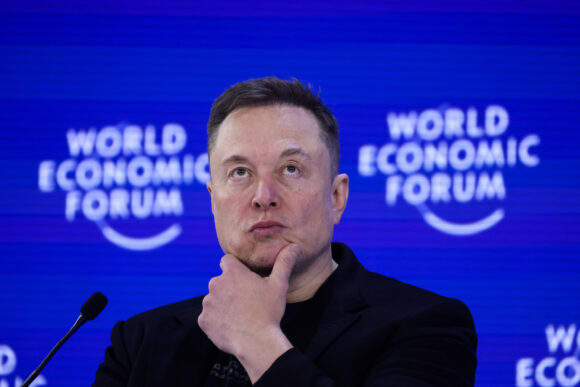
Top photograph: Elon Musk during the World Economic Forum (WEF) in Davos. Photo credit: Krisztian Bocsi/Bloomberg
Topics Europe Digital Marketing
Was this article valuable?
Here are more articles you may enjoy.
 Home Insurance Tops Property Taxes in Squeeze for US Households
  Europe’s Insurers Cut Coverage of Weather Losses, Report Says
  Viewpoint: Beware These Commercial Auto Endorsements!
  Broad AI Exclusions in Insurance Policies Could Create Uncertainty, Marsh CEO Says

