

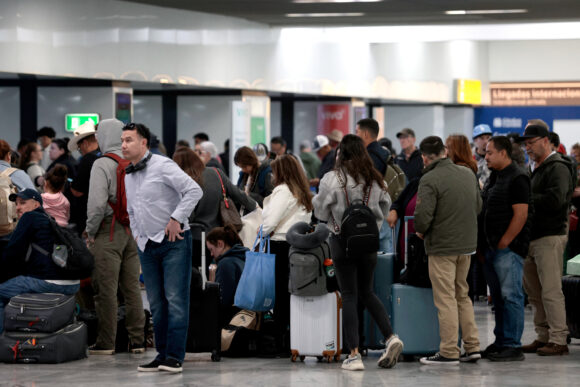
Despite assurances from President Claudia Sheinbaum and her security minister Monday that Mexico was returning to normal after a weekend of cartel violence, many vacationers to Puerto Vallarta and other cities still faced canceled flights and shelter-in-place warnings.
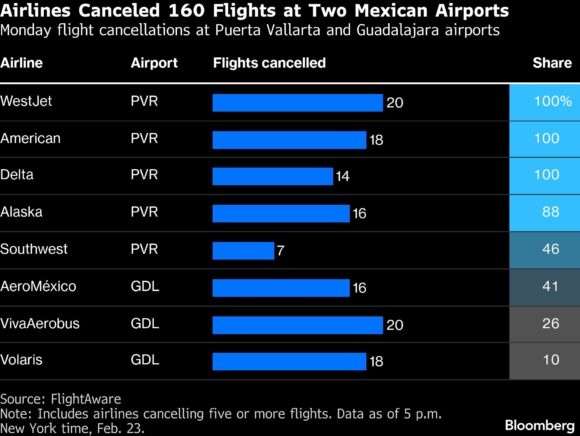
The travel disruptions began Sunday as criminal groups set up blockades, burned vehicles and attacked businesses in retaliation for the capture and killing of Nemesio Oseguera Cervantes, Mexico’s most wanted drug kingpin. Foreign governments including Canada and the US issued travel advisories and shelter-in-place recommendations for citizens traveling in the country, and dozens of flights were canceled to parts of Mexico.
Sheinbaum said that all commercial flights are expected to resume by Tuesday during her daily morning press conference. Security minister Omar García Harfuch also said that 85 roadblocks organized by criminal groups in response to Oseguera’s killing on Sunday were no longer there and the country was returning to normal.
But visitors on the ground painted a different picture.
Joanne Vaccaro, a 71-year-old American tourist, first learned of the danger when she attempted to travel by car on Sunday with her travel companions in San Pancho, a picturesque town an hour outside of Puerto Vallarta, and was told by the hotel staff that she couldn’t leave due to road closures and violence.
“We couldn’t leave, and all of the businesses in the town were closed, so there was no food,” said Vaccaro. “We did find a mini-mart that was open, so we stood in line for one hour and we were able to get basically junk food, not a whole lot was left in the supermarket.”
Among the areas worst affected by the violence are Puerto Vallarta and Guadalajara, cities inside the western state of Jalisco, where Oseguera — the leader of the Jalisco New Generation Cartel known as “El Mencho” — was captured by Mexican special forces Sunday and later died in custody.
Jalisco, Tamaulipas, Michoacán, Guerrero, Nuevo León, Baja California and Quintana Roo have also seen major disruptions and business closures. In Jalisco, there have been more than 200 violent incidents in Oxxo stores and gasoline stations, said Femsa, the owner of the convenient store chain, in a statement Monday. The company said it has begun reopening stores “as conditions allow.”
On Monday, Aeromexico announced that flights to and from Guadalajara, Puerto Vallarta, Manzanillo and Tepic were “progressively normalizing” with regular operations expected by Tuesday at the latest. Yet elsewhere, concerns have proliferated that the violence will continue to spread.
Canada expanded its list of affected areas late on Sunday, advising its citizens to follow local authorities’ directions, including shelter-in-place orders, and travel only when safe. Foreign Minister Anita Anand said Monday morning that more than 26,000 Canadians had registered with Global Affairs Canada, a surge of 8,000 in 24 hours.
“We know the actual number of Canadians in Mexico is likely much higher,” she said. The government’s registration system experienced initial technical difficulties due to a surge in volume but is now functioning well, she said.
The northern nation’s flagship carrier, Air Canada, announced late Monday it would resume service Puerto Vallarta on Tuesday, with Guadalajara flights to follow a day later.
Fallout from Sunday’s raid rattled markets, and especially transport stocks due to road closures and flight disruptions. The Mexican peso fell as much as 0.9% on Monday, dropping more than any of its emerging-market peers. Five- and 10-year credit default swaps climbed while Mexican stocks tracked by the Mexbol index slumped as much as 1.8%, led by losses in airport operator Grupo Aeroportuario del Pacifico.
Airline carrier Controladora Vuela Compania de Aviacion SAB, known as Volaris, retreated as much as 7.7%, the most in 10 months amid doubled trading volume. The $2.6 billion iShares MSCI Mexico ETF fell as much as 2.9%, the biggest intraday drop in three weeks.
In Puerto Vallarta area hotels, staff carried on as usual, though there were visible signs of worry and fatigue from the employees. One group of visitors from Winnipeg said their flight was canceled and hotel staff had to sleep outside because they couldn’t safely travel home. People waited to get information on rooms, with lines gathering at hotels’ front desks.
In the Punta Mita area, a nearby luxury tourist destination, hotel staff were also stranded and one of the beaches was closed off, according to a visitor who requested anonymity due to safety concerns. The person said that the hotel management sent out an email to homeowners in the area and politely asked if anyone would be willing to house any of the stranded staff. While some people agreed, others were frightened to take in strangers out of fears they could be linked to the drug cartels, the person added.
Vaccaro had no idea whether her flight from Puerto Vallarta on Wednesday would be canceled. In San Pancho, at least, she said the restaurants and other businesses had begun to reopen on Monday. “People are trying to figure out how and when they’ll be able to get out of here,” she said. “We just have to see how the situation unfolds.”
On late Monday afternoon, the security check at the Puerto Vallarta International Airport was eerily empty and the departures information screens were dotted with orange-coded flight cancelations.
Puerto Vallarta lifelong resident and taxi driver Tomas Rivera Mascorro braved the drive to the airport, passing several charred vehicles and a Corona truck burnt to a crisp. “This area is known as the friendliest city in the world,” Mascorro, 53, told Bloomberg. “We’re not used to seeing this kind of violence.”
Top photograph: Stranded passengers line up at Guadalajara Airport in Tlajomulco, Jalisco, Mexico, on Feb. 23, 2026; photo credit: Ulises Ruiz/AFP/Getty
Topics Mexico
Was this article valuable?
Here are more articles you may enjoy.
 Chubb Q3 Net Income Down Slightly on More Catastrophe Losses
  Florida AG Says His Office Investigating ‘Anti-Public Adjuster’ Endorsements in Policies
  Fisherman Killed by 12-Foot Alligator at Central Florida Lake
  All in the Family: Husband, Wife and Daughter Indicted for Insurance Fraud and Bribery

