

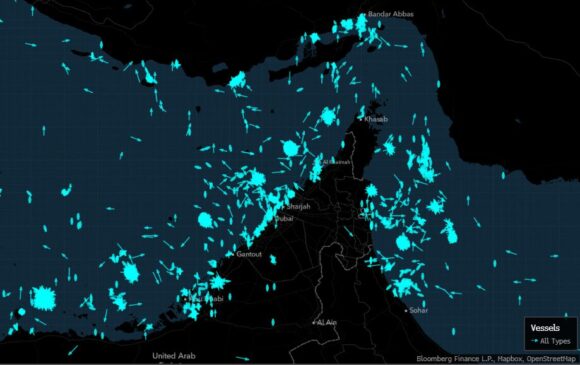
At least a dozen clusters of ships have appeared near the Strait of Hormuz, a likely sign of elevated electronic interference around the waterway that’s central to the US and Israeli war against Iran.
The groups, which can number more than 200 vessels for some clusters, contain ships of all types, with some that appear to be traveling at more than 100 knots, according to tracking data compiled by Bloomberg.
The appearance of the vessel groups stands to compound nervousness for shipowners and charterers, making local navigation more risky. As the conflict has dragged on, the industry has already faced escalating war-risk premiums, with several vessels targeted by missiles and other projectiles.
Trying to tell where any vessel is with tracking data is all but impossible, according to Mark Douglas, an analyst at Starboard Maritime Intelligence. Over the past 48 hours, the situation has become “impenetrable,” he said.
The maritime artery is a key focus at present because its effective closure has thrown the global energy market into disarray, forcing Persian Gulf producers to lock-in oil output as storage fills up. The halt to almost all normal flows initially lifted Brent toward $120 a barrel, although contracts fell on Tuesday after US President Donald Trump signaled the war may soon end.
The odd arrays of vessels point to navigational systems being interfered with by electronic jamming, making them appear on tracking platforms away from their actual locations. Such practices often spike at times of heightened geopolitical tensions, as militaries engage in electronic warfare.
Some of the clusters appear to form distinctive shapes, including an apparent circle of vessels inland near Abu Dhabi, and one in the form of an inverted “Z” off Ruwais in the United Arab Emirates, the data showed on Monday. Other groups are in the Gulf of Oman, possibly indicating vessels waiting in groups for tensions to ease, or secure clear loading dates, before entering Hormuz.
The jamming can also distort vessels’ reported speeds. The Asprouda, a 2013-built products tanker, signaled on Monday that it was traveling at an improbable 102.2 knots off Jebel Ali, equivalent to almost 190 kilometers an hour. Such tankers typically have a maximum speed of about 16 knots.
Jamming began immediately at the outset of the conflict and impacted more than 1,100 ships in the Persian Gulf, according to the maritime-intelligence firm Windward. Traffic through Hormuz totaled just five vessels on March 4, compared with 120 crossings on Feb. 26, according to Windward.
President Trump has floated the possibility the US could offer insurance for vessels and Naval escorts in a bid to revive maritime traffic through Hormuz, which links the Persian Gulf to global markets. He has also told CBS he was “thinking about taking it over,” although it was not immediately clear what specific actions the president was contemplating.
“Any vessel navigating the area clearly can’t rely on GPS,” said Douglas at Starboard Maritime, referring to the global positioning system. That “compounds the security situation in which vessels have been struck,” he said.
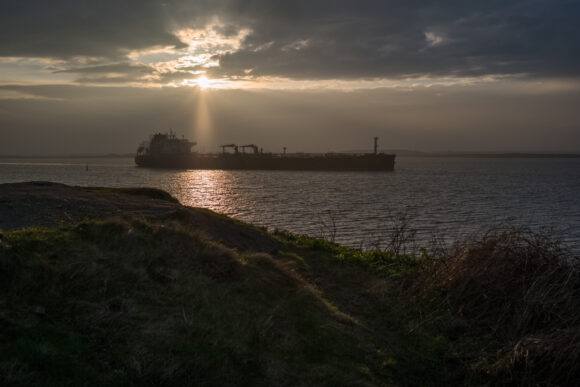
Photo by Ian Forsyth/Getty Images
Related:
- US Offers $20 Billion Reinsurance Plan to Spur Gulf Oil Flow
- Greek Oil Tanker Exits Hormuz Shipping Strait With Signal Off
- Maritime Insurance Premiums Surge as Iran Conflict Widens
Was this article valuable?
Here are more articles you may enjoy.
 Chubb Q3 Net Income Down Slightly on More Catastrophe Losses
  Chubb CEO Greenberg: Industry Has to ‘Put Arms Around’ AI Liability
  EU Cyber Agency Warns Websites May Go Dark as PHP Prepares Critical Fix
  Oaktree’s Deal to Buy A-Cap Insurer Crumbles, Spawning New Talks

