

The UK’s flood insurer of last resort is unfairly favoring wealthier households and will be reformed to reduce the burden of multimillion-pound payouts, the government said Wednesday.
As part of the changes, Flood Re will lower the premiums it charges insurers for contents-only coverage on lower-value properties by more than half starting next year, Emma Hardy, the minister for water and flooding, said in a statement to the House of Commons.
The government also plans to introduce Flood Performance Certificates, allowing homeowners who take steps to protect their properties to qualify for cheaper insurance. Separately, Flood Re and the insurance industry will agree to cap the value of claims that can be passed on to the program, while Flood Re will also revise the premiums it charges insurers to better balance between wealthier and poorer households and areas, Hardy said. Some of the reforms were first reported by the Financial Times.
The premium cut for lower-value homes would “help improve affordability” for lower-income households, Aviva Plc Chief Executive Officer Amanda Blanc said in a statement.
Flood Re, set up a decade ago to ensure people at high risk of flooding can obtain coverage, allows insurers to pass on the flood-risk portion of home insurance policies. The program is due to end in 2039, when the government expects improved flood defenses to reduce risks. Currently, Flood Re is assuming a higher share of flood-related damages as insurers grow more concerned about their exposure.
The program has been increasingly favoring wealthier homeowners, Hardy said. That’s largely because the premiums that Flood Re charges to insurers are based on council tax bands, which are organized according to 1991 property values. Some of those properties in Band H, the highest band, are now worth millions of pounds and insurance payouts for those claims are disproportionately high, Flood Re Chief Executive Officer Perry Thomas said in March.
“We now have a perverse system where money collected from all insurance customers, from all parts of the country, from all income brackets, is flowing to the richest households in the country,” Hardy said. “That is not fair and it needs to change.”
In three of the past four years, Flood Re has spent more repairing homes in the highest council tax band, which accounts for less than 4% of UK homes, than on homes in bands A and B, which make up roughly 45% of housing stock, Hardy said. She cited a 2025 case in which flood damage to a property with a padel court, gym and five-a-side football pitch resulted in a payout of more than £3 million ($4 million).
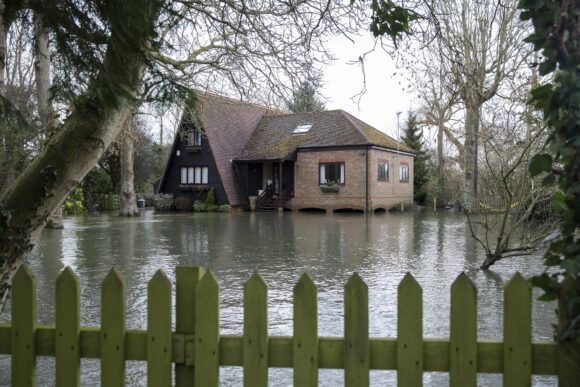
Photograph: A house surrounded by flood water in Wargrave, UK; photo credit: Oli Scarff/Getty Images
Related:
- Britain’s Garden Habits Are Making Their Homes Harder to Insure
- Viewpoint: How Climate Change Is Creating Uninsurable Areas Across Europe
- UK Warned of Housing Market Risks as Flood Re’s Future Unclear
- England Has 1.2 Million Buildings at Risk of Flooding With No Defenses
- Rich Britons Reap Biggest Benefits From UK State Flood Program
- UK Banks Slammed by Flood Re’s CEO for ‘Ignoring’ Mortgage Risks
- How the UK Is Keeping Flood Insurance Affordable – Until 2039
- Flood Re’s Reinsurance Costs Surge on UK Claims Frequency and Severity
Topics Flood
Was this article valuable?
Here are more articles you may enjoy.
 Viewpoint: The ‘Unbundled’ Insurer Emerges in Age of AI as Value Chain Fragments
  Two Past Hurricanes, OIR Data Give Idea of What to Expect From Isaias in Florida
  Iran Ramps Up Ship Attacks in Hormuz as Oil, Gas Flows Rise
  Uninsurable Future: Managing the Climate-Change-Fueled Home Insurance Crisis

