

A cyclone that wreaked more than €1 billion ($1.14 billion) in damage along Sicily’s coast has also exposed a flaw in Italy’s push to expand mandatory insurance against natural disasters.
Businesses were insured, but not for the risks they faced when Cyclone Harry swept from Messina to Syracuse in January. Many discovered their policies covered earthquakes, floods and landslides but not damage from cyclones or storm surges.
“If I am by the sea, of course I insure against storm surges, not river floods,” Luca Faro, who owns a restaurant in the small port of San Giovanni Li Cuti, told Reuters.
Faro said he suffered about €400,000 in damage to windows, roofs and refrigeration equipment, as well as two months of lost income, but received only €20,000 in state aid and nothing from his insurer, despite holding a mandatory catastrophe policy.
Italy introduced a law last year requiring businesses to insure assets such as equipment, buildings and land, with firms that opt out potentially losing access to disaster relief.
Many small and medium-sized companies, the backbone of Italy’s economy, have traditionally relied on government support after climate-related disasters.
Insurer Unipol UNPI.MI estimates that earthquakes, floods and storms cost the Italian state around €7 billion a year, and with public debt set to become the highest in the euro zone, Rome can ill afford to shoulder rising costs.
Sicily’s business association called the financial fallout from Cyclone Harry a “paradox” that will result in thousands of firms getting little or no compensation.
“Businesses are technically insured, but in practice lack coverage for the damage they have actually incurred,” said Marco Causarano, head of the small business lobby of Confindustria in Sicily’s eastern city of Catania.
Allianz board member Guenther Thallinger told Reuters that mandatory cover is “very, very rarely a solution” and the debate should focus on risk awareness, adaptation and risk avoidance.
Scientists say warmer seas and a moisture-laden atmosphere linked to climate change amplified the storm, increasing wind strength, rainfall and coastal flooding.
On January 20, a buoy between Sicily and Malta recorded a wave of 16.66 meters (55 feet), the highest ever measured by Italy’s Institute for Environmental Protection and Research (ISPRA).
Five months later, damaged roads and shuttered beachfront businesses still blighted Catania’s usually bustling seafront.
The cyclone’s aftermath risks eroding trust in disaster insurance just as the European Union is pushing businesses and insurers to shoulder a greater share of climate-related losses.
EU weather and climate disasters caused €822 billion in losses from 1980 to 2024, a quarter of which took place in the last four years, a report by Brussels-based think tank Bruegel said.
Only around 25% of disaster losses in Europe are insured, the report said, with Italy lagging many peers.
Industry Minister Adolfo Urso said at the annual assembly of insurance lobby ANIA earlier this month that Italy must also protect itself against catastrophic events such as Cyclone Harry, which “had not been anticipated before,” but did not elaborate.
Italy Has One of EU’s Widest Protection Gaps
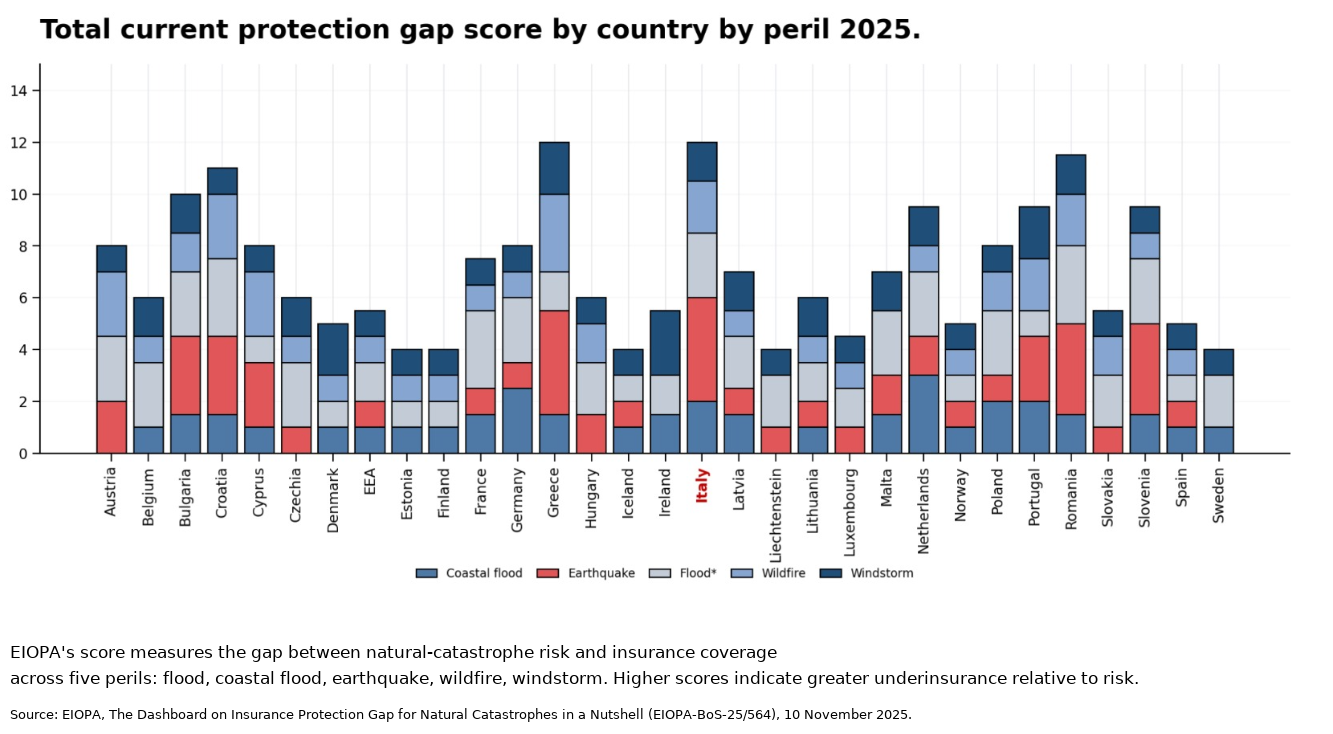
Italy recorded last year one of the European Union’s largest gaps between natural-catastrophe risk and insurance coverage, the bloc’s insurance regulator EIOPA said.
That “protection gap” is likely to widen as climate change drives stronger storms and more intense heatwaves across the Mediterranean, analysts said.
Of the roughly €101 billion in cumulative losses recorded in Italy from 2014 to 2025, €18.7 billion was covered by insurers and the rest by the public sector and private citizens, Unipol said.
Italy’s mandatory insurance scheme against natural catastrophes (Nat-Caf) is designed to narrow that gap. Although only 15% of its 4.5 million businesses were insured at the end of 2025, coverage doubled in less than a year due to the new law, ANIA said.
But Cyclone Harry risks undermining those efforts, said Paolo Angelini, head of Italy’s insurance watchdog IVASS.
“Mandatory insurance … marks a major achievement after 30 years of botched attempts. Yet the standard contract covers only some risks, while others are excluded,” Angelini said in June.
“A gap between the risks companies face and the protection they buy could undermine confidence in insurance, weaken take-up and make premiums harder to pool,” he added.
Sicily’s business lobby says the problem is compounded by policy terms that impose deductibles of up to 15% and exclude business interruption, leaving companies to shoulder part of the damage as well as lost revenue.
Companies seeking coverage for cyclones, hurricanes, hail, strong winds, storms and other adverse weather events must purchase a separate weather-related events policy rider, which does not cover storm surges or damage caused by rough seas.
“I paid €1,500 for the Nat-Cat but received only the €20,000 contribution the state gave to everyone,” said Pinella Alia, who runs a beach club in Catania, adding she could not find affordable storm surge insurance.
The insurance gap has implications beyond disaster recovery as without reliable cover, banks may be less willing to lend, investment could slow and pressure on public finances rise.
Insurers are likely to raise premiums and curb exposure in high-risk areas, fueling concerns about emerging “insurance deserts” such as those seen in California and Florida.
“There had never been a Cyclone Harry on the eastern coast of Sicily before. If it happens again in five years’ time, we’ll see insurance premiums rise, if they haven’t already,” Angelini at IVASS told Reuters.
($1 = 0.8777 euros)
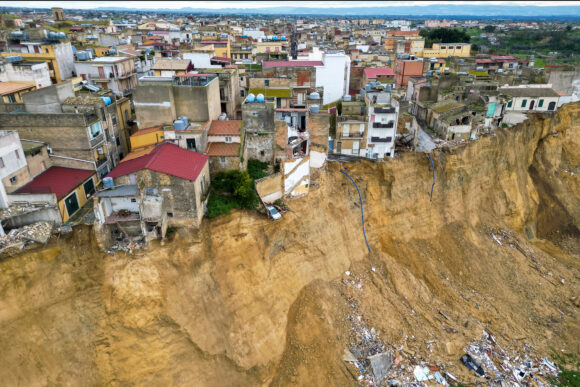
Photograph: This aerial view taken on Feb. 1, 2026, shows part of a 4 kilometers (2.5 miles) landslide that left the Sicilian town of Niscemi, southern Italy, teetering on the edge of a cliff after days of heavy rains from Cyclone Harry triggered a huge landslide that brought down properties and forced the evacuation of over 1,500 people. (Stefano Gattordo /LaPresse via AP)
Was this article valuable?
Here are more articles you may enjoy.
 AI Models May Soon Self-Replicate Across Smart-Home Devices, Anthropic Warns
  Hurricane Isaias Reaches Cat 3 Status as Insurers, Adjusters, Property Owners Prepare
  A Timeline of Developments in AI Safety Since the Attack on Hugging Face
  ‘Unusual’ Isaias Brings Winds, Downed Trees But Fewer Claims Than Expected

