

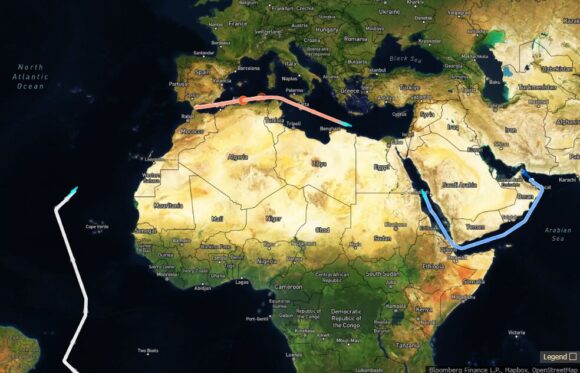
Empty supertankers are heading to Egypt’s Mediterranean port of Sidi Kerir to collect Saudi crude as observable traffic at the kingdom’s key Red Sea export hub dwindles following threats from Houthi militants.
At least eight very large crude carriers are signaling Sidi Kerir and are set to arrive in the coming weeks through to mid-August, ship-tracking data shows. State-owned Saudi Aramco has been offering more oil from the Egyptian port after Iran-backed Houthis struck a vessel in the Red Sea last week.
There were no tankers observed at the Saudi port of Yanbu in the Red Sea early Tuesday, although vessels may have picked up cargoes with their transponders switched off to avoid detection. The export hub became crucial after the Iran war started, allowing the kingdom to bypass the Strait of Hormuz by piping million of barrels a day to its west coast for export to global customers.
Some shipowners may be hesitant to sail to Saudi Arabia after some insurance providers began restricting coverage for any vessels calling at the kingdom’s ports due to the risk of attacks, according to ship and insurance brokers.
The Marshall Islands-flagged VLCC Bidbid is currently sailing to Sidi Kerir and is expected to pick up its cargo on Wednesday for delivery to Asia, shipping data shows. Two others, VL Bright and Taga, were heading for the US before abruptly switching their destinations to the Egyptian port, with the latter sailing almost exclusively on voyages to Japan in recent months.
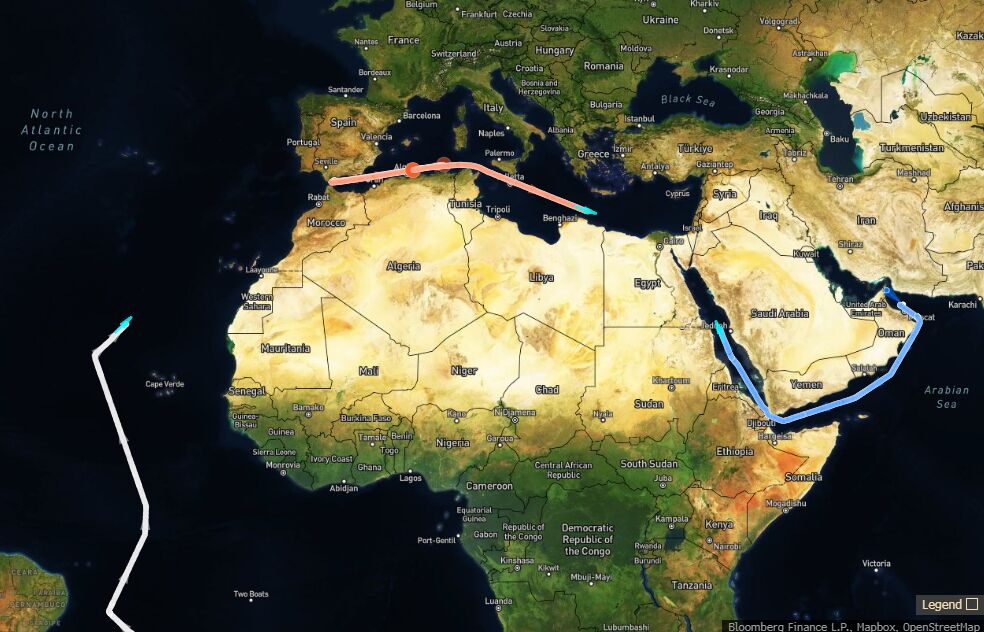
The remaining five ships bound for Sidi Kerir are all controlled by South Korea’s Sinokor Group, a privately-held company that has been among the most active in Hormuz since the Iran war started at the end of February.
Sinokor, Bidbid’s manager Asyad Shipping, VL Bright’s owner Hyundai Glovis, and Taga’s owner Nippon Yusen KK didn’t immediately respond to requests for comment.
For a vessel to collect Saudi crude from Sidi Kerir, oil is usually picked up at Yanbu by a tanker and then transported to the Egyptian port of Ain Sukhna in the Red Sea. From there, it’s pumped north to the country’s export hub on the Mediterranean via the Suez-Mediterranean Pipeline, known as SUMED.
Saudi Arabia has been rushing to export more oil through the northern route out of the Red Sea after Yemen-based Houthi rebels implemented a blockade and then attacked vessels along the southern route near Bab el Mandeb. Traffic through the strait remained brisk on Monday, according to data compiled by Kpler, with ships carrying Russian crude transiting.
Over the past week, only Chinese ships and vessels owned by countries friendly with Iran have continued to transit Bab el Mandeb, while western tankers and more risk-averse Asian shippers have opted for the costlier and longer route via the Suez Canal.
In the Strait of Hormuz, observable traffic was scant. Rotterdam Energy, a supertanker controlled by Sinokor, showed up in the Persian Gulf after last broadcasting from the Gulf of Oman, a sign that it may have entered the region with its transponders off.
Related:
Was this article valuable?
Here are more articles you may enjoy.
 Viewpoint: The ‘Unbundled’ Insurer Emerges in Age of AI as Value Chain Fragments
  Eastern States’ Grocers Shut Online Systems After Cyberattack
  AI Bubble Risks Worst S&P 500 Crash Since 2008, Strategist Says
  Florida Supreme Court Approves Board Certification in Insurance Law

