

As Europe comes to grips with its fifth heat wave of the year, the research arm of Swiss Re AG is warning of far-reaching consequences.
“Record heat underscores Europe’s chronic heat risk,” the authors of the Swiss Re Institute report said on Tuesday.
Record-breaking temperatures are battering a continent that’s less equipped to deal with the shock than other parts of the world. Only about 20% of European households have air conditioning, for example, compared with 76% in North America, Swiss Re Institute notes. That has implications for everything from human health to economic productivity, it said.
Read more: Heat Deaths Top 25,000 in Europe as Scorching Weather Persists
Europe is now struggling to cope with temperatures that “reduce agricultural productivity, strain water and energy systems, damage infrastructure, and lower labor productivity,” the report’s authors said.
The continent is heating up almost twice as fast as the rest of the world, a development that Swiss Re Institute warns can have “severe” consequences. The comments follow a report last month by Munich Re AG, in which it warned of the “dangerous mix” posed by El Niño and global warming.
The two firms’ analyses fit into a developing picture in which the insurance industry finds itself bracing for a new era of risk brought on by relentless temperature rises that are disrupting weather patterns.
Extreme heat has now left most of England gripped by drought conditions that are impacting harvests. Elsewhere in Europe, rivers crucial to transporting key commodities are drying up.
Oxford Economics said in a note on Tuesday that low water levels in Germany’s Rhine River have left chemical, metal and construction firms most at risk as supplies are disrupted. The development also implies higher inflation, while nuclear and hydro power are now being “adversely affected by hot rivers, leading natural gas to set electricity prices,” Oliver Rakau, chief Germany economist at the researcher, said in the note.
Though Europe’s wildfire risk “is still considered moderate, the increase in fire activity warrants closer attention,” Swiss Re Institute said. “As heat in Europe increases, wildfire-conducive conditions are likely to become more frequent.”
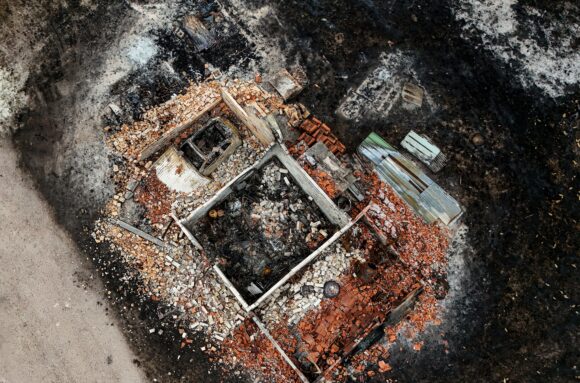
Fires in France, Spain and Greece have caused as much as €19.1 billion ($22 billion) in total damage and economic loss this summer, according to a preliminary estimate by AccuWeather. Heat and drought will continue to keep Europe’s wildfire risk elevated into the fall, the weather-tracking firm said.
“Europe’s recent wildfires highlight how hotter and drier conditions are making large wildfires more likely, and — with more homes, businesses and infrastructure built in risk-exposed areas — also more costly,” Balz Grollimund, head of catastrophe perils at Swiss Re, said in a statement.
The warning comes despite the decline in insured losses tied to natural catastrophes in the first half of 2026. Swiss Re Institute puts the figure at $42 billion, which it noted is “well below the long-term trend.” The most destructive event was the Venezuela earthquakes in which more than 5,000 people died, it said.
Severe convective storms, such as thunderstorms, hail and tornadoes, generated smaller first-half losses than in previous years. However, Swiss Re Institute said that “the relatively low insured losses were not a result of subdued storm activity.” It also warned that a “quiet first half is not necessarily indicative of below-average annual losses,” adding that the long-term “upward trend in insured losses is intact.”
A key risk for insurers to focus on now is how the world — and Europe in particular — adapts to rising temperatures, with wildfire risk a particular concern. Europe’s “extensive wildland–urban interface zones mean that a severe fire near densely populated areas could still generate substantial economic losses,” Swiss Re Institute said.
Photograph: Wildfires in France, Spain and Greece have caused as much as 19.1 billion euros in total damage and economic losses this summer, according to a preliminary estimate; photo credit: Christophe Archambault/AFP/Getty Images
Related:
- How the Hard Reality of Climate Change Hit Europe’s Economy This Summer
- Rhine Falls to Lowest Since 1880, Threatening European Trade
- Europe’s Wildfire Season Exposes Climate Insurance Protection Gap
- Europe’s Key Rivers Are Drying Up as Extreme Heat Impact Widens
- Insurers Are ‘Actively Evaluating’ New Catastrophe Risks as Europe Burns
- Heat Morphs Into a Major Economic Shock for an Unprepared Europe
Topics Europe
Was this article valuable?
Here are more articles you may enjoy.
 Hordes of Teens on E-Bikes Force Suburbs to Rewrite Road Rules
  Florida Commissioner Suspends A-Cap’s Atlantic Coast Life Over Surplus Issues
  Viewpoint: The ‘Unbundled’ Insurer Emerges in Age of AI as Value Chain Fragments
  AI Bubble Risks Worst S&P 500 Crash Since 2008, Strategist Says

