

Bulgarian shipbroker Yordan Petrov no longer sends his vessels into the Black Sea, calling the brave few who still do “kamikazes.”
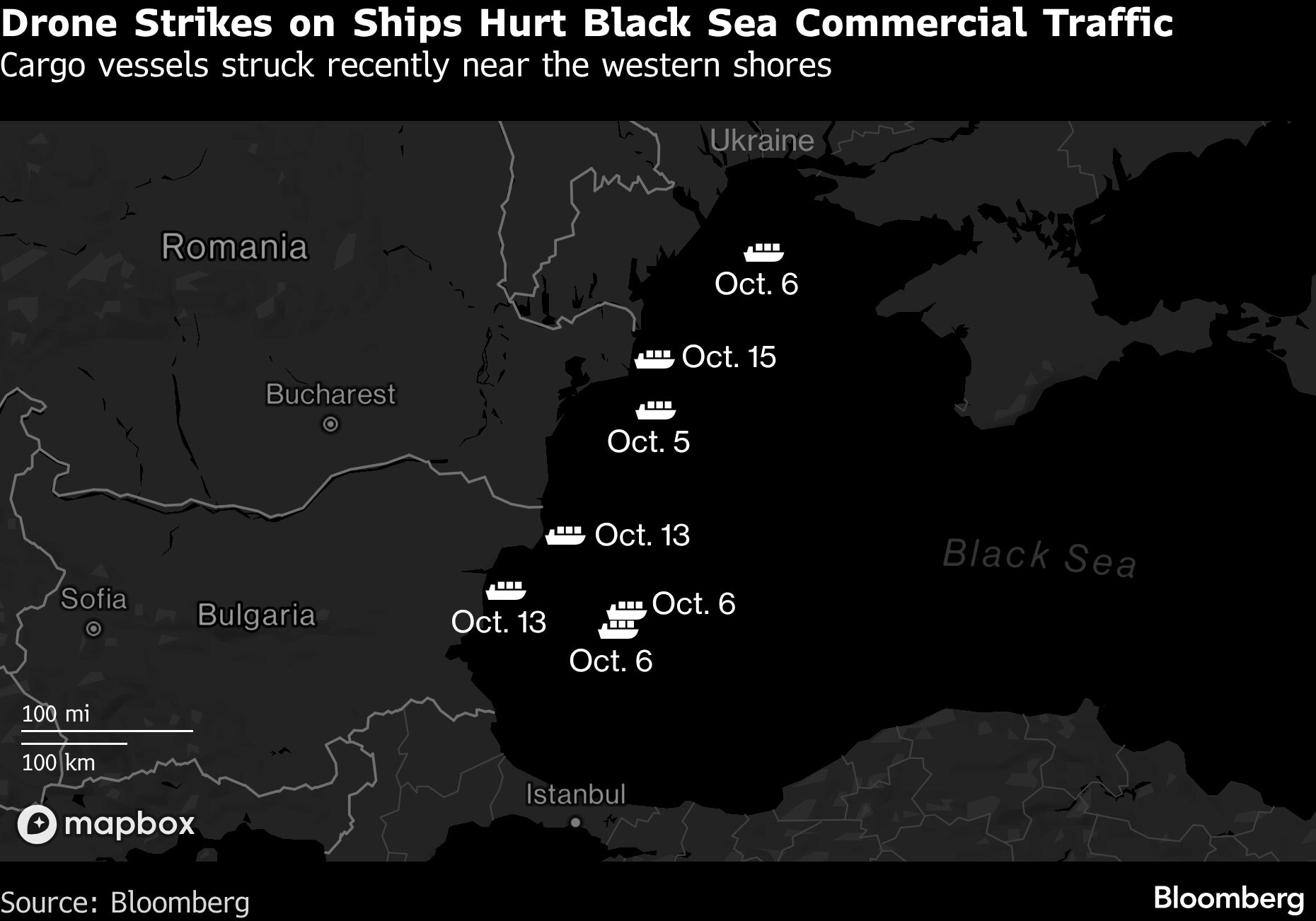
Seven commercial ships have been attacked by drones off the coast of Bulgaria and Romania since the start of October, for which authorities of both countries blamed Russia. The strikes killed more than two dozen sailors, they said.
The incidents took place within or on the cusp of NATO members’ territorial waters, spelling a dangerous new escalation. It’s a test of the alliance’s ability to deter an increasingly aggressive Russia that’s shown a new willingness to move beyond its hybrid campaign and attack people in Europe.
Read More: Russia’s Attacks on Europe Are Getting More Brazen and More Dangerous
“It exposes how neglected Black Sea security has been within NATO, and how little political will allies have shown to deter Moscow,” said Iulia Joja, director of the Black Sea program of the Washington-based Middle East Institute. “Until that changes, Russia will keep testing limits.”
Moscow has denied responsibility for the strikes. However, it’s said ships entering and leaving Ukraine’s ports are a potential target, responding to Ukrainian strikes on the Kremlin’s so-called “shadow fleet” exporting sanctioned oil.
Nations on NATO’s eastern flank are no stranger to drone incursions. Growing numbers of Russian and some Ukrainian drones have breached the airspace of the Baltic states and Poland, triggering air alerts and damaging civilian infrastructure.
But now the focus has moved further south to another sensitive area on the alliance’s borders. “If until recently the spotlight was pointed to the Baltics, the spotlight is already on the Black Sea,” Bulgarian Defense Minister Dimitar Stoyanov said last week.
Until October, drone incursions into the European Union hadn’t caused deaths. But when the HS Dignity was struck on Oct. 13 just five nautical miles from Bulgaria’s territorial waters, 11 sailors went missing and only five survived.
Then another ship caught fire on Oct. 15 within Romania’s territorial waters. It was shortly followed by a drone attack on a ship just outside Romania’s territorial waters. Almost a week later, seven of that ship’s 12 sailors have not been found and are presumed to have drowned.
Read more: Romania Blames Russia for Escalating Black Sea Ship Strikes
Death tolls like that are increasing pressure on the alliance to respond to the attacks. European nations are reluctant to do so as they’re desperate to avoid a cycle of escalation with Russia that would risk a direct conflict at a moment when they’re unsure of US support for the NATO alliance. Yet a failure to respond firmly exposes them as weak in the eyes of the Kremlin, inviting potentially more aggressive actions.
Petrov saw the danger of escalation looming as early as August, when his Varna-based company withdrew the four ships it directly operates. Since then, he said, sailors with whom he’s worked now consider the Black Sea comparable to the Persian Gulf, where Iran has been launching missiles at shipping since the US attack in February.
“Many shipowners refuse to enter” the Black Sea, he said.
Meanwhile, allies’ responses to the strikes also expose their weaknesses to each other. They’ve laid bare the full range of attitudes to Russian aggression across the alliance — from the robust to the timid — and the difficulty in coordinating an urgent response.
While Romanian President Nicusor Dan and European Commission President Ursula von der Leyen recently called the strikes deliberate attempts to deter western support for Ukraine, it took Bulgarian Prime Minister Rumen Radev a week to acknowledge the possibility of a Russian role.
Radev, who became premier this year in a landslide election, has often criticized the European Union’s military aid to Ukraine and urged the bloc to restore its ties to Russia.
He only pointed to Russia as the most likely author of the strikes on Oct. 13 when the Chelsea 3, a Ukrainian vessel, was hit off Bulgaria’s coast, compelling Radev to summon the Russian ambassador.
Moreover, on Wednesday Radev’s government said it would support only “non-lethal aid” to Ukraine under the European Peace Facility, the EU’s off-budget tool that has provided more than €6 billion ($6.7 billion) to Ukraine’s defense and military needs until 2024.
The turmoil at sea ramps up concern in Bulgaria about conflict just before it holds a presidential election on Sunday that Radev’s ally Iliana Yotova is expected to win in a runoff, an outcome further cementing his dominance over the Balkan nation. Like Radev, Yotova has called for an immediate ceasefire in Ukraine.
“It looks to me like Bulgaria is the weak link in the whole eastern flank,” opposition lawmaker Radoslav Ribarski said at a parliamentary defense committee session earlier this month. Bulgaria “doesn’t realize” the danger it’s in, he said.
As Bulgaria lacks strong defense capabilities to tackle that danger allies are willing to help as long as Sofia asks, according to a person familiar with the matter. However, it hadn’t done so until very recently, the person said.
Now Sofia is scrambling to boost its preparedness, calling for what Stoyanov dubbed the “whole possible spectrum” of air defense from NATO, including patrol aviation, air defense and anti-drone systems.
In contrast, even before the strikes Romania was racing to complete work on a joint Black Sea security hub with Bulgaria. A further delay risked losing the trust of NATO partners, Foreign Minister Dan Neculaescu told reporters in Bucharest on Tuesday.
The Romanian president also called a meeting of his defense council on Thursday to discuss a strategy for defending the nation’s Black Sea waters.
Still, not all the drone strikes in this part of NATO’s eastern flank have taken place at sea. In September, Russian drones struck Ukrainian border crossings with Romania. The same month they hit a Ukrainian frontier post with Moldova — a nation with a pro-European government that isn’t in NATO — killing two people, according to Ukrainian authorities.
As attacks continue, Radev has called for calm. He denied that there was any risk, saying that traffic at Bulgaria’s key ports is up compared to last October. “The ships haven’t stopped and won’t stop. Our shipping will continue,” he told reporters on Tuesday.
But those with businesses hit by the security situation paint a different picture. Agricultural producers still complain that risks for shipping delay their exports while shipbrokers like Petrov cite higher insurance costs and difficulties in staffing their crews.
“Shipping in the Black Sea is, for all practical purposes, dead,” said shipbroker Todor Georgiev, adding that joint traffic at the key ports of Varna and Burgas is often lower than wartorn Somalia’s port of Mogadishu.
To add to the grim picture, ghost ships from Russia’s shadow fleet, hit by Ukraine months ago, are adrift in the Black Sea and are sometimes pushed toward the Bulgarian and Turkish coasts by prevailing northeast winds. It’s another problem maritime authorities have to grapple with as they mount search and rescue operations for ever-growing numbers of disappearing sailors.
For Petrov, rising risks are the natural course of what he sees as an escalating war.
“In the eyes of the Russians, those who provide funding and sponsor the Ukrainian defense industry are NATO,” he said. “That’s us.”
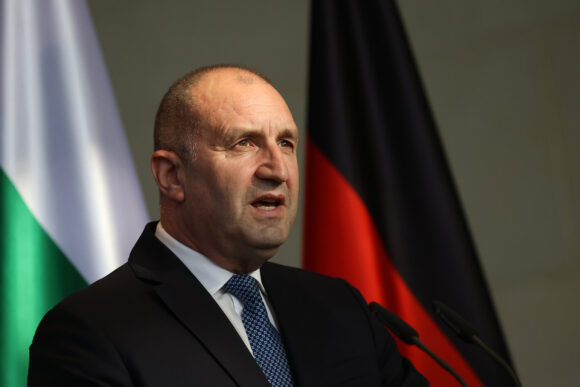
Top photograph: Bulgaria’s Prime Minister Rumen Radev; photo credit: Krisztian Bocsi/Bloomberg
Related:
- EU Backs Ukraine War Risk Insurance as Market Rebounds
- Ukraine War Escalates as Black Sea Drone Strikes Hit Cargo Ships
- Europe Struggles to Counter Russian Attacks Falling Short of War
Was this article valuable?
Here are more articles you may enjoy.
 Chubb Q3 Net Income Down Slightly on More Catastrophe Losses
 All in the Family: Husband, Wife and Daughter Indicted for Insurance Fraud and Bribery
 Travelers Reports Solid Underwriting, Record Investment Income for Q3
 Fisherman Killed by 12-Foot Alligator at Central Florida Lake


