

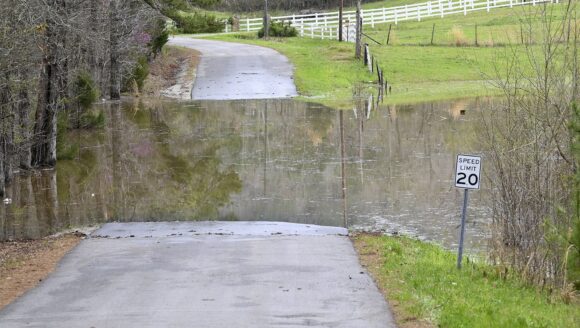
Record high-tide flooding washed over U.S. coasts in the past year, and rising sea levels are expected to send the deluges into streets, homes and businesses even more frequently over the next decade, the National Oceanic and Atmospheric Administration said.
The surges, sometimes referred to as “sunny day” or “nuisance” floods, are becoming increasingly common as the increase in sea levels continues, the agency said in an annual report. Damaging floods that used to happen mainly during storms now happen during regular events such a full-moon tide or with a change in prevailing winds.
High waters are flowing into coastal economies and crucial infrastructure like waste and storm water systems, with those areas seeing twice as many high-tide flooding days than they did 20 years ago. The trend is expected to continue into 2022 and beyond without improved flood defenses, NOAA said.
Read more: It No Longer Takes a Big Storm to Produce High Tide Flooding in Coastal Communities
“NOAA’s tide gauges show that 80% of locations where we collect date along the Southeast Atlantic and Gulf coasts are seeing an acceleration in the number of flood days,” said Nicole LeBoeuf, the newly appointed director of the National Ocean Service.
Flood records were set in Texas, Florida, South Carolina, and Georgia, NOAA said. Galveston and Corpus Christi, Texas, along with Bay Waveland, Mississippi, had a record 20 days with high-tide flooding from May 2020 to April 2021. Twenty years ago these locations would typically only flood two or three days a year.
Above Average
Such flooding occurs when the tide rises about 1.75 to 2 feet (0.53 to 0.61 meters) above the daily average high tide, with water spilling onto streets or bubbling up from storm drains, NOAA said.
Oceans are rising in part to due glacier melt and because sea water expands as it warms, said William Sweet, an oceanographer with the National Ocean Service. Bodies such as the Atlantic and Gulf of Mexico have been warmer than normal. There are also local influences such as passing storms that can influence the number of flood days.
In some areas this is all made worse because land is sinking as underground water is withdrawn and oil and natural gas are pumped out, Sweet said.
On top of this, starting in the mid-2030s, the alignment of rising sea levels with a lunar cycle will cause coastal cities all around the U.S. to begin a decade of dramatic increases in flood numbers, according to a study released earlier this month by the National Aeronautics and Space Administration researchers at the University of Hawaii. Sweet took part in that study.
While there were records in specific areas for the U.S. as a whole, they didn’t occur everywhere along the coasts. At the Battery in New York, 13 days occurred, two less than the record, and 9 to 14 are expected in the coming year, NOAA said.
By 2030, long-range projections call for 7 to 15 days of flooding along coastal communities nationally, the report said. By 2050, that rises to 25 to 75 days.
“We’re getting closer to the brim in many of these communities and inches matter,” Sweet said.
–With assistance from Michael Tobin.
Photograph: Multiple tornados caused flooding on Three Cedars Road on March 26, 2021 in Ohatchee, Alabama. Photo credit: Julie Bennett/Getty Images.
Was this article valuable?
Here are more articles you may enjoy.
 Kroger Plans to Slash 37% of Corporate Jobs in Next Three Years
  Broad AI Exclusions in Insurance Policies Could Create Uncertainty, Marsh CEO Says
  AI Models May Soon Self-Replicate Across Smart-Home Devices, Anthropic Warns
  Rider Dies, Others Hurt on Six Flags Roller Coaster in Georgia

