

The company that makes one of the two most widely used brands of formula for premature babies is threatening to stop. That is, unless US health officials and Congress help protect it from lawsuits related to infant deaths allegedly tied to its product.
It’s a warning that holds particular power over policy makers and legislators who’ve become acutely aware of the fragility of a baby formula market that’s been mired in recent scandals. The biggest players in the market have struggled with shortages in recent years, and a popular upstart is under scrutiny for a botulism outbreak.
At the heart of the lawsuits is a bowel disease that kills one premature baby every day in the US.
Hundreds of claims working their way through the courts allege that Abbott Laboratories failed to warn consumers that its specialty formula and fortifiers for preemies heighten the chances of developing necrotizing enterocolitis, or NEC, which causes the intestinal tissue of the tiniest babies to inflame and die. At least one jury has agreed with those claims, ordering the company last year to pay $500 million to a family who alleged their baby girl suffered NEC-associated brain damage after she ingested the formula.
Abbott has maintained that there is nothing in the current research to back up the allegations it’s facing in court. “Numerous studies and NEC authorities have made clear that preterm infant formula does not cause NEC,” Abbott spokesperson Scott Stoffel said in a statement. “It’s the absence of human milk that increases NEC risk rather than anything harmful in formula — a product that’s been helping infants thrive and survive for nearly 50 years.”
The medical community doesn’t fully understand what causes NEC, though it does know that babies who receive breast milk are at a much lower risk of developing it than those who are given cow’s milk-based formula.
Facing potentially billions of dollars in legal costs, Abbott is throwing everything it has at the issue. Chief Executive Officer Robert Ford last year warned that the company may be forced to pull its preemie formula off the market. Since then, Abbott has invested millions in lobbying lawmakers, according to disclosure forms and other federal records compiled by Bloomberg.
The company also has proposed transferring control of the sales and distribution of its preterm formula to the federal government to keep it on the market, Abbott told Bloomberg News in a statement.
More recently, it has taken its case straight to Congress to press for a law that would throw out all pending suits and shield it from any future ones, according to lobbying disclosures and congressional staff familiar with the company’s efforts.
Abbott’s preemie products, which are sold under the Similac brand, bring in only several million dollars a year but they threaten to become a liability for the $218 billion company — settlements could cost formula makers collectively as much as $4 billion, Bloomberg Intelligence analysts estimate. On every earnings call with investors this year, Ford has been asked about the NEC litigation.
“What Abbott is doing is saying ‘Let’s protect us or we’ll walk away from the market,'” said Connecticut Representative Rosa DeLauro, the top Democrat on the House Appropriations Committee. “They hurt families either way. It’s a power play.”
Abbott is “ready to work with anyone committed to following the science and medical experts to ensure continued access to these products,” Stoffel said.
At the same time, the company has received numerous complaints alleging a connection between its products and NEC-related injuries and deaths, Abbott officials admitted during legal proceedings. The company said it investigates all NEC complaints. In all cases, Abbott concluded there is no such connection, according to depositions viewed by Bloomberg of Courtney Colombo, Abbott’s director of postmarketing medical safety and surveillance, and Fabrizis Suarez, former medical director at Abbott.
While the FDA requires formula manufacturers to maintain records of all complaints and their investigations, they do not need to submit such reports to the agency.
The Department of Health and Human Services said in a statement that the FDA reviews Abbott’s adverse event reports as part of its inspections of its facilities.
Anika Hunte says her son Aries-Reign Peterson was “thriving and growing for several weeks” on her breast milk after his premature birth on Jan. 30, 2018, according to her complaint filed in a lawsuit against the hospital where he was born. She’s also suing Abbott.
The lawsuit claims his health began to decline the same day he was given Similac preterm formula and continued to worsen after doctors added a Similac fortifier to the combination. Aries-Reign was diagnosed with NEC and though he clung to life support for some time, he died on April 18, 2018.
“Although Abbott promotes an aggressive marketing campaign designed to make parents believe that Neosure is safe and necessary for growth of a premature infant, the product is in fact extremely dangerous for premature infants,” Hunte alleges in the complaint she filed in her lawsuit against Abbott.
Abbott “promotes (and never competes with) human milk as the first choice for preterm infant nutrition,” Stoffel said.
While a wealth of research supports the idea that human milk can protect preemies against NEC, no one has figured out why that is, said Tarah Colaizy, a professor of pediatrics and neonatology at the University of Iowa. She led a study published last year showing donor milk reduces the risk of NEC 50% when breast milk isn’t available for preterm babies. At the same time, even preemies who only receive breast milk can develop NEC.
“We need to know, what is it about not giving human milk that increases risk,” Colaizy said. “Is it a component in the formula? There’s not as much research about how other things might be negative or toxic.”
The Influence Campaign
Abbott’s influence campaign started in July 2024, just days before it received the $500 million verdict. In just a few sentences, CEO Ford set off a panic among public health officials.
“The decision to pull a product is not an easy one,” Ford said in an interview with CNBC’s Jim Cramer. But if the science and data aren’t respected, he said, “then yeah, we have to think about at least what is the implication of removing a product.”
He called on public health officials and others concerned about premature babies to “take action,” though he didn’t specify what could be done. Within several days of his comments, Ford met with then-FDA Commissioner Robert Califf and another top agency official, according to a record of meetings held by the agency’s leadership.
Three months later, a scientific consensus emerged in Abbott’s favor. The National Institutes of Health, the FDA and the Centers for Disease Control and Prevention released a joint statement saying: “There is no conclusive evidence that preterm infant formula causes NEC.”
The statement was based on a report the health agencies had commissioned from a working group of researchers, neonatologists and NEC experts in the wake of Ford’s comments. Abbott sought to use the report in its legal defense as many of the cases move collectively through pre-trial deliberations.
Plaintiffs’ lawyers suspected Abbott influenced the report, according to court documents. There are a lot of signs that “some inappropriate things went on,” one of the attorneys argued before the judge in July 2025.
When they sought internal company communications about it, Abbott withdrew its request to use the report at trial “to end distractions and delays” it said the plaintiffs’ attorneys had created, according to company spokesperson Stoffel.
Abbott had no role in the working group’s “membership, deliberations, drafting, or conclusions,” Stoffel said.
A person familiar with the working group’s process who’s not authorized to speak about the deliberations said the report was ghostwritten by nonprofit research organization RTI International, but the report didn’t disclose RTI’s role.
RTI has a relationship with Abbott — it lists the formula maker as a client of its division that helps companies with research and development.
An RTI spokesperson said it did not contract with Abbott in 2024. RTI researchers did not have conflicts of interest when they worked on the report, the spokesperson said.
The NIH said it requires all collaborators to adhere to its financial conflict of interest policies and disclose any competing interests.
The working group’s report focused heavily on evidence that human milk from mothers or donors is protective, reducing the risk of NEC up to 50% compared to preterm formula.
Even some people who were part of the working group say the conclusion could be confusing. “We say the absence of mother’s milk causes NEC,” said Lisa Stellwagen, a working group member and president of the Human Milk Banking Association of North America. “I don’t agree with that terminology because it’s not clear” and minimizes the role of other potential factors, she said.
Half a dozen working group members Bloomberg spoke to said more research is needed to determine the causes of NEC.
Courtney Weymouth says she wishes she had been warned of the alleged risks of formula for preemies when she gave birth to her son Brent in September 2024. He arrived 16 weeks early, weighed just 1 pound 10 ounces and faced a host of serious health issues. In the hospital, Brent was given Weymouth’s breastmilk plus a cow’s milk-based fortifier to help him grow. He grappled with NEC multiple times, leading surgeons to remove more than half of his intestines. He survived but must be hooked up to tubes in his crib 12 hours a day to receive his nutrition.
She doesn’t know what brand he received, but both Abbott and the other major preemie formula maker, Reckitt Benckiser Group, are facing lawsuits.
“I think if the formula is causing babies to get NEC, that the companies should be liable for that,” Weymouth said. “It’s changed our lives.”
Seeking a Shield
Abbott’s efforts to arm itself against the litigation picked up momentum earlier this year when lawmakers proposed legislation that would protect it and Reckitt from lawsuits. In March, Representative Diana Harshbarger, a Tennessee Republican, introduced a bill that would grant formula makers a liability shield and throw out current lawsuits. In June, a related amendment directing the FDA to examine and ensure the availability of preterm infant formula moved forward in a House committee, though it wasn’t included in the latest spending package deal to end the government shutdown.
“Abbott has a history of safety concerns,” said DeLauro, the top Democrat on the committee, referring to contamination at the company’s Michigan plant that led to nationwide shortages. The facility shut down for nearly four months after babies who ingested the company’s formula became ill and two died.
“Now this is really stunning that they want Congress to bail them out,” she said.
The company is following a playbook largely pioneered by the firearm industry, said Jennifer Pomeranz, a lawyer and assistant professor who leads the Public Health Policy Research Lab at New York University.
In the 1990s, gun makers were held liable for firearm-related deaths in multiple key lawsuits. They were able to successfully push passage of a law giving the gun industry legal immunity, said Pomeranz, who has testified on behalf of plaintiffs in the NEC lawsuits.
Abbott is also taking a cue from vaccine makers who’ve protected themselves from legal liability through a government-instituted compensation fund. The formula maker’s lobbyists are pushing for a similar fund that would give a payout to people who claim harm from its products, but would bar them from suing Abbott in court, according to a one-pager the company has given Congressional staff.
Congresswoman DeLauro said her staff has talked to Abbott about including a warning on its label limiting its usage to larger preemies, but the company has not been willing to entertain the idea.
Abbott’s formula stipulates that it should be used as directed by doctors and that they should monitor for gastrointestinal complications. “The instructions are correct and representative of the products and the way they are used,” Stoffel said.
While it’s unclear what’s going to happen to legislation in Congress, Abbott and Reckitt both have had more favorable outcomes in court as of late, with two federal cases thrown out. And soon Abbott could have a potential ally.
The FDA’s top food official, Kyle Diamantas, is a former corporate lawyer who used to defend Abbott in NEC lawsuits. He’s had to recuse himself from related FDA business for a year. He can return to weighing in on baby formula issues when that recusal lifts in January.
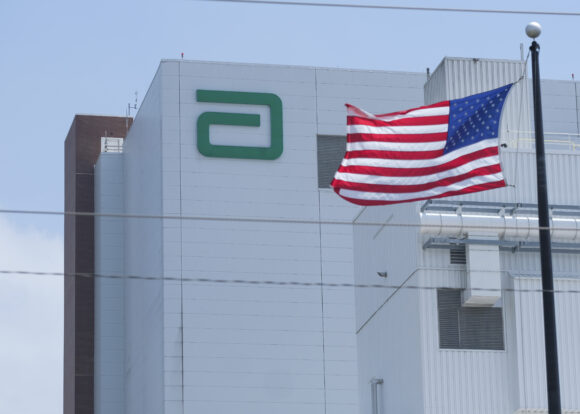
Photo: The Abbott Laboratories factory in Sturgis, Michigan. Photographer: Matthew Hatcher/Bloomberg
Topics Lawsuits
Was this article valuable?
Here are more articles you may enjoy.
 Travelers Reports Solid Underwriting, Record Investment Income for Q3
  EU Cyber Agency Warns Websites May Go Dark as PHP Prepares Critical Fix
  KCC Says Isaias Insured Losses to Be $3 Billion; AM Best Calls Storm an Earnings Event
  Home Insurance Tops Property Taxes in Squeeze for US Households

