

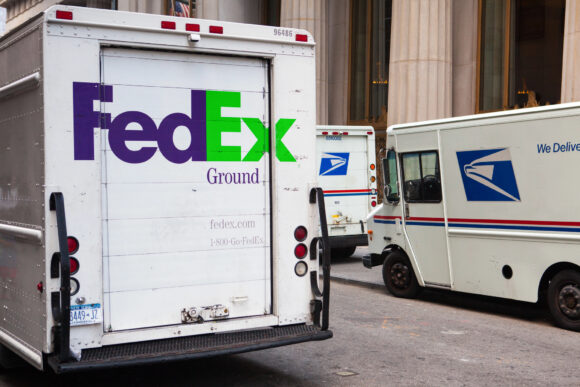
Global transportation company FedEx filed a lawsuit in the U.S. Court of International Trade seeking a refund for President Donald Trump’s emergency tariffs, one of the highest profile moves to recover funds since the U.S. Supreme Court last week deemed the tariffs illegal.
A flood of lawsuits to recover billions of dollars is expected by trade attorneys after the blockbuster ruling. The recovery process still has to be worked out by a lower court, though, complicating the matter.
More than $175 billion in U.S. tariff collections are subject to potential refunds after the U.S. Supreme Court on Friday ruled 6-3 that Trump overstepped his authority by using the International Emergency Economic Powers Act, a sanctions law, to impose tariffs on imported goods, Penn-Wharton Budget Model economists said.
“Plaintiffs seek for themselves a full refund from Defendants of all IEEPA duties Plaintiffs have paid to the United States,” FedEx said in the Feb. 23 lawsuit, referring to tariffs Trump imposed.
FedEx and its logistics arm served as importer of record on goods subject to IEEPA tariffs. The Memphis-based company did not provide the dollar value of the refund it is seeking.
FedEx in its lawsuit named U.S. Customs and Border Protection, the agency’s commissioner Rodney Scott and the United States of America as defendants. CBP and the White House did not immediately respond to requests for comment.
Washington, D.C.-based Crowell & Moring is representing FedEx in the lawsuit and referred Reuters to the company, which did not immediately comment.
Crowell & Moring also represents discount club retailer Costco, cosmetics firm Revlon, eyewear seller EssilorLuxottica and other companies in IEEPA tariff refund cases.
Importers, distributors and suppliers appear to be best placed to win IEEPA tariff refunds because their paperwork likely will include customs documents or invoices with line-item breakdowns of tariff costs tied to specific goods, said Ron Ciotti, a partner at the law firm Hinckley Allen in Boston, who represents construction contractors and developers across the United States.
“If there was a tariff escalation in your contract or a price adjustment clause based on tariffs, and that’s why the price went up, if you had a contract that stated that, then you might be able to get a refund,” Ciotti said.
California Governor Gavin Newsom, seen as a potential Democratic presidential candidate in 2028, separately demanded tariff refund checks for Americans after they were struck down by the Supreme Court.
“I’ve heard some (people) saying this is such a win for the consumer, because they should get refunds back on certain products that would have been under tariffs,” said Ciotti.
“I don’t see how they can,” he said, adding that many businesses and consumers paid higher prices for goods without any written explanation about how tariffs contributed to higher prices and may lack the proof needed to win a refund.
Was this article valuable?
Here are more articles you may enjoy.
 Home Insurance Tops Property Taxes in Squeeze for US Households
  Chubb Q3 Net Income Down Slightly on More Catastrophe Losses
  Oaktree’s Deal to Buy A-Cap Insurer Crumbles, Spawning New Talks
  World’s Largest Retirement Community Set to Borrow $180 Million for More Homes

