

A US safety investigator said United Parcel Service Inc. decided not to take further action after reviewing a 2011 service letter from Boeing Co. that flagged failures of a key structural component in the type of plane that later crashed in Louisville, Kentucky.
Investigators probing the 2025 accident found Boeing issued a service letter in 2008 informing operators of McDonnell Douglas MD-11F cargo jets of fractures in a component of the plane’s engine mount called the spherical bearing that helps uniformly distribute loads across the structure. At the time, however, the planemaker determined the problem wouldn’t result in a safety of flight issue. It released a revision of the letter in 2011 that added information about a redesigned spherical bearing.
“Investigators found that UPS had reviewed the service letters and determined no further action was required,” said Chihoon Shin, the investigator in charge for the UPS accident. The comments came on the first day of a two-day National Transportation Safety Board investigative hearing into the UPS tragedy, which killed 15 people on the aircraft and on the ground.
Service letters are informational and advise operators of best practices but their recommendations aren’t mandatory like other types of directives.
UPS in presentation slides for the hearing said it incorporated revisions to the aircraft maintenance manual after Boeing’s 2008 letter but determined no further actions were necessary after reviewing the 2011 letter, stressing that both letters concluded the issue wasn’t a safety of flight condition. The company also said that it didn’t receive any communications from Boeing after 2011 about bearing failures.
“UPS continues to cooperate fully with the investigation and is participating as requested by the Board,” the company said in a statement. “The questions and comments shared during the hearing do not reflect the NTSB’s findings or conclusions.”
Transcripts released by the NTSB also show that mechanics told investigators they weren’t aware of the 2011 Boeing service letter.
“I have never heard of that until now,” one mechanic with ST Engineering San Antonio Aerospace, which handled maintenance for UPS’s MD-11s, said when asked about it. The revelation came in a tranche of documents released at the start of the NTSB hearing.
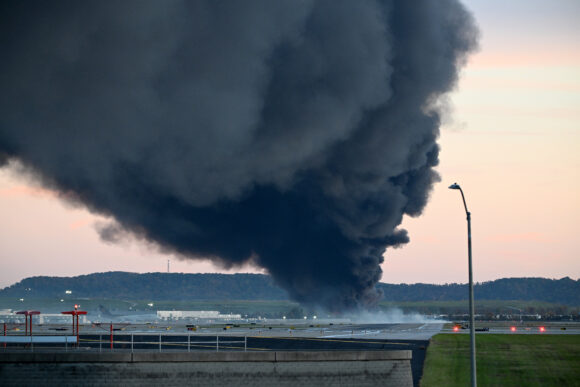
The UPS McDonnell Douglas MD-11F cargo jet involved in the November 2025 crash lost its left engine during takeoff. It cleared a fence at the end of the runway at Louisville Muhammad Ali International Airport but then plunged into terrain and buildings outside of the facility’s perimeter.
Safety investigators this week are working to uncover additional clues as to what caused the deadly accident.
A preliminary report found fatigue cracks in that key structural component that helped secure the turbine to the aircraft. In an update in January, investigators disclosed that Boeing, which took over McDonnell Douglas in 1997, warned operators in the 2011 service letter about past failures of the spherical bearing race on three different planes.
The UPS accident in 2025 added to a deadly year for global aviation. In June of that year, 241 passengers and crew aboard an Air India flight died when the aircraft crashed shortly after takeoff. Months earlier, a US Army helicopter collided with an American Airlines Group Inc. regional jet on approach to Ronald Reagan Washington National Airport, resulting in the deaths of 67 people.
Following the UPS crash, the US Federal Aviation Administration grounded all McDonnell Douglas MD-11 and MD-11F cargo aircraft. The agency prohibited further flight until operators completed inspections and repairs using safety protocols established by Boeing and approved by the regulator.
FedEx Corp. recently began flying the aircraft again after the FAA gave the green light. UPS has retired all of its MD-11 planes.
Photo: Fire and smoke mark where a UPS cargo plane crashed near Louisville Muhammad Ali International Airport on Nov. 4, 2025. Photographer: Stephen Cohen/Getty Images
Was this article valuable?
Here are more articles you may enjoy.
 Another Crane, Then Another, Collapses Onto Home in Fort Lauderdale
  Florida Commissioner Suspends A-Cap’s Atlantic Coast Life Over Surplus Issues
  US P/C Insurers See Fewer Ratings Downgrades in H1 2026 on Improved Performance
  McKinsey Rebukes Partner Who Questioned Challenges Facing Women CEOs

