


Global cyber insured losses from the Microsoft 365 outage on Nov. 12-14 are estimated by various industry observers to range from $100 million to $700 million.
CyberCube, the cyber risk analytics provider, estimates that the outage will most likely be less than $100 million, with a conservative upper limit estimated at $350 million.
Credit ratings agency Morningstar DBRS said: “In our view, the overall credit impact of the Microsoft outage on insurers is likely to be limited, with global insured losses estimates at US$300 million to US$500 million….”
Insurance broker Acrisure had a higher insurance loss estimate of US$700 million.
“Overall, the impact on the insurance market is expected to be minimal, with most losses likely limited to short-term productivity and operational delays,” said Marsh Re in a report titled “Delivery failed: Microsoft 365 outage.”
“Claims may nevertheless arise where policyholders relied on Microsoft 365 for critical, time-sensitive, or revenue-generating activities and the applicable waiting period was exceeded,” Marsh Re added. “The event also highlights the systemic and accumulation risks associated with reliance on a dominant technology provider, even where individual claims remain limited.”
Technical Issue, Not Cyber Activity
Microsoft attributed the outage to a technical issue introduced during a network capacity upgrade, not cyber activity, CyberCube said, explaining that severe disruption lasted about 18 hours, and the event ran roughly 38 hours in total – well beyond the eight to 12 hour waiting periods common in contingent system failure cover.
Despite the duration of the outage, CyberCube expects several factors will suppress insured losses.
“Cover only responds where policies extend business interruption to non-malicious system failure at an outside provider. Impacts reported from the event all focus on the inconvenience and productivity loss, with workarounds widely available and little to no mention of lost revenue,” the company said. “Simply put, email is not in the critical transaction path of most businesses.”
As of Nov. 13, Marsh Re described the outage as “a significant but uneven disruption with broad geographic exposure and progressive recovery,” but not a complete Microsoft 365 outage, a cloud infrastructure failure, nor or a cyberattack.
“Given that the disruption has exceeded 12 hours, potential business interruption or contingent business interruption losses may be relevant where insureds relied on Microsoft 365 for critical, time-sensitive, or revenue-generating operations,” Marsh Re said. “Overall, however, the impact on the insurance market is expected to be minimal, given the uneven nature of the disruption and likelihood that most losses will be limited to short-term productivity and operational delays.”
Read more: Microsoft Says Services Fully Restored After Outage Roiled World
“This event once again reminds us how the technology world is concentrated in the hands of a few key providers. But it also reminds us that not all layers of the technology stack are equally critical to business operations,” commented Jon Laux, CyberCube’s vice president of Products and Analytics.
“Factors that informed our loss estimates include the relatively short duration of this event, the absence of any reported data corruption or leakage, and the ease with which companies fell back on alternative communication channels to email,” he said.
“The Microsoft outage could result in a number of insurance claims, mostly related to businesses experiencing financial losses, operational disruptions, and delays in serving customers,” according to Mario de Cicco, vice president, European Financial Institutions, Morningstar DBRS.
“However, not all businesses will automatically be entitled to compensation, as this depends on the terms and conditions of their insurance policies,” di Cicco added. “Some cyber insurance policies only cover losses caused by malicious cyberattacks, whereas the Microsoft outage appears to have resulted from a technical failure rather than a deliberate attack. Additionally, some policies include waiting periods before business interruption cover becomes effective.”
As a useful comparison, di Cicco discussed the 2024 CrowdStrike outage.
“The issue was caused by a faulty software update that affected around 8.5 million Windows devices worldwide. It disrupted major industries, including airlines, hospitals, banks, and retailers, and caused flight cancellations, business interruptions, financial losses, and delays in services that generated insurance claims,” he said.
The CrowdStrike had a significant global impact, generating insurance losses between US$400 million and US$1.5 billion, he said, quoting CyberCube estimates. On the other hand, the Microsoft outage is estimated to cost insurers US$300 million to US$500 million, well below the CrowdStrike outage estimates, he added.
“Both outages highlight the credit and operational risks that insurance companies face from their growing reliance on concentrated technology providers and server infrastructures, the consequences of which are difficult to predict,” di Cicco said. “The ultimate impact on claims will be determined by the scope of policy coverage, and insurers’ responses will depend on the waiting period, deductibles, sublimits, and exclusions. Economic losses outside of policy terms and conditions will be borne by businesses.”
The report from Marsh Re explained that large technology-service incidents, including notable Google-related disruptions and the CrowdStrike outage, “demonstrate that widely used technology can create global exposure.”
“From an accumulation perspective, Microsoft’s market dominance highlights the potential for a cyber systemic event to arise from disruption to this single point of failure risk,” Marsh Re said.
“However, significant technology incidents do not necessarily translate into meaningful losses across the insurance market. Loss outcomes depend on the duration, severity, and type of impairment experienced by each insured,” Marsh Re added. (See chart below).
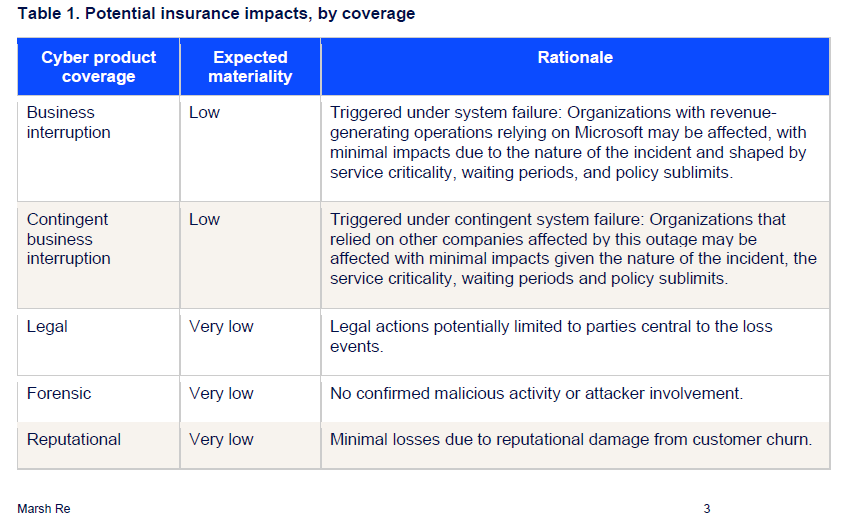
A report published by Acrisure London Wholesale detailed how business interruption works within cyber policies.
“Cyber policies typically include coverage for business interruption as a result of system failure. Where the failure occurs at an external provider, dependent or contingent business interruption cover may respond,” Acrisure said in the report titled “The Cyber Insurance Implications of Microsoft’s Outage.”
“However, the scope varies as some policies are triggered by any external provider while others restrict cover to non-IT providers or even a scheduled list of suppliers. Establishing whether Microsoft and the affected services fall within those definitions is therefore essential,” said the report, which was authored by Lara Wheeler, assistant vice president with Acrisure London Wholesale’s Cyber team.
The report explained that business Interruption is also generally subject to a time retention, known as a “waiting period,” which is typically 8-12 hours.
“The duration of the Microsoft outage means many businesses will have already exceeded their applicable waiting period. However, businesses will still need to demonstrate and quantify financial loss directly resulting from the interruption to establish coverage,” the Acrisure report continued.
Photograph: A Microsoft logo and sign outside the Microsoft Visitor Center are seen at the company’s headquarters on Monday, Nov. 9, 2026, in Redmond, Wash. (AP Photo/Lindsey Wasson, File)
Topics Profit Loss
Was this article valuable?
Here are more articles you may enjoy.
 Insurtech Lemonade Posts $43.7M Loss for Q3
 Startup Specialty Insurer Pinion Gets Green Light to Acquire Catlin
 SpaceX Plans $24 Billion Data Center and Gas Plant in Texas
 Five Weeks After Isaias, 68,000 Claims and $736M in Losses, Florida Carrier Data Show


