
Florida has the largest wind-mitigation grant program in the country, providing more than $300 million to homeowners over the last few years and resulting in insurance premium discounts for thousands of people.
But it’s not enough. The program is not targeted at enough properties that would produce the most benefit for insurers, homeowners and state interests. And too many insureds and builders fail to see the return from retrofitting their homes or building stronger structures in the most hurricane-prone state.
That was the word from Florida professors, actuaries and insurance interests who participated in a panel discussion at the Florida Office of Insurance Regulation’s Insurance Summit, held last week in Tallahassee.
“If investing in upgrades adds as much value as you put into the upgrade, why aren’t all developers doing it?” asked session attendee Mark Tanner, an actuary with Insurance Strategies Consulting.
The chief reason is the upfront cost of building homes to “code-plus” standards that exceed most state building codes and stand tall in a storm, said Charles Nyce, professor of risk management and insurance at Florida State University. Constructing to a true hurricane-resistant standard may add $20,000 to $30,000 in costs, he said. (The My Safe Florida Home grant program provides matching grants only up to $10,000.)
 And the savings or return on investment depends on many factors, including sale price of a property, locale, whether an actual windstorm reduced damage and showed the benefits of stronger construction, and other factors.
“It’s a hard sell,” Nyce said.
Homeowners must be sold on less-fiscal benefits, such as peace of mind, avoiding the hassle of insurance claims, and avoiding the possibility of having to move out while hurricane repairs are made, said Gabriel Carillo, professor and program director of the Center for Risk Management and Insurance Education at the University of Central Florida.
“But I don’t know how you package that and sell it to people,” Carillo said.
There’s a better way, Nyce argued. It involves robust public-private partnerships between insurers, mortgage lenders and government funding, along with innovations such as a storm-resistance grading system, changes in accounting and tax rules, and, perhaps, the advent of home-hardening construction firms that also sell property insurance.
“Tesla sells insurance on its cars. Where are the mitigation companies that sell homeowners’ insurance?” Nyce said.
Most homeowner decisions are left to the homeowner. And with costs rising, most insureds will opt out of adding large upfront costs without a guaranteed return on investment. But new programs and new incentives could change that, he said. In a paper published in November 2025 by the LeRoy Collins Institute at FSU, Nyce and other professors made some bold recommendations:
- Develop an easy-to-grasp, uniform grading system for homes and their storm resistance measures. Comprehensive—not piecemeal or roof-only measures—would see a higher grade, one that can be used to market properties and gain lower-cost loans. “Sharing this data with catastrophe modelers and insurers in the Florida property insurance market would help maximize the value of these investments. Creating a property-level mitigation database would be a key step forward,” the authors wrote.
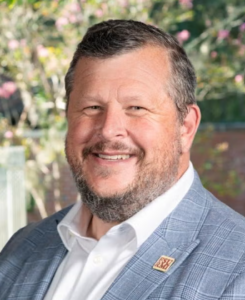
Nyce - Launch a pilot program that would encourage and evaluate mortgage lending and insurance company funding for home hardening. The state could incentivize lenders to amortize mitigation costs up front and/or over a longer period. “They could also incentivize private property insurers to participate in risk mitigation through experimental long-term property contracts where the insurer funds the mitigation.” Banks could offer lower interest rates for mitigated homes. The day before at the conference, Louisiana Insurance Commissioner Tim Temple underscored the idea of more institution-driven mitigation efforts. He wondered aloud what it would take for insurance companies, lenders and real estate groups to push for more home hardening.
- With Florida’s Citizens Property Insurance Corp. being a quasi-public entity, backed by assessments on all Florida insurance companies’ policyholders if a costly disaster hits the state, Citizens’ policyholders should be given priority. They should be required to enroll in the My Safe Florida Home mitigation grant program, the researchers noted.
- Strengthen building codes across the state. “Even though Florida has some of the strongest building codes in the nation, consistent updating is required to reduce future exposure,” the report recommended.
- Call your member of Congress: The federal government could offer more tax credits for storm mitigation measures. Like health savings accounts that help ease the cost of medical care for consumers, laws could be adopted to allow pre-tax disaster preparedness accounts for homeowners. Florida state government could provide more direct funding, and local governments could offer property tax credits for resiliency efforts.
- And state insurance regulations and federal tax rules could be changed, the report argued. Currently, insurance companies can set rates and collect premiums only for losses that are expected to occur during the policy period. They are financially disincentivized from building surplus to pay for property damage losses occurring beyond a one- or two-year horizon, the professors wrote. “We therefore recommend that federal tax laws be changed to allow at least a portion of surplus reserves of private insurance companies to be accumulated and invested on a tax-free basis if those funds are used to indemnify insured homeowners in major catastrophes. This change would give insurance companies more flexibility to smooth losses over time and decrease premiums.”
The 44-page paper and more of its recommendations can be seen here.
The panel at the OIR Summit last week was titled “The Resiliency Panel.” As Nyce noted, “Resiliency is easier when losses are lower,” Nyce said.
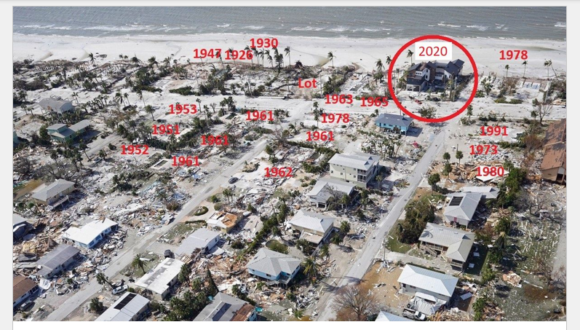
Top photo: A graphic by Michel Bruneau, professor at SUNY, showing age of homes on a section of Fort Myers Beach hit hard by Hurricane Ian in 2022. Newer homes withstood the wind and waves with much less damage.
Related: Hurricane-Strong Homes? Concrete Walls But Affordable
Florida’s Home Hardening Plan Is Massive, Popular—and Flawed, Critics Say
Topics Florida
Was this article valuable?
Here are more articles you may enjoy.
 Hackers Breached Propulsion System of US-Bound Oil Tanker
  Hordes of Teens on E-Bikes Force Suburbs to Rewrite Road Rules
  McDonald’s Hit With Class Action Alleging AI-Powered Menu Price-Fixing
  Gulf Coast on Alert for First Hurricane of 2026