

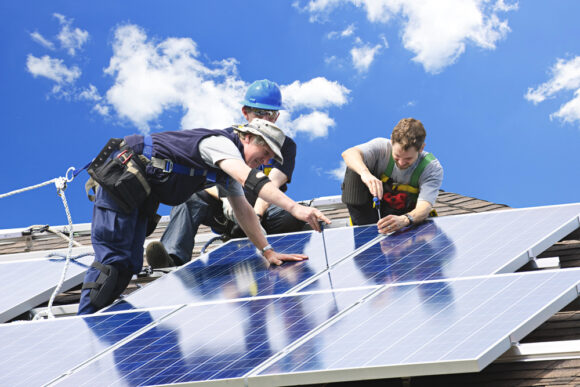
While the residential solar market is collapsing nationwide after President Donald Trump ended a popular tax credit in December, one state is proving to be a surprising exception: Florida.
A big reason why is a sweeping permitting law that took effect in the state last summer, experts said, with new rules aimed at making it both faster and cheaper to install new rooftop solar.
Florida installed more than 110 megawatts of home solar in the first three months of the year and BloombergNEF recently called it the fastest-growing state for residential solar in the country.
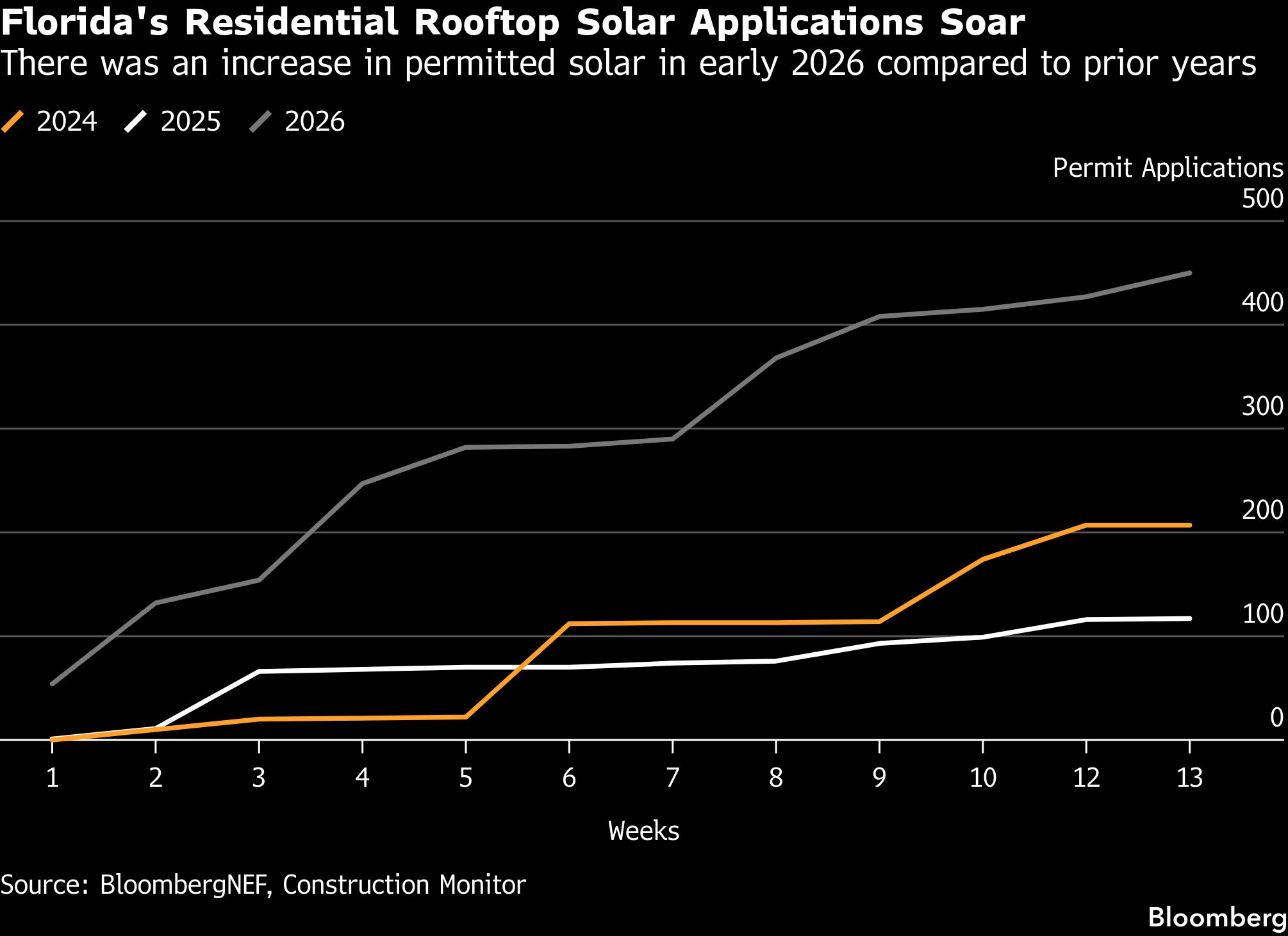
And more is coming: In the first 13 weeks of the year, Florida led the nation with approved permits for at least 450 megawatts-worth of home solar projects — a fourfold increase compared to the same period in the previous two years, according to data compiled by BloombergNEF and Construction Monitor. In other states, meanwhile, the number of applications was lower than in prior years.
“We’re doing better than I had braced for and expected as an industry in Florida with the tax credit going away,” said Jacob Traverso, director of operations at the Florida-based contractor Solar Source.
Nationally, the residential solar market is forecast to contract 21% this year after the expiration of the federal tax credit and a more challenging financing environment, according to a report by Wood Mackenzie and the Solar Energy Industries Association.
As the Trump administration removes incentives and funding championed by former President Joe Biden to expand renewable energy, streamlining the permitting process remains a bipartisan policy that enjoys support even from the staunchest conservatives.
A growing number of states, including California and Maryland, have adopted laws in recent years to speed up solar permitting. But one big difference between those laws and the new one in Florida, which was passed last year with bipartisan support, is that Florida’s applies to a number of construction trades, not just solar contractors— which perhaps widened its appeal beyond renewable energy advocates.
“That was the huge innovation,” said Matt Kirby, advocacy director of Permit Power.
In addition to shrinking the permit approval times to within five days from 20, the new law officially allows third parties to inspect solar systems statewide, a job previously handled largely by government. It also allows for remote project inspections, meaning inspectors can use photos, videos or drone footage in their reviews. The hope is that this streamlining and added flexibility lowers solar project costs, experts said.
To be sure, what’s playing out in Florida is not a solar boom. Some of the early 2026 solar installations were for projects locked in last year, when homeowners rushed to take advantage of the expiring tax break. Often, the solar industry experiences a “hangover” from the year before as people try to wrap projects before the calendar year ends, said Bill Johnson, board president of the Florida Solar Energy Industry Association, “but last year was obviously more extreme.”
He added that his own solar company, Brilliant Harvest, LLC, “is still fairly busy” this year.
The permitting changes and other state pro-solar policies are helping Florida withstand federal attacks on renewables better than other places. For example, it remains one of the few states to allow net metering at a time when electricity prices are skyrocketing. Under it, homeowners get credits for extra solar electricity they produce but don’t use.
That this is happening in a conservative stronghold is noteworthy, experts said, potentially offering lessons for how the home solar industry can endure in any state.
The average residential solar project in the US costs around $31,000, but it can be far cheaper to get rooftop solar in other countries, such as Australia and Germany. The premium is due to high so-called soft costs, which include permits, inspections, fees and labor. And they can make up roughly 30% of a home solar project’s total costs in the US, according to Heaven Campbell, Florida program director for the nonprofit Solar United Neighbors.
The federal incentive, which offered a 30% tax credit on eligible costs for home solar projects, translating to thousands of dollars in savings, was meant to help cover some of these costs. In Florida, the state’s policies are now helping bring down solar costs in other ways.
As a result, BloombergNEF projected Florida could see 710 megawatts installed in 2026, up 62% from the 439 megawatts installed in 2025.
There are some signs that new permit application approvals have slowed in Florida in the second quarter — and surged to a lead in California, according to BloombergNEF analyst Cosmo van Steenis. In fact, the Golden State, a longtime solar leader, is the only one projected to install more residential solar than Florida by the end of the year, according to BloombergNEF.
Meanwhile, Florida passed yet another law this year expanding its permitting reforms. Starting in 2027, there will be a universal residential building permit application for solar and other single trades across the state, instead of each local jurisdiction having a different one. The move, experts say, will further speed up new projects and help cut costs.
The reform, Johnson said, solves for something “that I personally have kind of railed against literally since I started contracting 17 years ago.” As a state licensed contractor, he explained, “I have to submit exactly the same paperwork to every building department that I work in or every jurisdiction that I work within, but each one is on its own form.”
Was this article valuable?
Here are more articles you may enjoy.
 ‘Unusual’ Isaias Brings Winds, Downed Trees But Fewer Claims Than Expected
  Kroger Plans to Slash 37% of Corporate Jobs in Next Three Years
  Hordes of Teens on E-Bikes Force Suburbs to Rewrite Road Rules
  Supervisor’s Punching of Employees Enough for Tort Suit, NC Appeals Court Says

