

After years of trying to convince developers and investors that it’s a viable alternative to Miami and Palm Beach, Fort Lauderdale’s pitch is starting to resonate.
The South Florida city has drawn an influx of luxury condominium projects and one of the region’s largest new corporate tenants. Much of the work is planned and financed by deep-pocketed New York developers betting that Fort Lauderdale’s time has finally come.
“For some people, Miami became too hectic, too busy, too noisy,” said Miki Naftali, whose firm is developing more than 250 condo units and a rental building in the once-industrial Flagler Village. “So Fort Lauderdale is a fantastic city for those that just want one notch down.”
In five to 10 years, he added, “You will see a lot of price appreciation, because we are just at the beginning of the story.”
Roughly an hour’s drive from both Miami and Palm Beach, Fort Lauderdale’s relatively lower cost of living combined with improving rapid transit is starting to invigorate the city’s downtown.
The Brightline to downtown Miami takes about 40 minutes and can cost as little as $9 with a multi-ride pack, less than the highest rush-hour tolls. Airlines have also increased service to the local airport, filling the void left when Spirit Airlines shut down.
Among the area’s newest residents from other states, the New York City metro area remains by far the biggest feeder, but California is gaining, with 22% of out-of-state movers coming from Los Angeles or San Diego, according to the city’s downtown development group. And most are young, with the population of adults under age 45 living in downtown Fort Lauderdale up 25% since 2020.
Some of the new residents may be drawn by Florida’s lower overall taxes, but soaring costs in Miami may make its northern neighbor more attractive. Homes in Fort Lauderdale have always been cheaper, but the discount is shrinking. The median sale price in Fort Lauderdale is about $70,000 less than Miami, down from a gap of around $120,000 a year ago, according to data from Redfin.
To Dependable Equities co-founders Isaac Schlesinger and Simon Dushinsky, it looks a lot like their home borough of Brooklyn, where they developed luxury condos in Williamsburg, Greenpoint and Bushwick.
The pair is developing three projects in Fort Lauderdale. The first, Ombelle, is a two-tower, 754-unit project estimated to complete around 2028. One of the towers is 45% presold, Schlesinger said. In a nod to its target demographic, Ombelle will host the city’s first Equinox gym.
The residential developments dovetail a growing corporate sector that includes retailers AutoNation and Chewy and aerospace firm VSE. Broward County’s commercial sales volume has risen the most this year compared to its neighbors, reaching $3.4 billion, according to CBRE.
GXO Logistics, a Greenwich, Connecticut-based supply-chain management company, is taking about 35,000 square feet at Hines’ $500 million T3 FAT Village development in downtown Fort Lauderdale.
The lease is among the three largest signed in South Florida since 2023, behind deals by ServiceNow in Palm Beach and FIFA in Miami, according to Tere Blanca, founder and chief executive officer of Blanca Commercial Real Estate.
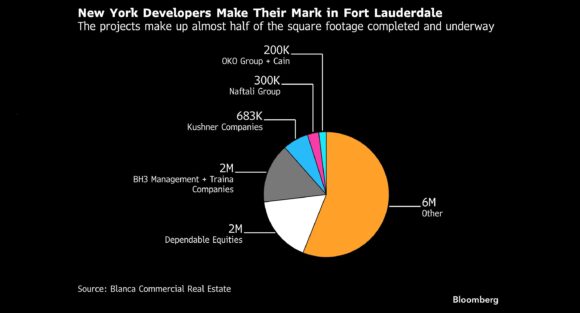
New York-based firms are behind 4.6 million square feet of downtown development, roughly 45% of the total. Between 2021 and 2024, New York developers accounted for about 13% of completed projects, according to Blanca.
New York builders are also bringing New York financing. Apollo Global Management’s Athene Annuity and Life Company is backing the Brooklyn developers behind the 46-story Andare Residences, soon to be the tallest tower in Fort Lauderdale.
“I look at the Fort Lauderdale numbers and I’m like, ‘Wow, this is a whole new world being created,'” said Ana Bozovic of Analytics Miami. “That’s following the New York money.”
In contrast, in Orlando and other fast-growing parts of the state, developers have turned to regional banks and insurance lenders to finance even the biggest projects.
Not everyone is convinced. Fort Lauderdale has been called “up and coming” for three decades, and some warn the luxury wave is out of step with the city’s longtime appeal to middle-class families.
“When you’re pitching Fort Lauderdale around the country it makes sense, but then reality hits when you’re on the ground,” said Peter Zalewski, a South Florida real estate broker. “It’s a suburb with high rises. The demographic has always been working class.”
Zalewski pointed to Panama City as a cautionary example, a Florida market that attracted outside capital without the demand to sustain it.
“Developers have overspent,” he said. “We don’t have salaries like Silicon Valley.”
New York developers remain undeterred, egged on by growing public investment. Fort Lauderdale partnered on a $130 million overhaul of Las Olas Marina that made more space for larger super-yachts, restaurants, new retail and a waterfront promenade. The city also plans to widen sidewalks, add landscaping and improve pedestrian and bicycle connections along the strip connecting downtown to the beach.
“I’m looking forward to continuing being involved in the maturing of the city to the point where the question of skepticism will be answered on its own,” Schlesinger said.
Was this article valuable?
Here are more articles you may enjoy.
 Sedgwick: Property Claims Face Delays, Are Growing More Complex
  Industry Reacts to Senators’ Letter for Claims Data and Recent Reports
  McDonald’s Hit With Class Action Alleging AI-Powered Menu Price-Fixing
  US P/C Insurers See Fewer Ratings Downgrades in H1 2026 on Improved Performance

