

Before the sun rose on Oct. 5, a school bus carrying students to Winter Haven High School in Central Florida was clipped by an oncoming car. The impact sent the bus into oncoming traffic, where it collided head-on with another vehicle and flipped over. A 16-year-old student and a 26-year-old commuter were killed.
The swift arrival of first responders helped avert further tragedy. Three students were airlifted and more than 30 others were taken by ambulance and bus to nearby hospitals.
Later, Polk County Sheriff Grady Judd tried to soothe his shaken community. “It was a terrible, tragic morning,” Judd said at a news briefing. “We had a beautiful 10th grade girl lose her life.”
Judd also had something else on his mind. He talked about how he fears a crisis is coming for his department if voters decide to enshrine a historic tax cut in the Florida constitution on Nov. 3. The measure, Amendment 3, would gut funding that law enforcement counts on, he said.
“Do you want us not to take care of your children as efficiently or effectively or as quickly?” asked Judd, a Republican who was first elected sheriff in 2004. “It’s easy to say, ‘oh, I can get me some tax relief’ but what about when the emergency comes?”
Amendment 3 would lower property taxes for qualifying Florida homeowners by increasing the portion of their primary residence’s value that isn’t taxed. By 2028, up to $250,000 would be exempt from property taxes, compared with about $50,000 today.
It needs support from 60% of voters to pass. A University of North Florida poll published Oct. 21 found that about half of likely voters plan to vote “yes,” with 14% undecided.
The tax debate comes as the state’s long-dominant Republicans are facing energized Democrats in races for US Senate and governor. Many Floridians are chafing at gas and grocery prices, and a big tax cut — the brainchild of outgoing Republican Governor Ron DeSantis — would seem to have appeal.
That would appear especially true in Polk County, a fast-growing inland pocket along Interstate 4 where commuters to Orlando and Tampa have flocked in search of affordable homes. Yet there are questions about who will pick up the tab for services residents count on: Amendment 3, some critics say, could inadvertently amount to one of the largest-ever stripping of funds from police in US history.
“It is absolutely a defunding of the police,” Judd said in an interview at his office. “I find that ironic, because it was the Democrats who wanted to defund the police.”
Like many Florida Republicans, Judd said he supports the idea of property-tax cuts, but “this is not the instrument.” The proposal is “draconian,” he said.
Law enforcement isn’t the only government function that could take a hit. Leaders of the state’s 411 municipalities and 67 counties are preparing to have significantly less money for everything from emergency medical services to garbage collection to stormwater management. Some communities are designing new fees to cover things like parks and fire departments.
The most acute shortfalls are expected outside Florida’s economic hubs, in poor and rural areas where few homes are worth more than $250,000 and there’s less commercial property and tourism. How local governments manage lost revenue “could trigger longer-term credit deterioration for some,” S&P analysts led by Jane Ridley and Michael Parker wrote in a note.
Investors are watching carefully. “You can’t just take away revenue over here and not replace it with something else,” said Lyle Fitterer, co-lead of Baird’s municipal sector. “You’ve got bondholders that need to be paid back.”
While DeSantis had touted the idea of a trust fund to bail out rural communities, the version of Amendment 3 passed by the legislature doesn’t require the state to replace lost revenue for cities and counties. Instead, it outlines how remaining property-tax revenue can be spent, prioritizing police, fire and rescue services. Property taxes for schoolboards, a separate levy in Florida, would be untouched.
The effects from one community to the next are likely to be uneven. Places with a more robust mix of primary residences, rental properties and vacation homes will have more revenue to take up the slack from the higher homestead cap. Yet in places where there are fewer tourists and seasonal residents, there is likely to be a crunch.
“It’s the most important thing on the ballot this year,” said Holly Bullard, the chief strategy and development officer of the Florida Policy Institute, which is among the groups fighting the measure. “This will forever change Florida.”
DeSantis, who is term-limited and has just weeks left as governor, long floated the idea of eliminating property taxes, which he called “paying rent to the government.” He has pointed to wealthier, urban areas like Miami, Fort Lauderdale, Palm Beach and Orlando, where an influx of affluent residents during the pandemic caused property values to soar, creating a windfall for tax collectors.
Jeff Brandes, a Republican and former state senator who runs the Florida Policy Project think tank, is critical of what he has said was a hurried process to get Amendment 3 in front of voters before DeSantis leaves office. He said the legislature rushed through a special session in June with no fiscal analysis or provisions for preserving public safety.
“We’d find ourselves in a position where we’ve defunded the police,” he said. “This is the weird place we’re in.”
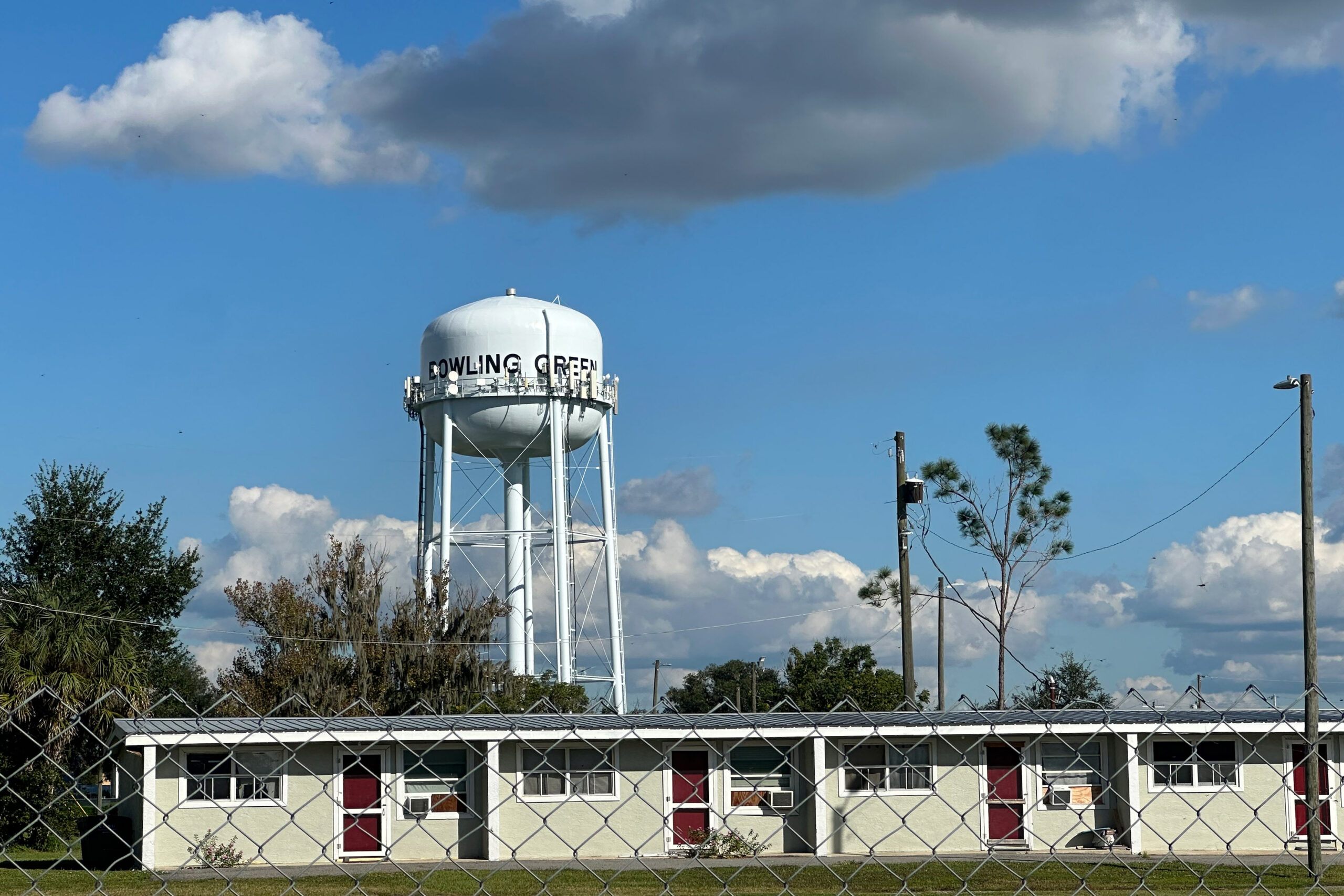
There’s likely nowhere that Amendment 3 would hit harder than Bowling Green, a town of 2,400 in Hardee County dominated by cattle ranching, phosphate mining and citrus groves. Some 98% of its homesteaded properties, or primary residences, are valued at less than $250,000.
Bowling Green Mayor Sam Fite said if the amendment passes, the city would lose about a third of the revenue it collects from property tax overall, or roughly $180,000. That money helps pay for a police department of seven officers, a garbage truck, contract maintenance services, parks and recreation programs, and utilities.
“For us, it’s a real big threat,” Fite said. “We do not have a lot of fat to cut.”
Fite is considering whether to increase Bowling Green’s millage rate, or the property-tax rate per $1,000 of assessed value, to Florida’s limit of 10 mills, or $10, from 7. Public employees may be switched to lower-cost health plans. Another potential savings: skipping the $3,000 black-and-white paint job on a planned new police cruiser.
None of that would hit Bowling Green as hard as the potential loss of its police force. Police Chief John Scheel said he’s typically able to respond to a 911 call in one to two minutes, much faster than in rural areas that don’t have their own force. Without his department, law enforcement in Bowling Green would be turned over to the Hardee County Sheriff’s Office, which covers an area of about 640 square miles.
Scheel, who’s held his post for 26 years, said he was hesitant to discuss the effects of Amendment 3 with his force. “You really don’t want people jumping ship on you,” he said.
The road to Amendment 3 was riddled with political infighting. A row between DeSantis and then-Florida House Speaker Daniel Perez dragged out for months, and DeSantis has said the proposal the Legislature put on the ballot “wasn’t my proposal.” DeSantis has said he’ll vote for the measure.
DeSantis has argued that the increase in Florida home values should come with property tax relief, noting that it’s an affordability issue that he can address more directly than rising insurance premiums or grocery bills. Representative Byron Donalds, the Republican nominee to succeed DeSantis who is leading Democrat David Jolly in the polls, has said he’d pursue some form of property tax relief if Amendment 3 fails.
Among the most enthusiastic backers of Amendment 3 has been the state’s real estate industry. The Florida Realtors association has poured about $20 million into a PAC to encourage voters to pass it. And some DeSantis allies in law enforcement, including Miami-Dade Sheriff Rosie Cordero-Stutz, have agreed that their budgets could be reined in.
Still, a stream of Florida Republicans have come out against the measure, including outgoing Senate President Ben Albritton. And law-enforcement and local leaders are sounding alarm bells about potential cutbacks and new fees to offset lost revenue.
In Volusia County, home to Daytona Beach, Sheriff Mike Chitwood said he’d have to fire nearly half of his 500 deputies. Osceola County, south of Orlando, froze hiring and paused $92 million in capital projects. Dunedin, DeSantis’s hometown in Pinellas County, outlined a contingency plan that includes closing a public pool, increasing fees for community centers and youth programs and reducing firefighter staffing and specialized trainings.
Cities including DeLand and St. Petersburg are floating fire fees to make up for lost revenues to fire and rescue departments.
Analysts foresee other gaps in public spending. Bullard said mosquito control, which is often supported by special taxing districts, would lose funding. Animal shelters run by county governments would likely be unable to keep their “no-kill” status, she said.
Polk County, which has a mix of lower- and middle-income suburbs and farmland, stands to lose $100 million in the first two years if Amendment 3 passes, said Judd, the sheriff. His department might need to shed roles like crossing guards, security guards and animal control.
Judd has dealt with the effects of economic shocks in the past. When the housing crisis ripped through Florida nearly two decades ago, his office absorbed public-safety and policing duties for six municipalities in Polk County, a sprawling area roughly the size of Delaware. If Amendment 3 passes, he may have more enforcement to absorb, and less money to do so, he said.
“This will make the Great Recession look like a day at Disney World,” Judd said.
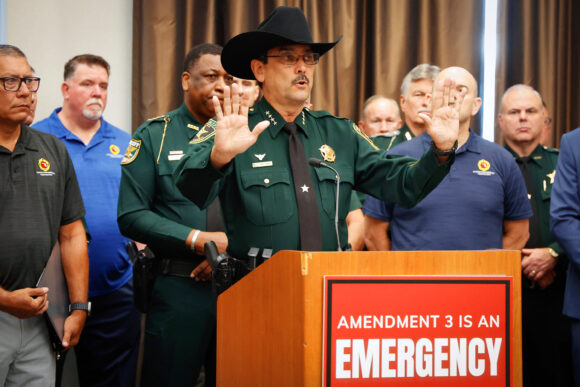
Top photo: Marion County Sheriff Billy Woods in September. Woods, the president of the Florida Sheriffs Association, warns of the impact on local services provided by first responders should Amendment 3 pass in the state. Photographer: Rich Pope/Orlando Sentinel/Tribune News Service/Getty Images
Topics Florida Property Law Enforcement
Was this article valuable?
Here are more articles you may enjoy.
 Yellow Furball Mascot Liberty Biberty Sparks ‘Beautiful’ Protest. Seriously?
 Phoenix Hit by Hail and Strong Winds, Damaging Vehicles Across Valley
 Social Engineering: The Analog Threat to Digital Defenses
 AM Best: Social Inflation Drives Surge in Commercial Auto Liability Claims


