

Uber Technologies Inc. was hit with $8.5 million in damages in a trial over a 19-year-old woman’s claim that she was raped by her driver in Arizona, raising the rideshare giant’s risk of a costly settlement to resolve thousands of similar cases.
The verdict reached by a nine-person jury in Phoenix on Feb. 5 is the first time Uber has been found liable for not preventing an alleged sexual assault of a passenger. The company faces almost 3,000 similar civil lawsuits from passengers filed around the country. The company prevailed in a similar case last year in California state court.
Uber said it will appeal but also hailed some of the jury’s conclusions.
Sarah London, a lawyer for the plaintiff, Jaylynn Dean, said the verdict “validates the thousands of survivors who have come forward at great personal risk to demand accountability against Uber for its focus on profit over passenger safety.”
Uber has been fighting sexual assault claims for a decade by arguing that the company can’t be blamed for misconduct by drivers, who it classifies as contractors rather than employees. It has also long struggled to fend off criticism that it doesn’t do enough to ensure rides are safe.
Bloomberg Intelligence has estimated that if Uber continues to fare poorly in early trials, the company may ultimately have to pay in excess of $500 million to settle more than 3,000 pending cases.
“Decisions in the first cases will be pivotal in shaping any broad settlement,” BI litigation analysts Matthew Schettenhelm and Holly Froum wrote in a Feb. 2 research note.
On Wednesday, Uber issued disappointing earnings guidance for the first quarter, underscoring that its investments into new ride options and growing its delivery business will weigh on margins.
Dean alleged that her driver raped her in November 2023 while giving her a late-night ride from a bar in Tempe, Arizona. She said in her lawsuit that the driver ended the ride early and took advantage of her while she was laying down in the back seat because her anxiety medication was reacting with alcohol.
The driver told police and testified at trial that the sex was consensual.
Dean’s attorneys asked the jury to award $24 million to compensate her for her past and future mental health harms, and around $120 million in punitive damages to punish Uber for its lax safety standards.
The jury found that Uber was liable because the driver was acting as an apparent agent of the company. But the panel said Uber didn’t act negligently or design a defective product. Jurors ultimately decided not to award punitive damages.
Uber highlighted the claims the jury rejected in its statement and noted the damages award was “far below what was sought.”
“This verdict affirms that Uber acted responsibly and has invested meaningfully in rider safety,” the company said in a statement. “We will continue to put safety at the heart of everything we do.”
The company also vowed to appeal the finding that the driver was acting as an agent of the company, saying the judge erred on the instructions given to the jury.
London, the lawyer for Dean, said “the jury heard extensive evidence about Uber’s practices and recognized that Uber is responsible for the conduct of its drivers.”
Thursday’s verdict is a stark contrast to the outcome of the California case. A San Francisco jury found that while the company was negligent for not taking adequate safety measures to protect a female college student, it wasn’t legally responsible for what happened to her in 2016.
Dean’s suit, similar to thousands filed across the country, claimed that Uber knew about the prevalence of sexual assault on its service but failed to ensure safety with measures such as dashboard-mounted cameras and matching female riders with woman drivers.
The company’s internal documents showed that Uber knew of the prevalence of sexual assault and instead chose to prioritize ridership growth over safety, Dean’s lawyers argued at trial.
Alex Walsh, one of Dean’s lawyers, told the jury during closing arguments that Uber marketed its service as a safe means of transportation for women traveling alone at night even when it knew of substantial risk factors for assault.
“What did Uber know internally?” Walsh said. “That it’s not safe to put your drunk girlfriend in an Uber late at night.”
Dean reported the incident to police soon after she returned to her hotel and later notified Uber, which suspended the driver.
Uber countered throughout the trial that it has industry-leading safety standards and has recently rolled out an option for women to request female drivers.
The company conducts extensive background checks on drivers, including criminal history, driving violations and civil suits, Uber’s attorneys said. Dean’s driver had passed all 12 of his background checks over a seven-year period and more than half of his 10,000 rides before the incident received five-star ratings.
“There was no way to predict or foresee what happened in this particular trip,” Uber’s attorney Kim Bueno told the jury during closing arguments.
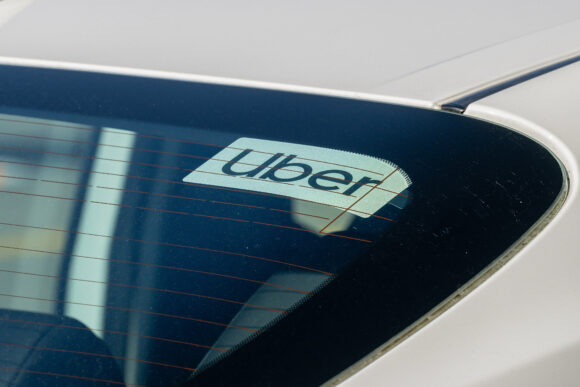
Top photo: Uber signage on a vehicle at San Francisco International Airport (SFO) in San Francisco, California, on Monday, Feb. 2, 2026. Photographer: David Paul Morris/Bloomberg.
Topics Sharing Economy Ridesharing
Was this article valuable?
Here are more articles you may enjoy.
 Former Trident Reciprocal CEO Ordered to Pay $468K in Attorney and Arbitrator Fees
  Chubb Q3 Net Income Down Slightly on More Catastrophe Losses
  Florida AG Says His Office Investigating ‘Anti-Public Adjuster’ Endorsements in Policies
  AM Best: Social Inflation Drives Surge in Commercial Auto Liability Claims

