

Los Angeles’ water and power utility is tapping the municipal bond market with its first offering since a judge ruled last month that the utility must face hundreds of lawsuits faulting its response to the devastating 2025 Palisades Fire.
The Los Angeles Department of Water and Power — the largest municipal electric utility in the US — plans to sell $400 million in power revenue bonds this week. The borrowing comes during a quiet stretch for issuance otherwise, with only about $6.4 billion of muni deals scheduled in the period, according to JPMorgan Chase & Co.
Concerns about the utility’s credit profile increased after a Los Angeles Superior Court judge concluded that a unique California law allows property and business owners to pursue claims that LADWP failed to supply enough water to fight the blaze that consumed the Pacific Palisades area, causing tens of billions of dollars in damage. The utility has said it will appeal the ruling.
Related: Study: Rebuilding LA to Wildfire Safety Standards Could Lower Future Fire Losses
Moody’s Ratings analysts said the firm took into consideration “substantial contingent liabilities” associated with the Palisades Fire in its rating, which is three levels below the top mark. “The outcome of civil litigation is not expected to be known for some time, but adds significant uncertainty to the power system’s longer-term financial profile,” the analysts wrote in a report.
Proceeds from the sale will go toward the utility’s capital-improvement plans for its power system, which includes projects connected to rebuilding areas damaged by the Palisades Fire, according to bond documents. The fire, which impacted the power system, burned almost 24,000 acres and damaged or destroyed over 7,800 structures.
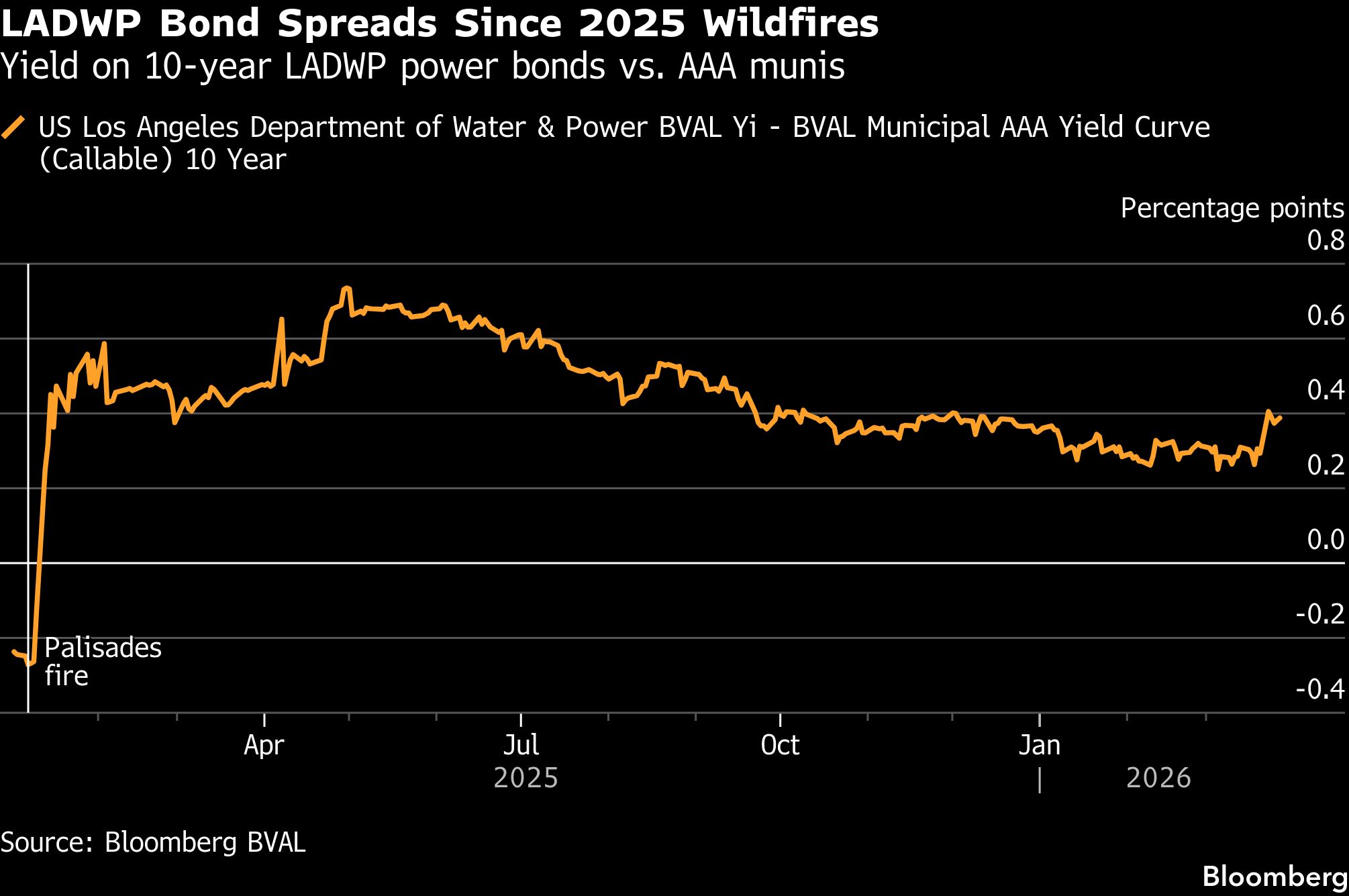
After the deadly wildfires, S&P Global Ratings lowered the utility’s power-system debt to A from AA-. LADWP later switched rating firms, and Moody’s downgraded that debt one level to Aa3 this month.
LA-based Bel Air Investment Advisors sold all of its exposure to LADWP after the Palisades Fire began, and the firm continues to avoid the utility’s debt due to the potential legal liability.
Related: ‘Nation’s First’ Smoke Damage Standards Bill Wending Through California Legislature
Once such situations enter the court system, “it’s just really hard to handicap what’s going happen,” said Patrick Strollo, head of credit research at Bel Air. “At this point, where spreads are, I don’t even feel like you’re being compensated for that risk.”
In bond documents for this sale, the utility said the cases “are not yet at a stage where it is possible to reasonably estimate the potential ultimate financial exposure to the city or the department.” It added that “the city and the department deny all liability claims and intend to vigorously defend against all of these lawsuits, but cannot predict the outcome” of the cases.
Risk Compensation
In January, the utility sold about $770 million of power system bonds, which included a 2052 segment priced at a spread of 51 basis points.
Some investors see an opportunity at the power-system debt’s recent levels.
“It’s definitely compensating somewhat for that overhanging risk,” said Chad Farrington, co-head of municipal-bond strategy at DWS Group. His firm owns the utility’s bonds. “Current market levels are compensating for the risk.”
He cited spreads that remain historically wider than the utility’s pre-fire pricing.
“For a California issuer, that’s still really cheap,” Farrington said, noting that the utility’s power bonds used to trade at yields below the muni benchmark before the blaze. “The large amount of debt that’s going to be incurred for this credit is the bigger issue.”
The utility’s current five-year capital improvement plan has increased almost 30% over prior versions and includes nearly $12 billion in additional debt as part of the city’s accelerated goal of achieving 100% clean energy by 2035, according to a Moody’s report for this week’s offering.
“Although historical trends would suggest actual capital expenditures would be somewhere between half to two-thirds of planned spending, this would still represent a meaningful acceleration over prior programs,” Moody’s lead analyst William Oh wrote.
Was this article valuable?
Here are more articles you may enjoy.
 Industry Reacts to Senators’ Letter for Claims Data and Recent Reports
  Large Commercial Property Rates Drop 14.5% in Q2 to Highlight Latest Willis Report
  Uninsurable Future: Managing the Climate-Change-Fueled Home Insurance Crisis
  Zurich Insurance Completes Acquisition of Beazley, Names New Beazley CEO

