

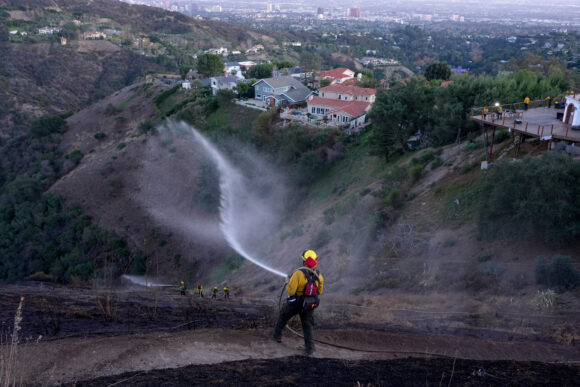
A California agency on Wednesday approved long-delayed regulations designed to protect homes from wildfire, but they’re less stringent than defenses recommended by scientists and firefighters.
The new rules, which apply to about 2 million homes, were mandated by a 2020 state law requiring residents in high-risk wildfire areas to establish an ember-resistant perimeter by removing vegetation and other combustible material within five feet of a dwelling. Scientists say that space, known as Zone Zero, nearly doubles a home’s chance of survival.
But after years of backlash from some homeowners over Zone Zero’s aesthetic and financial impact, the California Board of Forestry and Fire Protection on Wednesday reduced the non-combustible zone from five feet to a minimum of one foot. In the remaining portion of Zone Zero, some plants and grass would still be allowed and trees can remain if the limbs are trimmed away from the ground and roof. Wood gates and fences within five feet of a home must be replaced with non-flammable versions.
Todd Lando, a battalion chief with the Central Marin Fire Department in the Bay Area, told the board that the weaker regulations would be harder to enforce and could raise wildfire risks by allowing plants in Zone Zero. “I advocated for a simple, fully non-combustible Zone Zero because the science supports it,” he said.
Increasingly destructive wildfires over the past decade have destroyed nearly 60,000 homes and have spawned a continuing insurance crisis as insurers cancel policies in high-risk neighborhoods, forcing hundreds of thousands of homeowners to seek expensive, bare-bones coverage from the FAIR Plan, California’s insurer of last resort.
“That has affected our financial situation related to our ability to buy and sell homes, to insure homes and has put us in a very precarious place,” said Yana Valachovic, a University of California wildfire scientist closely involved with the regulations’ development.
“The new regulation is an important starting point, but it should be viewed as a minimum standard, not the highest level of wildfire protection,” Mark Sektnan, vice president for state government relations at the American Property Casualty Insurance Association, said in a statement.
Los Angeles residents who spoke at the board’s meeting opposed the less restrictive regulations as too draconian and pushed for further revisions.
“There is no perfect solution to the problems of creating safer communities,” responded Terrence O’Brien, chair of the forestry board. “Waiting and postponing is not, in my opinion, an option.”
The regulations are set to take effect for new construction in September but existing homes have up to five years to fully comply. Depending on the jurisdiction, either the state or local authorities will enforce Zone Zero. Local governments, though, are free to establish stricter Zone Zero rules. After the LA catastrophe, for instance, the Bay Area city of Berkeley approved more stringent regulations that took effect in January.
The forestry board had missed a 2023 deadline to implement Zone Zero amid homeowner resistance as well as cost concerns from the governor’s office and opposition from the board itself to strict standards, Bloomberg News found. The regulations were on hold when the January 2025 Los Angeles wildfires incinerated 16,000 homes and killed 31 people.
In the aftermath, Governor Gavin Newsom ordered the board to adopt Zone Zero regulations by the end of 2025. That deadline came and went as the board held a series of contentious public meetings. Southern California residents, even those whose neighborhoods burned in the LA fires, objected to removing plants and trees within a few feet of their homes. Insurance industry executives, firefighters and scientists, meanwhile, warned that watering down Zone Zero would only deepen California’s climate-driven insurance crisis as wildfires increasingly spread to densely populated urban areas.
“Today’s regulation is a meaningful step for wildfire resilience in the state of California but more work is needed to strengthen it over time,” said Steve Hawks, senior director for wildfire at the nonprofit Insurance Institute for Business & Home Safety and a former official with Cal Fire, the state firefighting agency.
Was this article valuable?
Here are more articles you may enjoy.
 Travelers Reports Solid Underwriting, Record Investment Income for Q3
  KCC Says Isaias Insured Losses to Be $3 Billion; AM Best Calls Storm an Earnings Event
  Broad AI Exclusions in Insurance Policies Could Create Uncertainty, Marsh CEO Says
  How Federal Ban on Intoxicating Hemp Products Will Reshape Risk, Coverage

