
Warning about potential high-fatality accidents, safety investigators recommended two years ago that the Federal Aviation Administration impose greater oversight on commercial hot air balloon operators, government documents show. The FAA rejected those recommendations.
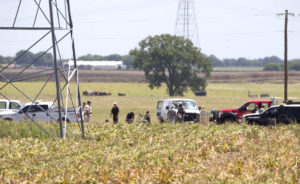
Now, federal authorities are investigating the crash of a hot air balloon that made contact with high-tension power lines before crashing into a pasture in Central Texas, killing all 16 on board. It is the worst such disaster in U.S. history.
A power line was tripped at 7:42 a.m. on July 30, and the first call to 911 came a minute later, National Transportation Safety Board member Robert Sumwalt said during a news conference. The crash site was near a row of high-tension power lines, and aerial photos showed an area of scorched land underneath. One witness described to The Associated Press seeing a “fireball” near the power lines.
In a letter to FAA Administrator Michael Huerta in April 2014, the National Transportation Safety Board urged the FAA to require tour companies to get agency permission to operate, and to make balloon operators subject to FAA safety inspections.
“The potential for a high number of fatalities in a single air tour balloon accident is of particular concern if air tour balloon operators continue to conduct operations under less stringent regulations and oversight,” then-NTSB Chairman Deborah Hersman wrote. She pointed to a 2013 commercial balloon tour accident in Egypt that resulted in 19 deaths.
Although “such an accident has yet to occur” in the U.S., Hersman wrote at the time, “based on the number of recurring accidents in the United States involving similar safety issues, the NTSB believes that air tour balloon operators should be subject to greater regulatory oversight.”
The FAA’s Huerta responded that regulations were unnecessary because the risks were too low.
“Since the amount of ballooning is so low, the FAA believes the risk posed to all pilots and participants is also low given that ballooners understand the risks and general hazards associated with this activity,” Huerta responded last November.
The NTSB had based its warning on three prior balloon accidents that it had investigated.
Those investigations highlighted “operational deficiencies in commercial air tour balloon operations, such as operating in unfavorable wind conditions and failure to follow flight manual procedures,” Hersman’s letter said.
The board noted that balloon tour operators aren’t subject to the same safety oversight as somewhat similar airplane and helicopter tour operations.
After Huerta’s reply, the NTSB classified the FAA’s response to the two balloon safety recommendations as “open-unacceptable,” which means the safety board was not satisfied with the FAA’s response.
Speaking to The Associated Press just before leaving for Texas to lead the crash investigation, NTSB board member Robert Sumwalt said he was studying the board’s recommendations from previous hot air balloon accidents.
“I think the fact that it is open-unacceptable pretty much speaks for itself,” he said.
The differences between the two agencies over the oversight of commercial balloon tours are chronicled in federal records.
FAA’s Huerta noted in his letter that NTSB’s recommendations cited federal rules that include drug and alcohol testing as a legal basis to require greater safety oversight of balloon operations.
“The FAA lacks compelling evidence to believe that medications not approved by the FAA have led to balloon accidents,” he wrote.
The NTSB responded this year that drug and alcohol testing programs are but one aspect of federal rules, and that the FAA misconstrued the intent of the safety recommendations.
The NTSB “did not issue these recommendations for the purpose of requiring such programs,” the board wrote.
“Rather, we issued them as a result of our concern about the operational deficiencies identified in our investigations of accidents involving commercial air tour balloon operations. Our concern is that such operations do not receive oversight equal to that of similar airplane and helicopter air tour operations.”
Topics Texas Legislation Aviation Aerospace
Was this article valuable?
Here are more articles you may enjoy.
 Business Interruption Claims Approach $1M Average, Says Allianz
  NYC Restaurants Shut Off Air Conditioning, Close on Sundays as Costs Surge
  Friend of Suspected FBI Data Thief: ‘Crazy’ Teen Warned Not to Hack Bureau
  Viewpoint: The ‘Unbundled’ Insurer Emerges in Age of AI as Value Chain Fragments
 From This Issue