
One of the upsides of apartment living is that you aren’t responsible for many of the maintenance issues that come with homeownership. One of the downsides is that you can’t always just do whatever you want with your apartment. Another upside is that you have the potential of a built-in community with neighbors in the building. The downside to that is you don’t always get to pick who your neighbors are and what they might do.
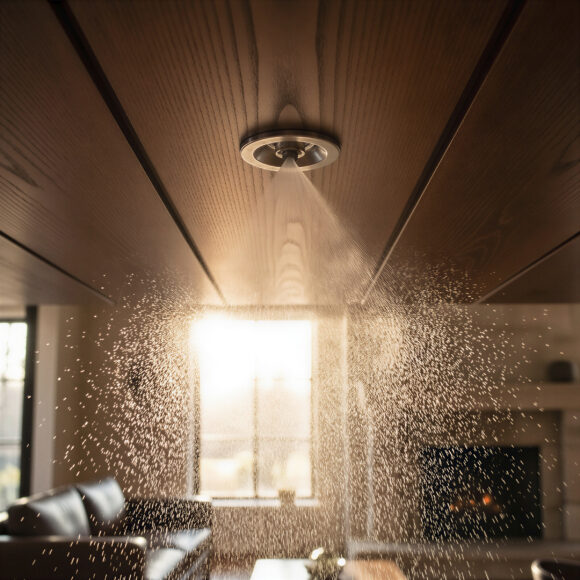
Take this story, shared by ABC News on X. A woman simply wanted to get some exercise in her apartment. Rather than getting an exercise bike, weight set, or doing virtual tai chi, she wanted to learn pole dancing. She got a pole, set it up in her apartment, and gave it a try. The pole wasn’t installed properly. It shifted and hit the sprinkler. You don’t have to watch the video to know what happened next.
This brings us to the wonderful world of habitational properties, insurance, where the checks are coming from, and who is getting them. Let’s track what is likely to happen next. The water came into her apartment, damaging her property and parts of the building. Considering that a standard fire sprinkler head can release between 13 and 26 gallons of water per minute, if it takes 10 minutes for someone to turn the water off, that means over 200 gallons of water could be released and it’s going somewhere.
The water will work through the floors and walls into adjacent apartments, the hallway, and the apartments below this unit. All of those units could experience damage to the units and the personal property in them. Everyone that has property damage is going to be looking at someone else to repair or replace their property. They will trace the source of the water back to a slightly damaged sprinkler head, and whether people call their renters’ insurer or an attorney, in the end, there are two likely subjects for lawsuits for those damages: the renter and the landlord.
While you can’t plan for everything that a renter might do (did anyone really have pole-dancing sprinkler breakage on their bingo card?), you can prepare for the eventuality that someone might do something and get themselves and the landlord sued.
Make sure the property owner is properly covered.
In this case, we have a renter who is likely responsible for the damage to the building. We say likely because there’s still the possibility that we might have a products liability claim here, but that’s beyond the scope of this article. Even with a responsible party, that doesn’t mean all claims have a responsible party. That simply means the first layer of protection for the building owner is a solid commercial property policy.
Without diving into policy minutia, that means the property needs as many covered causes of loss as possible. In this case, we would be hoping that any water exclusions wouldn’t include accidental discharge from a sprinkler system, but there are endorsements that exclude sprinkler leakage. We wouldn’t want to find anything related to that after the sprinkler was damaged from being hit by the dance pole.
This is also a good place to ensure that the property owner has a business income and extra expense policy in place to handle the potential loss of rents that can happen because six or more units can’t be rented out until they’re dried out and repaired.
Since this property loss is likely to turn into a liability issue, we need to talk about the commercial general liability (CGL) policy. Often, we think about what limits are normally secured, but when thinking about it from a broader risk perspective, the better question isn’t what’s normally available but how much protection does the insured need. In a case such as this one, we might be looking at the potential of tens of thousands of dollars, so if the occurrence limit is $500,000 or $1,000,000, that’s a drop in the bucket and we’re OK.
But what happens if a catastrophic event occurs? What if, instead of this incident causing a little property damage in a few units, there was something that the building owner didn’t know about, like the chance that the floor would fail, collapsing down onto another unit and injuring several people? The point isn’t to look at the worst possible outcome; it’s about looking for the worst likely outcome and thinking about something worse than that.
Maybe you’re asking about the renter’s liability insurance; shouldn’t we be talking about that policy?
Establish solid insurance requirements in the lease.
Let’s talk about that renter’s liability policy. Yes, it should be there, but unless the lease requires it to be there, you can’t be sure. You can’t be sure anyway, but that’s the next point. Wait for it.
Every lease should include insurance requirements, and they need to be more than just telling the renter that the building owner is not responsible for their personal property and thus, they suggest that renters purchase renter’s insurance to protect their personal property in the event it is damaged.
The lease should include minimum insurance requirements. Individual renters aren’t likely to have a renter’s policy with $1,000,000 occurrence limits for liability, but unless the lease spells out the minimum limit that the owner will accept, the renter will buy the minimum coverage available. Maybe their $100,000 occurrence limit meets the owner’s requirements and that’s great, and maybe that occurrence limit will generally protect them if they do something to cause bodily injury or property damage. It only helps if they have insurance in place, and keep it there, as long as they are renting an apartment.
That brings up another wrinkle. Does the lease require that renters indemnify and hold harmless the building owner for the acts and omissions of the renter? Sure, they may have insurance for the things that they do, but when they do something like break a sprinkler head, they aren’t the only one getting sued. The building owner is getting sued just for renting the apartment to a person who might break a sprinkler head. The building owner is in a better risk management position when that renter has to defend them, not their own policy. If the loss is bad enough, the building owner’s policy can contribute later, but not on the first dollar.
To be clear, the lease should require that the renters have renter’s insurance with a minimum liability limit, and along with that, they should add as additional insureds the building owner, management company, and anyone else who might get sued because they’re in the building.
There’s one more thing to talk about.
Verify that tenants are meeting the insurance requirements.
Great. There are requirements, and maybe the building owner requests to see the declarations, and requests some indication that they’re added as additional insured, but does anyone know if they cancelled their policy?
The best risk management policies and procedures require follow-up. This isn’t something that can just be set and forget. It’s something that needs to be handled annually, and if people aren’t in compliance, that must be dealt with according to the terms of the lease. It’s just like being aware of which pets people are bringing into the building, using credit reports to determine the chances that the applicant won’t be able to pay their rent, and asking for references when people apply to rent an apartment.
Whenever you’re dealing with people, each person involved adds their own dimension to the risk picture, and these steps are all about mitigating the risk that each person brings to the whole picture.
Topics Property
Was this article valuable?
Here are more articles you may enjoy.
 Hordes of Teens on E-Bikes Force Suburbs to Rewrite Road Rules
  Industry Reacts to Senators’ Letter for Claims Data and Recent Reports
  Florida Supreme Court Approves Board Certification in Insurance Law
  AI Models May Soon Self-Replicate Across Smart-Home Devices, Anthropic Warns
From This Issue