

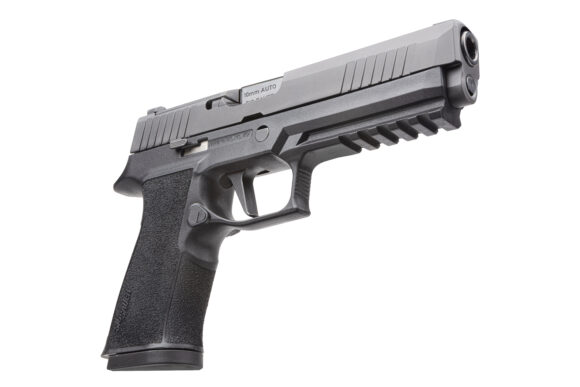
A federal jury in Maine has handed New Hampshire-based gun manufacturer Sig Sauer a victory over claims its P320 handgun is defective.
The case involved a complaint by David Alan Cole, a detective with the Somerset County Sheriffs Department, who claimed he was injured when his Sig Sauer handgun unintentionally discharged a bullet into his thigh when his hands were not on the gun or the trigger. The bullet penetrated his right calf and reached his right ankle and had to be surgically removed. Cole was executing a search warrant at the time.
Cole sued the gunmaker for product defect, negligence and breach of implied warranty. He sought compensatory and punitive damages for his injuries.
The nine-person federal district court jury ruled unanimously that the police detective failed to prove there were defects in the manufacture or design of the firearm and found no negligence on the part of Sig Sauer.
Sig Sauer has faced multiple similar lawsuits alleging unintentional discharge but has maintained the gun meets all safety standards. Sig Sauer markets the P320 primarily to law enforcement and military personnel.
“The jury’s unanimous verdict in Maine federal court is an important outcome because it further validates the engineering and design of the P320 and the extensive independent testing behind it,” said Kristen Dennison, counsel for Sig Sauer.
While it still faces lawsuits, the gunmaker has notched a few wins recently. Last month, the Eighth Circuit Court of Appeals dismissed a class-action lawsuit targeting the P320. Also, in May, plaintiffs in Connecticut and Massachusetts voluntarily withdrew their complaints.
In past cases, separate juries in Georgia and Pennsylvania sided with injured plaintiffs and awarded multi-million-dollar payouts.
Also the state of New Jersey has filed a consumer fraud lawsuit against Sig Sauer seeking to force a recall.
As part of its defense Sig Sauer has argued that the design, manufacture, packaging, warning and labeling of the handgun were in “conformity with the generally recognized state of the art, practice, custom, and knowledge at the time such product was designed, manufactured, packaged and labeled.”
However, Sig Sauer also argued, if there if there was any defect or deficiency, such defect or deficiency did not relate to SIG, but was the result of acts or omissions on the part of others for whom SIG is not responsible including negligent or faulty maintenance, handling, use, or alteration.
In Cole’s case, he maintains that while he was walking in the building, his P320 was in its holster, attached to his belt. He was holding his jacket in both of his hands. As Cole was walking, and in the presence of several witnesses, he heard a gunshot. Immediately, he responded as if he and the departments were under attack by gunfire. Seconds later, realized he was struck by a bullet from his own P320. Cole maintained that at all time during the event, his P320 was in its holster and his hands were not on the P320 and his finger was not on the trigger.
Cole’s complaint contained almost 10 pages of reports from across the country of unintentional discharges being blamed for injuries. They include reports from SWAT teams, police and sheriffs’ departments, ICE agents, firearms instructors, and military veterans. Among them is a report of nine instances among officers in the Oklahoma highway patrol and a Georgia police chief who removed P320s from his department’s weapons.
In 2017, Sig Sauer announced a “voluntary upgrade” program for the model P320 pistol, stating that the pistol meets “rigorous testing protocols for global military and law enforcement agencies” and all “U.S. standards for safety.”
Cole labeled this statement as false, arguing there are no federal government standards for gun safety and no federal agency oversees how firearms are designed or built. Firearms were expressly exempted by Congress from any federal regulation when it created the Consumer Product Safety Commission in 1972.
In 2018, Sig Sauer issued a second “voluntary upgrade” notice to all users or owners of the P320, but still did not recall the weapon, Cole complained.
Photo: Sig Sauer P320 Photo from Sig Sauer.
Was this article valuable?
Here are more articles you may enjoy.
 All in the Family: Husband, Wife and Daughter Indicted for Insurance Fraud and Bribery
  AI Models May Soon Self-Replicate Across Smart-Home Devices, Anthropic Warns
  Kroger Plans to Slash 37% of Corporate Jobs in Next Three Years
  Business Interruption Claims Approach $1M Average, Says Allianz

