

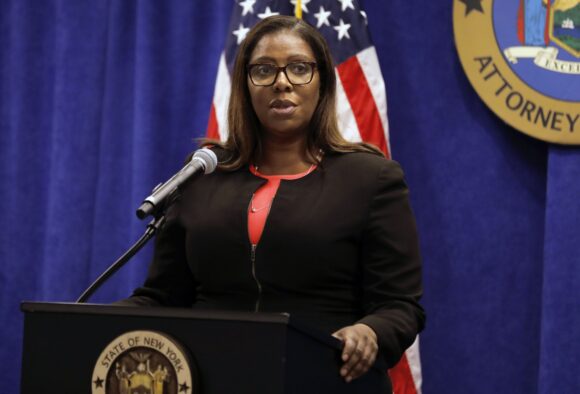
Attorneys general for 17 states have urged New York State’s highest court to reject an appeal by Donald Trump of a civil case in which he and several co-defendants were found liable for inflating the values of his Mar-a-Lago property and Trump Tower penthouse to obtain better terms on loans and insurance rates.
The attorneys general argue that throwing out the case brought by New York Attorney General Letitia James in 2022 could weaken the ability of states to hold businesses and individuals accountable for fraud. The case was brought under New York’s business fraud state known as the Executive Law.
In a September 2023 ruling by Justice Arthur Engoron in Manhattan, Trump, his sons and other co-defendants were found liable for fraud for exaggerating his net worth by billions of dollars a year on financial records submitted to banks and insurers.
Trump has argued that New York should never have brought the suit because the banks and insurance companies involved were sophisticated financial institutions that did not raise concerns about being defrauded. On the contrary, the Trump Organization paid all principal, interest, and premiums in full and on time or ahead of schedule, and the counterparties made well over $100 million in profits, according to the appeal.
His lawyers contend the state has invoked the Executive Law in the past only to combat “persistent fraud or illegality” resulting in widespread consumer deception and harm. They claim the case is political.
“This Court should put an end to this politically motivated action. None of the four lenders or insurers ever complained—before, during, or after trial—that they were even injured, let alone defrauded, in any of their transactions with the Trump Organization,” Trump’s lawyers argue in their appeal.
Amicus Brief
In their amicus brief filed with the New York Court of Appeals, the attorneys general maintain that New York’s law is broadly aimed at stopping fraud and thus appropriate in Trump’s case. They further note that many states have laws that allow the attorney general to take action against fraudulent and deceptive business practices, even when those directly involved do not file complaints.
The attorneys general say Trump is wrong to suggest that they have no role to play in policing fraud committed upon a private party who declines to pursue the remedies available to them at law. To the contrary, states have a “well-recognized sovereign interest in preventing all kinds of fraud,” especially in banking and insurance, and state laws like New York’s serve a legitimate public interest generally and also in the specific context of this case when applied to “ultrasophisticated” parties, the attorneys general argue.
“Fraud is fraud, whether you’re cheating an individual or a multibillion-dollar bank. State attorneys general have clear authority to stop fraud and hold perpetrators accountable, no matter how rich or powerful they are. No one is above the law, including Donald Trump,” said Connecticut Attorney General William Tong.
Tong joined the brief alongside the attorneys general of Arizona, California, Delaware, Hawaii, Illinois, Maine, Massachusetts, Michigan, Minnesota, Nevada, New Jersey, New Mexico, Oregon, Vermont, Virginia, and Washington.
In April, Trump asked New York’s highest court to vacate the lower court’s finding that he and his partners were liable. As one reason, the appeal points to questions raised about the testimony of a key witness, Trump’s former lawyer Michael Cohen. The appeal cites a Substack post by Cohen now claiming that he felt “compelled and coerced” to deliver testimony against Trump.
Trump has criticized both James and Engoron, who oversaw the non-jury trial finding him and his associates liable, calling both of them biased against him because he’s a Republican.
Last August, Trump succeeded in having the $464 million penalty imposed in the liability case vacated. A Manhattan appellate court still found that Trump broke the law by inflating the valuation of assets, but it said the massive penalty was unconstitutionally excessive.
In addition to the $464 million penalty, the lower court placed a temporary ban on Trump and his sons serving as corporate officers in New York. Those sanctions have remained on hold.
Top Photo: New York Attorney General Letitia James
Was this article valuable?
Here are more articles you may enjoy.
 Japan’s Cyberattack Surge Tests Its Push to Strengthen Defenses
 Erie CEO NeCastro Steps Down Early; Bolash Named Interim Leader
 Florida Agency Owner and Unlicensed Agent Charged in Fake Certificates Scheme
 WSJ Wins Dismissal of Trump’s $10 Billion Defamation Suit


