

Venezuela’s oil industry is running its day-to-day operations via phone calls and handwritten reports in the month since a cyberattack on state-owned oil giant Petróleos de Venezuela SA.
A Dec. 15 attack shut down PDVSA’s system, leaving the company to run its business outside its own technological networks, according to multiple people with knowledge of the situation who were not authorized to speak publicly. That’s slowed payments to contractors and employees, and information on production data, three of the people said.
It’s unclear who carried out the cyberattack. The US — which is pushing to indefinitely control future sales of Venezuelan oil after capturing leader Nicolás Maduro — has not taken responsibility.
Read more: Companies Work to Handle Safety Challenges of New Venezuelan Oil Exports: Sources
The incident highlights just how frail the the country’s technological infrastructure is, even in the industry most responsible for its revenue. Decades of disinvestment and corruption have marred PDVSA, and US sanctions have prevented the company from buying what it needs to update its systems.
Venezuela’s oil ministry and PDVSA did not immediately reply to a request for comment.
The attack also hit PDVSA’s operational platform known as SCADA, which runs processes in refineries, compression plants and pipelines. The company’s SAP software is still down and many processes are being done manually, the people said. The company still cannot access system platforms on which accounting, payments and production data run.
Internal email is also down, restricting official communication. Employees working in legal, finance, engineering and health departments in Caracas, Barinas, Puerto La Cruz and El Tigre are communicating internally via WhatsApp or Telegram. Within PDVSA’s Orinoco Belt operations, employees are communicating via Telegram and Gmail for now.
Employees are also in the dark on payments. A PDVSA retiree said he couldn’t verify his pension deposit in January as the access to his historic account at the company’s portal was down. He was asked to submit his personal information by hand to a clerk at PDVSA headquarters in Caracas, who then proceeded with payments via a different account.
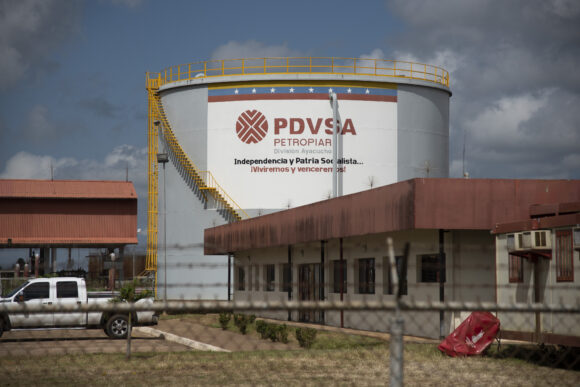
Photograph: An oil tank at the Petroleos de Venezuela SA Petropiar facility in El Tigre, Venezuela. Photo credit: Carlos Becerra/Bloomberg
Was this article valuable?
Here are more articles you may enjoy.
 EU Cyber Agency Warns Websites May Go Dark as PHP Prepares Critical Fix
  Report: Auto Insurance Total Loss Frequency Climbs, More Drivers Pay Repairs
  ‘Unusual’ Isaias Brings Winds, Downed Trees But Fewer Claims Than Expected
  How Federal Ban on Intoxicating Hemp Products Will Reshape Risk, Coverage

