

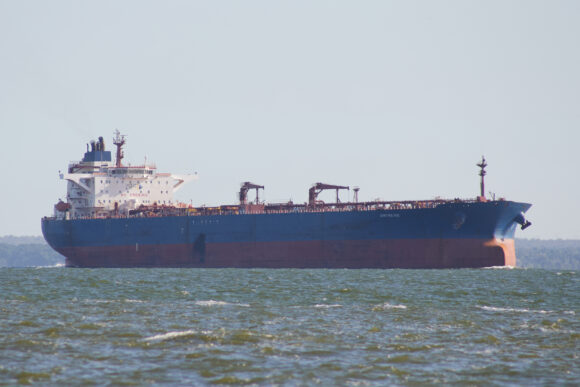
Oil companies aiming to participate in new exports of Venezuelan crude to the U.S. following the ouster of President Nicolas Maduro are in hasty discussions to find tankers and put together operations to transfer the crude safely from vessels and dilapidated Venezuelan ports, four sources familiar with the operations said.
Trading houses and oil companies, including Chevron, Vitol and Trafigura, are competing for U.S. government deals to export crude from Venezuela, sources said, after President Donald Trump said that Venezuela is set to turn over as much as 50 million barrels of sanctioned oil to the United States.
Trafigura said in a meeting with the White House on Friday that its first vessel should load in the next week.
Faced with a U.S. blockade in recent months, Venezuela has been storing oil in tankers and has nearly completely filled storage tanks onshore. The vessels holding the oil are old, poorly maintained, and under sanctions. Other vessels cannot make direct contact with sanctioned ships due to liability and insurance requirements, even if the U.S. grants licenses, the sources said.
Onshore tanks have also not been maintained for years, posing risks for parties trying to load the oil.
Shipping company Maersk Tankers is among the firms looking to expand their ship-to-ship transfer operations in Venezuela, three of the sources said.
Maersk Tankers could replicate the ship-to-shore-to-ship logistics it has used before in Amuay Bay in Venezuela, one source said. Maersk already has operations in nearby Aruba and Curacao, islands whose waters are often used to transfer Venezuelan oil. However, while the transfers are possible in Aruba and U.S. ports, they are more expensive.
Transfer operations will also be complicated by a shortage of smaller ships to move oil from the storage vessels to piers from where the oil can be transferred to another ship, as well as inadequate maintenance of machinery and equipment, another shipping source said.
Another firm, AET, which previously had business related to Venezuelan cargoes before U.S. sanctions were imposed on the country in 2019, is being approached by potential clients to expand operations, two of the sources said.
AET said in a statement to Reuters that it “is not currently working with any party to call, tranship, load, or discharge, Venezuelan cargo, either directly or indirectly.” It also said it does not comment on potential business opportunities across all markets.
(Editor’s note: Reuters has corrected this story, which originally said AET already helps transfer Chevron’s shipments of Venezuelan crude to the U.S., which is not the case. AET emphasized to Insurance Journal it has not not carried, transhipped, or performed any Ship-to-Ship (STS) operations involving Venezuelan cargo — sanctioned or otherwise — for any party, including Chevron, since 2019. AET has not called on any Venezuelan port since 2019, and it is not currently working with any party to call, tranship, load, or discharge Venezuelan cargo, the company said.)
Maersk Tankers and Chevron did not immediately respond to requests for comment.
While supply could reach the 500,000 barrels per day Venezuela previously exported to the U.S. before sanctions and would drain accumulated inventories in 90-120 days, it will be difficult to meet that goal if oil must be taken from both tankers and onshore storage, the sources said.
Companies are also competing fiercely for loading slots at Venezuela’s main Jose oil terminal, where there are capacity and speed limitations. Chevron, a key joint venture partner in the country, is also aggressively vying to keep its privileged position at Venezuela’s terminals, while lining up its vessel fleet, one source said.
Oil companies, including Chevron, Vitol and Trafigura, are already sourcing supplies of much-needed naphtha, an industry source in Venezuela said. The naphtha is typically blended into the heavy Venezuelan crude to lower its density, and make it easier to transport and process at refineries.
(Reporting by Marianna Parraga and Arathy Somasekhar in Houston; Editing by Liz Hampton and Rosalba O’Brien)
Photograph: The oil tanker named Xanthos Eos steam on Lake Maracaibo, Venezuela, Wednesday, Jan. 7, 2026. (AP Photo/Edgar Frias)
Was this article valuable?
Here are more articles you may enjoy.
 KCC Says Isaias Insured Losses to Be $3 Billion; AM Best Calls Storm an Earnings Event
  Report: Auto Insurance Total Loss Frequency Climbs, More Drivers Pay Repairs
  Home Insurance Tops Property Taxes in Squeeze for US Households
  NYC Restaurants Shut Off Air Conditioning, Close on Sundays as Costs Surge

