

Severe convective storms (SCS) have surpassed tropical cyclones to become the costliest insured peril of the 21st century, according to Aon plc.
Total economic losses reached $260 billion — 23% below the 21st-century average and the lowest since 2015, said Aon’s 2026 Climate and Catastrophe Insight report. (Economic losses include insured loss claims).
“Yet beneath this quieter surface, the year told a very different story,” Aon cautioned. “Insured losses reached $127 billion, 27% above the long-term average, a reminder that even in a below-average hazard year, the concentration and severity of certain events can reshape the global loss picture.”
In comments accompanying the report, Aon said this divergence shows how high‑severity frequency-peril events — particularly in the U.S. — drive substantial insurance claims.
“While insured losses declined slightly from 2024, the long-term trend is clear: Weather exposures are rising,” commented Aon CEO Greg Case, in a forward to the report.
Indeed, 2025 marked the sixth consecutive year that insurance payouts exceeded $100 billion.
In contrast to the active first half, losses from catastrophe activity were subdued during the third quarter of the year and were about 25% below average in the fourth quarter, Aon added. “The lack of hurricane landfalls in the U.S. and a general pause in Atlantic storm activity during the climatological peak of the season were among the crucial factors.”
The global insurance protection gap narrowed to 51%, the lowest on record, Aon said, noting that this improvement was largely due to the concentration of losses in the U.S., which had 81% of global insured losses as a result of the market’s high insurance penetration. (The protection gap is the difference between economic losses from a natural disaster and the amount covered by insurance).
“In many regions, especially emerging markets, more than half of economic losses worldwide remained uncovered, underscoring the persistent challenge of closing the gap in emerging markets,” the report continued.
Other key findings from the report include:
- SCS accounted for $61 billion in insured losses globally in 2025, the third‑highest SCS total on record.
- Thirty insured loss events hit $1 billion during 2025, far above the historical average of 17, which underscores the accumulation effect of increasingly frequent, medium-sized catastrophes.
- Nearly 50 billion-dollar economic-loss events (49) occurred in 2025, above the long‑term average of 46.
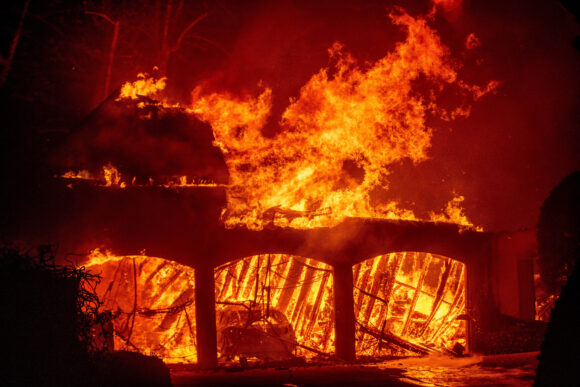
- Wildfires in California (Palisades and Eaton Fires) were the costliest events of the year, causing $58 billion in economic losses and $41 billion in insured losses, making them the most expensive wildfires ever recorded globally.
- Global fatalities totaled 42,000 driven primarily by earthquakes and heatwaves — 45% below the 21st‑century average. The Myanmar earthquake was the deadliest event apart from heatwaves, claiming 5,456 lives.
- Extreme heat caused more than 25,000 deaths globally and remained a major driver of natural-disaster-related deaths, as 2025 ranked as the third‑hottest year on record.
- The events that resulted in economic losses above $10 billion were the Palisades and Eaton Fires in California, the mid-March SCS outbreak in the U.S., seasonal flooding in China, the Myanmar earthquake and Hurricane Melissa in the Caribbean. For the first time since 2020, there were no such events in EMEA.
- SCS and wildfire were the only perils in 2025 that exceeded their long-term loss averages for economic losses.
The report also provided insights into regional trends, including:
- United States: More than 54% of global economic losses occurred in the U.S., with above-average losses driven by wildfires and SCS. Insured losses reached $103 billion, which represented 81% of global industry losses.
- Americas: Hurricane Melissa was the region’s costliest event, with $11 billion in economic damages and $2.5 billion insured losses in Jamaica, Cuba and elsewhere. South America experienced significant drought impacts, led by Brazil’s prolonged drought with approximately $5 billion in agricultural losses. Severe flooding events hit Mexico, Ecuador and Bolivia.
- EMEA: Natural disasters in the EMEA region resulted in at least $21 billion in economic losses, well below the 21st century average of $54 billion, marking the lowest loss since 2006. Insurers covered approximately $12 billion, under the long-term mean of $15 billion. These figures were much lower than in 2024, when major flood events significantly increased costs across the region.
- APAC: The Myanmar earthquake was the deadliest global event except for heatwaves, with $15.7 billion in economic losses. Flooding in China and cyclones in South and Southeast Asia also drove significant losses. Australia experienced two billion-dollar insured loss events.
Alternative Risk Transfer Solutions
The Aon report revealed that alternative risk transfer is becoming increasingly critical to providing the capital needed to help organizations mitigate risk and strengthen resilience.
“For Hurricane Melissa, the Jamaican government secured over $650 million in liquidity less than two months after landfall,” the Aon report continued. “This included $91 million from the Caribbean Catastrophe Risk Insurance Facility (CCRIF) and $150 million from their World Bank-supported catastrophe bond, both of which utilized parametric triggers.”
Parametric insurance products, which release funds automatically when specified triggers are met, proved critical during events such as Hurricane Melissa by providing speedy payouts, Aon indicated.
The report calls for increased resilience via smarter technology and stronger infrastructure; better forecasting, resilient building standards and modernized infrastructure to reduce long-term damage and assist communities and businesses to recover faster.
“As leaders consider a range of scenarios and hazards, they will benefit greatly from the use of predictive analytics to better understand their exposures, price future risks and measure the impact of their mitigation efforts,” CEO Case went on to say.
“A data-driven approach not only advances resilience, but helps to ensure businesses remain competitive and relevant in an environment where risks and customer expectations are constantly evolving,” Case added.
“Resilience today must be both physical and financial,” according to Michal Lorinc, head of Aon’s catastrophe insight and author of the report, commenting in a press release accompanying the report.
“Organizations are urged to embed adaptation into their workforce and location strategies, invest in predictive analytics and encourage cross-functional approaches to weather risk,” Lorinc added. “As climate events continue to affect people and property, the opportunity lies in using data to strengthen preparedness, rethink risk management strategies and build partnerships that support faster recovery and long-term resilience.”
Photograph: The Eaton Fire burns a residence Wednesday, Jan. 8, 2025 in Altadena, Calif. (AP Photo/Ethan Swope, File)
Was this article valuable?
Here are more articles you may enjoy.
 Reuters: DXC in Advanced Talks to Sell Insurance Software Unit for $2.4 Billion
  Chubb Q3 Net Income Down Slightly on More Catastrophe Losses
  Report: Auto Insurance Total Loss Frequency Climbs, More Drivers Pay Repairs
  Insurer Rolls Out Policy to Protect Data Centers Against Growing Backlash

