

Europe is facing another summer of intense wildfires, but firefighters who will be on the frontline warn that they’re entering the season under-funded, under-equipped and under-staffed.
The continent experienced its worst season for wildfires on record last year, with blazes burning through over one million hectares across, an area equivalent to the whole of the island of Cyprus. The wettest winter in years in parts of the Mediterranean has led to vegetation overgrowing in many forests, and firefighters fear extreme heat could turn bushes and grass into fuel for fires.
The European Union is gearing up for the season, stationing a record 777 firefighters from 14 EU countries in high-risk areas across the Mediterranean to assist local teams when large fires break out. But firefighters and their unions told Bloomberg that they feel ill-prepared for what’s to come.
“Our people are really angry,” said Simón Alonso, a spokesman for the Atifcyl association of forest fire workers in the Spanish region of Castilla y León. “Some people have been trained but not hired, others have been hired but have nothing to do because orders are not coming from above — everything is completely disjointed.”
Last autumn, after the 2025 wildfires were extinguished, firefighters in Portugal, Spain, Greece and France took to the streets calling for higher wages, year-round contracts, better equipment and more resources.
Some of those demands remain unresolved. On May 27, nine French firefighting unions met for the first time ever with advisors of Prime Minister Sebastien Lecornu in Paris and told them “the system is at a breaking point,” said Alain Laratta, secretary general at the Avenir Secours union. About 80% of French firefighters are volunteers, with budgets depending on over 100 different regional and local governments. Firefighters called for a unified funding system.
“Our mentality as firefighters is to always find a solution, but we have been doing the impossible for three consecutive years,” Laratta said. “This is the last year for the government to change the rules — if they don’t succeed, the consequence is that we will be unable to face simultaneous fires.”
In Portugal, firefighters are asking for a permanent funding mechanism to insulate them from the vagaries of economic cycles and budgetary constraints. The League of Portuguese Firefighters, a federation of fire brigades and associations, plans to submit a bill to parliament that will propose tapping oil levies, as well as car and fire insurance taxes, to finance the scheme.
Spokespeople for the French and Portuguese governments didn’t respond to requests for comment.
In Greece, preparations for the season have been more comprehensive, according to Antonios Koukouzas, president of the EPAYPS Greek firefighters’ union and a fire major in the eastern Attica region. More personnel have been hired and there are more helicopters and aircraft available than in previous years.
“Our outlook is cautiously optimistic, but not complacent,” Koukouzas said. “Greece entered the 2025 season better prepared — however 2025 also saw the limits of any firefighting system under extreme and simultaneous conditions.”
In Spain, efforts to strengthen fire response have been unequal across regions and parts of the administration, and at times chaotic, according to accounts by several firefighters, who spoke on condition of anonymity for fear of repercussions from their employers. Fire response in the country mainly depends on regional authorities, some of which rely entirely on public servants, while others also resort to private contractors.
Alonso — who works in a helicopter brigade operated by the central government’s Ministry for the Environmental Transition — and two other firefighters said contractors for local and regional governments have incentives to cut costs. That means they can put in more competitive bids by paying lower salaries, providing older and lower quality equipment and hiring fewer people than their contracts require, the firefighters said.
Some regions in Spain have a shortfall in firefighters that dates back to the aftermath of the 2008 financial crisis, when cost-cutting led to experienced firefighters leaving the force, and permanent year-round jobs becoming seasonal work for the summer.
Last summer, as large wildfires broke out simultaneously across the country’s north, public administrations went on a hiring spree and offered jobs to firefighters in the private sector. That led to companies employing young, inexperienced and untrained personnel to extinguish extreme blazes fueled by dry weather, high temperatures and strong winds made worse by climate change, according to accounts by Alonso and two other firefighters.
Spain has seen nine large forest fires for the year to date, compared to just one for the first six months of last year, according to Sara Aagesen, the country’s minister for the environmental transition. The ministry has improved working conditions, extended contracts to 12 months, rather than just for the fire season, and will spend €335 million ($384 million) to buy new amphibious planes, which will be delivered soon, she told reporters on Friday during a visit to a fire brigade in Castilla y León.
“This brings attention about the importance of preventing, having the right teams and protecting those who protect us,” Aagesen said. “It is fundamental that we protect our fire brigades so they have the best conditions.”
Public administrations in the regions of Castilla y León and Galicia have ramped up direct hiring of firefighters in recent months. In Castilla y León, the administration has responded to complaints about how private contractors operate by moving to transfer contracts to one single publicly-owned company. The dispute escalated last month after Asemfo, the association representing privately-owned contractors, threatened to exclude 950 firefighters out of the region’s 5,000 from this summer’s firefighting campaign.
“We are operating in a situation of absolute legal insecurity,” said Oscar Matilla, manager at Rebofosa, a Castilla y León-based contractor of firefighting services for the regional government. “We are fulfilling the conditions required in the contracts we signed, but now they’re asking us for much more.”
The forest department in Castilla y León will deploy more teams, more helicopters, drones and bulldozers this season, the regional government said earlier this month, as it declared the period of high fire danger had started.
The situation is so uncertain that many private companies have not yet formalized hirings. Some job posts remain vacant, while some firefighters have joined teams that have no directions on what to do, including preventive jobs that need to be done early in the season, according to Alonso.
“Fires are becoming more violent and the only way to stop them is with permanent systems that can help prevent them,” Alonso said. “If our structure remains temporary, disjointed, inefficient and privatized, this will happen again and it will be worse.”
Governments have failed to do fire prevention work for years, and for the past decades they focused on preserving forests that thrived under a climate that no longer exists, said Marc Castellnou, head of forests for firefighters in the Spanish northeastern region of Catalonia. “Managing the land requires decades, it’s not just a matter of one winter,” Castellnou said.
Many elements need to come together for a fire season to be as catastrophic as last year’s, including a very wet winter, a hot and dry spring and extremely hot and windy conditions during summer. Current conditions indicate that’s where the continent is heading.
“So far, the cycle is exactly the same,” Castellnou said. “The fires we will see this year will be an exact repetition of last year’s.”
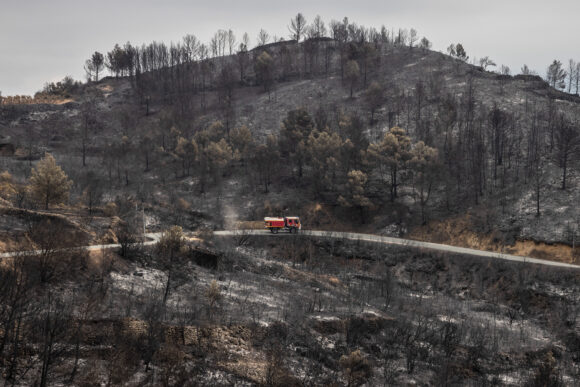
Photograph: A firefighting truck on burnt woodland following a wildfire in Fontjoncouse, Aude, France, in August 2025; photo credit: Angel Garcia/Bloomberg
Related:
Viewpoint: How Climate Change Is Creating Uninsurable Areas Across Europe
Topics Catastrophe Natural Disasters Wildfire
Was this article valuable?
Here are more articles you may enjoy.
 Reuters: DXC in Advanced Talks to Sell Insurance Software Unit for $2.4 Billion
  Viewpoint: Beware These Commercial Auto Endorsements!
  NYC Restaurants Shut Off Air Conditioning, Close on Sundays as Costs Surge
  ‘Unusual’ Isaias Brings Winds, Downed Trees But Fewer Claims Than Expected

