

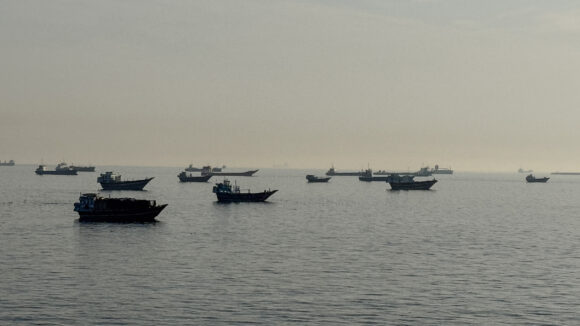
At anchor in the Persian Gulf, Abhijit Chopra found out about the US-Iran peace deal when his phone lit up with messages from family and friends. The captain of a crude oil tanker, he had to temper his excitement. There were no signs of celebration from nearby vessels, and no ships making haste towards the Strait of Hormuz.
Chopra and his 21-strong crew have been trapped since the war began in late February. At the beginning, they struggled with fear and uncertainty, which ebbed into boredom and a constant battle not to let negative thoughts set in. For more than 120 days they have waited, dining together and bonding by singing old Hindi songs at karaoke. In early March, Chopra and his crew — all of whom were Indian, aside from one Ukrainian — celebrated Holi, a major Hindu festival, onboard the tanker. They painted each other’s foreheads with turmeric powder taken from their kitchen.
Signs that the strait might reopen came and went. That’s why this time, Chopra didn’t overreact. “When they said the Strait of Hormuz was open, we were a bit optimistic that the vessel might transit,” he said. But when there was fresh news of attacks on tankers, they realized they were going to be stuck a bit longer. “There was a little bit of disappointment,” he said.
Around 8,000 seafarers who are not from the region remain stranded in the gulf, according to the International Maritime Organization, the United Nations agency that’s tasked with regulating and coordinating global shipping. Sailors have been left to the mercy of geopolitical forces and distant diplomatic negotiations, working to keep their ships in service as missiles and drones passed overhead. Their fate is a stark reminder that the global economy is heavily dependent on individuals, who at times have to go to extraordinary lengths and face incredible risks to keep trade flowing.
“Ultimately, we are just ordinary people. We are fathers, we are sons, we are husbands who are staying for months out at sea carrying out a duty,” Chopra said. “And we are doing this because somebody has to do this and the world’s goods, economies depend on all this seafaring job.”
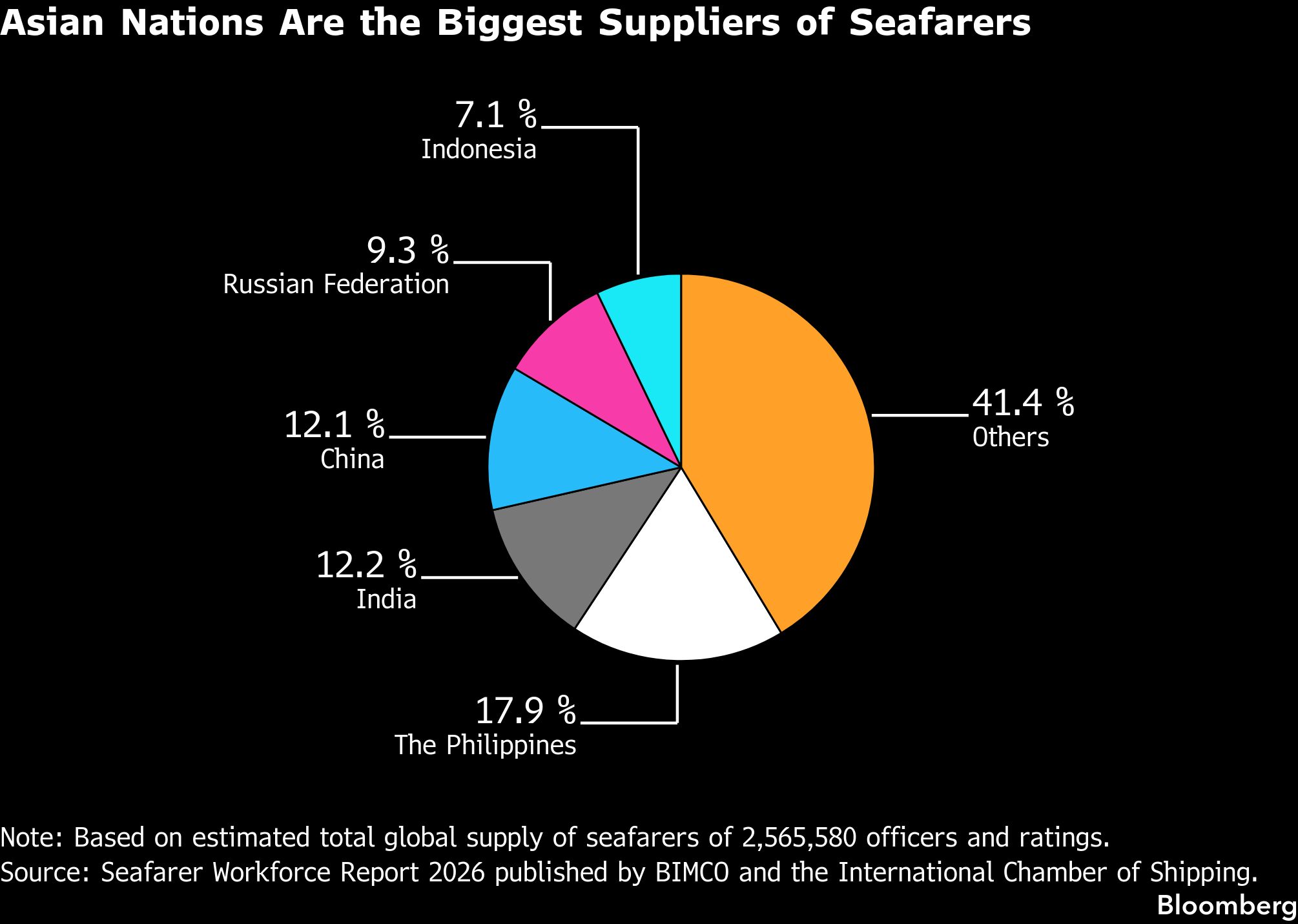
Oceangoing ships are responsible for moving more than 80% of global goods, or about 70% in total value, a World Bank estimate shows. Today, nearly 2.6 million seafarers serve onboard the world’s fleet of more than 85,000 merchant vessels, according to a joint report issued by BIMCO, a trade association for the shipping industry, and the International Chamber of Shipping. The majority are recruited from lower-income countries, often in Asia, with the Philippines and India providing around 30% of the global workforce.
Working on ships can be difficult and dangerous, with crews often away from home for months at a time. Seafarers’ conditions at sea are largely governed by the Maritime Labour Convention, an International Labour Organization treaty that outlines work and welfare rights, and touches on protections for them in extraordinary scenarios.
But for a global industry as decentralized as shipping, enforcement and compliance is patchy. Large shipowners are often compliant, but seafarers on vessels owned by smaller companies may not be offered even those basic set of rights, top executives at support groups have told Bloomberg News.
“Global shipping is almost set up to provide multiple, different channels for ownership and operation, where I can be a shipowner sitting in London and flag it to Liberia and register it in Greece and I sit back and earn revenue from the ship,” said Ben Bailey, program director for the Mission to Seafarers, a welfare charity for maritime workers. “It is the seafarers that risk falling through the gaps and not have their rights met.”
When crises and conflicts occur, those rights are tested to the extreme.
Raman Kapoor, the captain of a Suezmax tanker, oversaw several runs in the gulf in late 2025 and early 2026, and had just 10 days left on his tour when the war broke out on Feb. 28. The ship had just finished loading a cargo of crude oil at the Iraqi port of Basra when the onshore pilot came running to Kapoor to tell him that ships in the Strait of Hormuz had been attacked.
A call soon came from his employers, and he was ordered to leave port and headed to an anchorage out in the gulf. “The entire scenario changed,” Kapoor said. “Our processes, what’s our next port, the ship’s schedule, everything changed. All of a sudden we found that we were inside a war zone and there was no safe way out.”
Service contracts for sailors typically range between four to nine months. In a war that’s been going on for more than four months, that means that many of those seafarers trapped in the Persian Gulf are at or near the end of their contracts and should be relieved by fresh crew. In some cases, sailors are also allowed to request that they’re evacuated from conflict zones.
However, keeping a large commercial vessel operational requires around 22 people, and ship operators need to carefully manage and time mariners’ departures and make sure that there are replacements.
A sailor’s pay often takes what’s set out in a global bargaining framework as guidance, and those serving in war zones can get a boost to their pay— in some cases, inflating their monthly salaries to as high as $30,000 — but it was difficult for crewing agencies and ship operators to find mariners willing to fly into the gulf.
Early in the war, the Philippines, the single-largest source nation for many seafarers, asked crewing agencies to stop sending its nationals to the Persian Gulf, exacerbating the shortage of available replacements, though Manila later eased that restriction. Some gulf countries, including Iraq and Kuwait, stopped issuing visas for short periods of time as the security situation worsened, preventing seafarers wanting to go ashore in order to go home from being able to get off from their vessels.
Some sailors said they had to ration food and water at the beginning of the conflict, over fears that they might not be able to resupply. Cooking ingredients and other groceries were delivered to Kapoor’s ship on a small supply vessel. The rations, including snacks, soft drinks and cigarettes, are enough to last for 1.5 to 2 months and can cost up to $10,000 for each batch.
Just keeping a ship seaworthy is a lot of work. The crew inspects their vessel every few hours, checks equipment and stands watch to look out for hazards. Electronic interference has made it hard to use global positioning systems, so sometimes seafarers needed to make visual confirmation of landmarks and other vessels. Sailors said these routines helped keep them grounded and alert as they waited at anchor.
But life on a ship — that in Kapoor’s case is only 280 meters long, and around 50 meters wide — is inevitably constrained. Satellite phone time is limited and expensive, so crews often ration it carefully. On some ships, sailors try to schedule one call home each week. For people who have spent months at sea with no clear idea when they might return, those brief conversations with family are often the emotional high point of the week.
For some crew, fishing has become both entertainment and food supply. Bored sailors spend hours casting lines from the side of the ship. The catch often goes straight to the galley, where the cook turns it into dinner. Anything extra gets cleaned and laid out on deck to dry under the gulf sun. Ribbonfish are especially common. Several crew members said the homemade dried fish has turned out to be surprisingly delicious — a welcome change from weeks of repetitive meals.
Captains said crew members were encouraged to do everything together, and no one should be left alone — including when they dine or relax. Several sailors said access to knives and other sharp tools is more tightly controlled than normal, reflecting concerns about mental health as uncertainty drags on.
“We do our best to keep the morale on board for everyone—be professional, disciplined, and supportive,” Chopra said. “But there is definitely a sense of strain and uncertainty over this hundred plus days where we do not have clarity of what is about to happen.”
There have been occasional, visceral reminders of the war. Just after midnight on March 12, Kapoor’s crew were winding down for the day when they saw flames engulfing another tanker, the Safesea Vishnu, which was only a nautical mile away. The vessel had been struck by an unmanned craft while conducting a ship-to-ship transfer of naphtha. One crew member died.
Kapoor’s ship couldn’t sail out of the area because there were too many other vessels crowded around. Sailors sheltered in a designated safe space, just beneath their accommodation area.
“It was a very frightening moment for all of us because we are just seafarers. We are not trained for any war. We are not warriors. So everyone was so scared what would happen if the next missile or drone attacked our ship,” said Kapoor.
Steven Arillo, a navigation and safety officer on a liquefied natural gas tanker, was docked at the Ras Laffan facility in Qatar when it was hit with Iranian missiles in the middle of March. The crew were only given half an hour to leave the port. One of Arillo’s crewmates mounted a bodycam and turned it on to record missiles streaking above the complex.
His ship, crewed mainly by Filipino seafarers, was the last out of the dock before another barrage hit the plant, igniting a huge explosion. If the ship had been delayed by half an hour, he said he’s sure they would have been hit. “We’re very lucky that we left right in time,” he said.
Like many others, Arillo and his crewmates asked to go home, but there was no replacement available and flights out of the region were disrupted. Stuck on board, he worked out and perfected his latte art — posting regularly to Instagram — as he waited with his binoculars to check for incoming danger.
“When you’re inside the war zone every day of your life, it’s like a ticking bomb,” he said. “You don’t know what would happen next.”
At least 14 civilian seafarers from countries other than Iran have been killed during the war, according to industry experts’ calculations. Iran has said that around 50 of their own mariners have died. One seafarer remains unaccounted for, while there has also been at least two reported non-combat related deaths, IMO said.
As the war dragged on, governments around the world tried to negotiate with the Iranian authorities for safe passage. Pakistan secured the extraction of around 20 vessels. An Indian tanker was escorted by the Iranian navy after New Delhi negotiated with Tehran. Tokyo at one point in time, prioritized ships with clear associations with Japan—including crew nationality—as it negotiated with Tehran to extract vessels, according to people familiar with the matter.
Often whether seafarer could sail out safely through Hormuz depended on the value and importance of the cargo aboard the ship he was manning, the shipowner’s willingness to risk the vessel as an asset, and their ability to secure expensive insurance cover.
The shipping community has lamented the state-to-state negotiations, and the conditions on which they secured safe passage.
Iran has insisted during peace talks with the US that it expects to maintain control over the Strait of Hormuz, with an implicit threat to ships that pass without meeting its conditions.
The wellbeing of seafarers is also closely tied to freedom of navigation and the laws and norms of the sea, according to Jacqueline Smith, maritime coordinator at the International Transport Workers’ Federation, a trade union.
“If Iran asks for $10,000 to cross and the company says no, but still expects the vessel to cross, what happens then?” she said. “Do we ask seafarers to sail through in the middle of the night, lights off, and risk it all?”
Sailors serving on oceangoing ships have increasingly been caught in geopolitical crosshairs in recent years. The Covid-19 pandemic ground the global economy to a halt and left thousands of seafarers stranded at sea. Russia’s full-scale invasion of Ukraine in 2022 turned the Black Sea into a zone where drone attacks on ships became more common. The growth of the “shadow fleet” of ageing vessels using fake flags or the flags of nations that take little interest in the wellbeing of sailors has created new risks for crews.
“They are the underbelly of the industry that potentially will walk away when it becomes too difficult, and seafarers then get left stuck on those ships,” Bailey, from the Mission to Seafarers said. He’s also concerned that conflict and danger are becoming a new normal for the industry as a whole.
“The biggest worry is how the levels of uncertainty of the war has now gone to a worrying level of acceptance,” he said. “Seafarers, shipowners used to be terrified at the sight of missiles, being attacked. As time went on, they’re normalizing what is otherwise an abnormal situation.”
In June, the US and Iran agreed to an interim 60-day deal that included reopening the strait. More ships are now transiting the chokepoint — although still far fewer than before the war began.
In all, around 11,000 seafarers who are not from the region were stranded in the gulf during the war, according to the IMO, which announced a short-lived plan to evacuate sailors in June. It was rescinded within days after Iran attacked ships transiting Hormuz.
The plan evacuated 136 ships and rescued about 2,900 seafarers, according to Natasha Brown, a spokeswoman for the organization. “It is still paused, until I can secure the necessary security guarantees from all parties,” she said, adding that the IMO has received feedback from seafarers that there needs to be designated safe corridors, clear protocols and the right to refuse unsafe passage for them to deal with future crises like this current one.
Getting a ship ready for the transit isn’t a quick process, according to Angad Banga, chief executive officer of maritime conglomerate The Caravel Group, which owns Fleet Management Limited, one of the world’s largest ship management companies.
First, ships have to be kept in seaworthy conditions. This includes getting rid of barnacles and other things that may foul the hulls and ensuring that all equipment is ready. Then, bunkering plans have to be drawn up. Once it’s clear that the vessel is likely able to sail through Hormuz, comes training the crew for the journey, including practicing what to do in security situations. That can include rehearsing the exact words to say should they be challenged by the Iranians while crossing Hormuz.
That means there’s still work to do, and time to pass, before many of the ships in the gulf can make their way out into the open sea.
Arillo’s crew was relieved in May by a crew from Indonesia, who sailed the ship through the strait. When he arrived back in the Philippines, he proposed to his girlfriend on the beach. The ship’s operator brought the crew to a hotel in Manila for a banquet, and treated them to a complimentary stay at the hotel and a water bottle with the picture of the LNG vessel they served on.
Kapoor’s crewing agency also managed to work out a way to get him relieved, and in mid-May, a replacement — a Romanian captain — stepped onto his tanker. After a few days’ worth of debriefing and getting him familiar with the tanker’s operations and crew, Kapoor set off for home.
He took a five-hour boat ride to Basra, then a flight to Doha, Qatar, and then an onward journey to Delhi. He then caught a domestic flight to Manali, his hometown in the Himalayas. When his wife met him at the airport on May 14, she broke down in tears. Kapoor kept his in. “It was a big, big moment for all of us,” he said.
Chopra is still stuck in the gulf, where he’s been since late January, waiting for more clarity. “I’ve told my crew, myself, to be optimistic, but be carefully optimistic,” he said. “We have to hope for the best.”
Photograph: Vessels are seen anchored in the Strait of Hormuz, off the port city of Khasab on Oman’s northern Musandam Peninsula in May 2026. Photo credit: AFP/Getty Images
Was this article valuable?
Here are more articles you may enjoy.
 Viewpoint: The ‘Unbundled’ Insurer Emerges in Age of AI as Value Chain Fragments
  Florida Injury Lawyer Suspended After Murder-for-Hire Arrest in 2021 Case
  Florida Commissioner Suspends A-Cap’s Atlantic Coast Life Over Surplus Issues
  McKinsey Rebukes Partner Who Questioned Challenges Facing Women CEOs

