

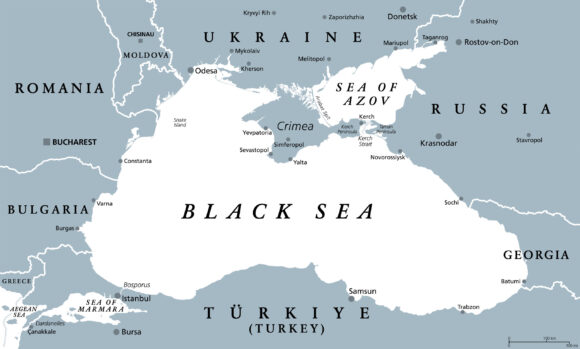
Russia on Tuesday accused Ukraine of terrorism over its escalating attacks on shipping in the Sea of Azov, a route that handles about a quarter of its grain exports.
Ukrainian drones hit 11 Russian vessels in the Sea of Azov overnight, Kyiv’s drone forces commander said.
In a statement on Telegram, Robert Brovdi said the targets included five tankers, five dry cargo vessels and a tugboat, bringing the total number of vessels struck in the past nine days to 116.
The report did not specify any attacks on grain ships. Industry sources, who spoke on condition of anonymity because of the sensitivity of the matter, told Reuters that several grain ships were hit on July 13 and July 14 and caught fire.
“They are standing there like targets before a firing squad. In a couple of days, there won’t be a single intact boat left in the Sea of Azov, only damaged ones,” one of the sources told Reuters.
“What the Ukrainian regime is doing goes beyond even piracy. Pirates, at least, plunder and keep the spoils for themselves,” Russian Foreign Minister Sergei Lavrov said.
“But here, it benefits neither them nor anyone else – the goal is simply to cause damage and intimidate. It is terrorism, pure and simple,” Lavrov said.
A Ukrainian military source told Reuters: “The Ukrainian Armed Forces strike only military targets or targets that contribute to strengthening Russia’s combat capability.
“Civilian cargoes are not among them. By talking about attacks on civilian vessels, Russia is looking for a pretext to justify its cynical strikes on Ukrainian civilian infrastructure.”
Russia has stepped up its strikes on Ukrainian Black Sea ports since the end of last year, and Ukrainian officials say ports in the Odesa region could see their monthly grain export capacity cut by as much as one-third.
Azov Shipping Restricted
Shipping in the Sea of Azov remained restricted on Tuesday, according to Reuters sources. It lies at the mouth of the Don River, which flows through Russia’s main southern grain-producing region, and handles mostly smaller, coastal ships.
A source told Reuters on Monday that commercial vessels were unable to enter or leave the Sea of Azov via the Kerch Strait or the Azov-Don channel connecting the sea with the Don River.
In recent months, Ukraine has carried out a series of attacks on Russian oil refineries, fuel depots, ports and other energy infrastructure, which have created fuel shortages across Russia and disrupted exports.
Neither the Agriculture Ministry nor the Transport Ministry confirmed that Sea of Azov traffic was restricted.
However, the Agriculture Ministry on Tuesday acknowledged that exports may get diverted to other routes.
Shipments May Be Redirected
“Given Russia’s significant capacity for transshipping agricultural cargo in various regions, supply logistics will be redirected if necessary,” the ministry said in a statement.
Grain exporters said that cargoes could be rerouted through deep-water grain terminals on the Black Sea or via Baltic Sea ports, although some of those have been attacked by Ukrainian drones.
Doing so would allow Russia to uphold its export obligations, the ministry said.
Russia will fully meet its grain export commitments to foreign partners despite the situation in the Sea of Azov, Russia’s Union of Grain Exporters and Producers said.
Russia has begun harvesting new crops in southern regions but the new grain is only starting to arrive in ports.
“The main goal of the work is to minimize the impact of temporary logistical difficulties on the sale of the new harvest by farmers,” said local authorities in Rostov, a leading grain–producing region.
(Reporting by Reuters; editing by Barbara Lewis, Louise Heavens and Jason Neely)
Topics Catastrophe Natural Disasters Russia
Was this article valuable?
Here are more articles you may enjoy.
 Reuters: DXC in Advanced Talks to Sell Insurance Software Unit for $2.4 Billion
  Storm Austen Will Be Stronger Than Forecast Along UK Coasts
  Diageo’s Toxic Spill Hits a Pristine River in Scottish Whisky Country
  Report: Auto Insurance Total Loss Frequency Climbs, More Drivers Pay Repairs

