

Six months after US-Israeli strikes disrupted Middle Eastern fossil fuel production and turned the Strait of Hormuz into a naval battleground, the world is getting a fuller picture of how the Iran war has reshaped the economics of energy.
A handful of new reports show how, by dramatically raising fossil-fuel prices, the conflict has also been pushing governments, companies and consumers towards renewable energy, with a clear set of winners and losers emerging.
Global fossil fuel importers have paid more than $330 billion in extra costs — an amount equal to Finland’s 2025 gross domestic product — since the war began on Feb. 28, according to data from the Centre for Research on Energy and Clean Air (CREA), a Helsinki-based nonprofit. Meanwhile, higher energy prices have been a boon to a handful of oil-and-gas producing countries outside the war zone.
Read more: Iran War Is ‘Supercharging’ Clean Energy Transition, UN Climate Chief Says
Economies that had moved to ditch fossil fuels prior to the war have withstood the crisis better, too. In China, for example, renewable energy projects added since 2020 allowed the country to avoid nearly $8 billion in fossil fuel imports between March and July, CREA estimated.
These transformations could eventually have an effect on the environment: Overall, global greenhouse gas emissions were relatively contained during the first half of the year, inching up just 0.2% compared with the same period a year earlier, according to an early analysis of emissions through mid-year 2026 by the nonprofit Climate Trace.
“Renewables continue to grow. That does seem like good news,” says Ting So, lead analyst for Climate Trace. But he added that the volatility of disruptions in the Strait of Hormuz makes it hard to predict long-term trends.
Winners: Clean Tech and Non-Gulf Fossil-Fuel Producers
China has emerged as a beneficiary of the realignment, leveraging its dominance in green technology manufacturing at a time when soaring oil and gas prices are boosting interest in solar panels, batteries and electric vehicles.
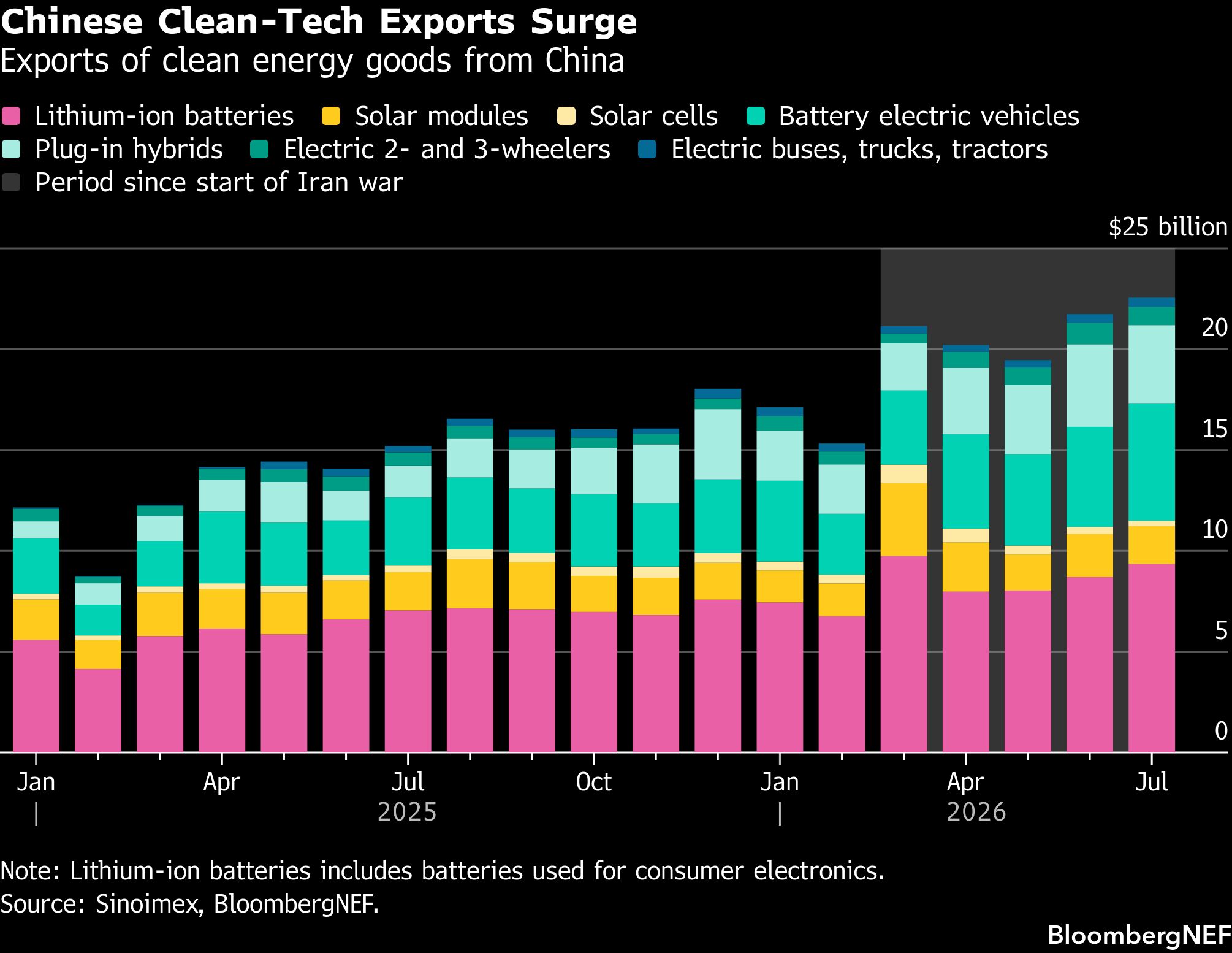
Since the start of the conflict, China has logged five consecutive months of record clean tech exports measured in dollar terms, according to BloombergNEF. In July, Chinese carmakers sold more than half a million EVs and plug-in hybrids to overseas markets, a roughly 150% increase from a year earlier.
Oil-and-gas producers in North and South America have also reaped windfall profits. As buyers shunned Gulf suppliers, fossil fuel companies in the US, Canada and Latin America ramped up production.
While a ceasefire could erode wartime supply premiums, researchers expect some of these market shifts to persist. “The boost to Latin America’s mining sector could remain,” said Rafael Rabioglio, a BNEF analyst, in the report. As high fuel costs accelerate global electrification, demand for critical minerals such as copper and lithium will benefit major producers including Chile and Peru in the long term.
Losers: Gulf States and Import-Dependent Regions
In the Persian Gulf, drone strikes and explosions have damaged key facilities, including Saudi Arabia’s largest oil refinery and a key liquefied natural gas export terminal in Qatar. Coupled with shipping bottlenecks, initial export losses across the Gulf averaged nearly $2 billion per day in March, according to an estimate from Rice University.
Beyond lost revenue, the war also damaged as much as $58 billion worth of energy infrastructure, which requires costly repairs, according to an April estimate by consulting firm Rystad Energy. The conflict also threatens to stall the region’s transition into a greener economy. “The war has driven up the cost of debt in the region, undermining clean power project economics in the near term,” BNEF analysts said in their report.
Import-dependent economies like Japan and South Korea, meanwhile, are suffering collateral damage. The two Asian nations, which depended on shipments through the Strait of Hormuz for most of their oil supplies prior to the Iran war, had no choice but to absorb higher fuel prices. In Africa, where many countries are net importers of refined oil products, the soaring prices have fueled a broader economic crisis. Ethiopia, for instance, recently experienced currency selloffs, forcing the country to draw down billions of dollars in its foreign exchange reserves to defend the weakening birr.
Accelerated Transition
The burden of higher energy prices has fallen disproportionately on developing economies. Poorer nations spent an additional 1% of their GDP absorbing the price shock, CREA found. That’s more than double the economic drag experienced by wealthier states.
As they seek to break up with fossil fuels, African nations are scrambling to add renewable energy. The region as a whole imported 37% more solar equipment from China in the first half of 2026 than in the same period last year, BNEF data showed. The current boom has spread across the entire continent, from South Africa to Nigeria and the Democratic Republic of Congo and Egypt.
“In countries where consumers are not being well shielded from higher fuel prices, they are moving very quickly to adjust their energy consumption pattern,” said Ethan Zindler, a BNEF analyst.
That same trend is also happening across developing Asia. For instance, in the Philippines — where initial fuel shortages prompted the government to mandate a four-day workweek to save on energy — demand for solar products has surged. In March, the country’s imports of Chinese solar equipment jumped 262% year-over-year.
EV adoption has accelerated, too. Monthly EV sales almost doubled in the Philippines and Indonesia in June and July compared to the same period in 2025, according to BNEF. In India, monthly passenger EV sales reached 30,000 units in those two months, up from fewer than 20,000 units last year.
In the first half of 2026, slight emissions reductions by China and the US, the world’s largest polluters, were balanced out by increases in India and Brazil, the Climate Trace analysis found.
At the same time, fears that this year’s energy-market disruptions would lead to a major near-term increase in coal-fired power did not become a reality, according to the results. Instead, over the first six months of the year, renewable energy actually expanded more quickly, So says.
“That’s a positive development that maybe not everyone thought” would happen, he says.
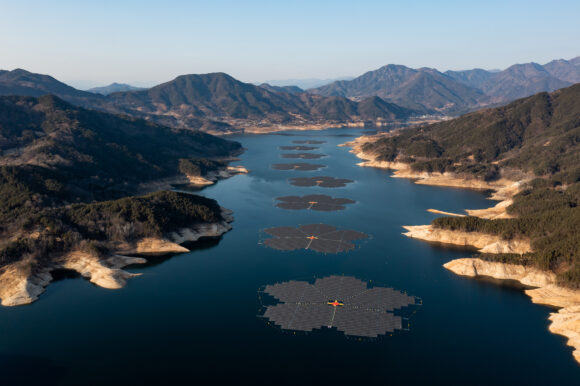
Photograph: Floating solar panels manufactured by Hanwha Solutions Corp. on the Hapcheon Dam in Hapcheon, Gyeongsangnam-do province, South Korea, on Tuesday, Feb. 8, 2022. More than 92,000 solar panels floating on the surface of a reservoir are able to generate 41 megawatts, enough to power 20,000 homes; photo credit: SeongJoon Cho/Bloomberg
Was this article valuable?
Here are more articles you may enjoy.
 Warren, Hawley Press Insurers Over Closed, Unpaid Claims
  Hackers Breached Propulsion System of US-Bound Oil Tanker
  Town Denied Insurance for $11M Judgment Over the Political Closing of Quarry
  AXA XL Launches Insurance Company, AXA XL E&S

