


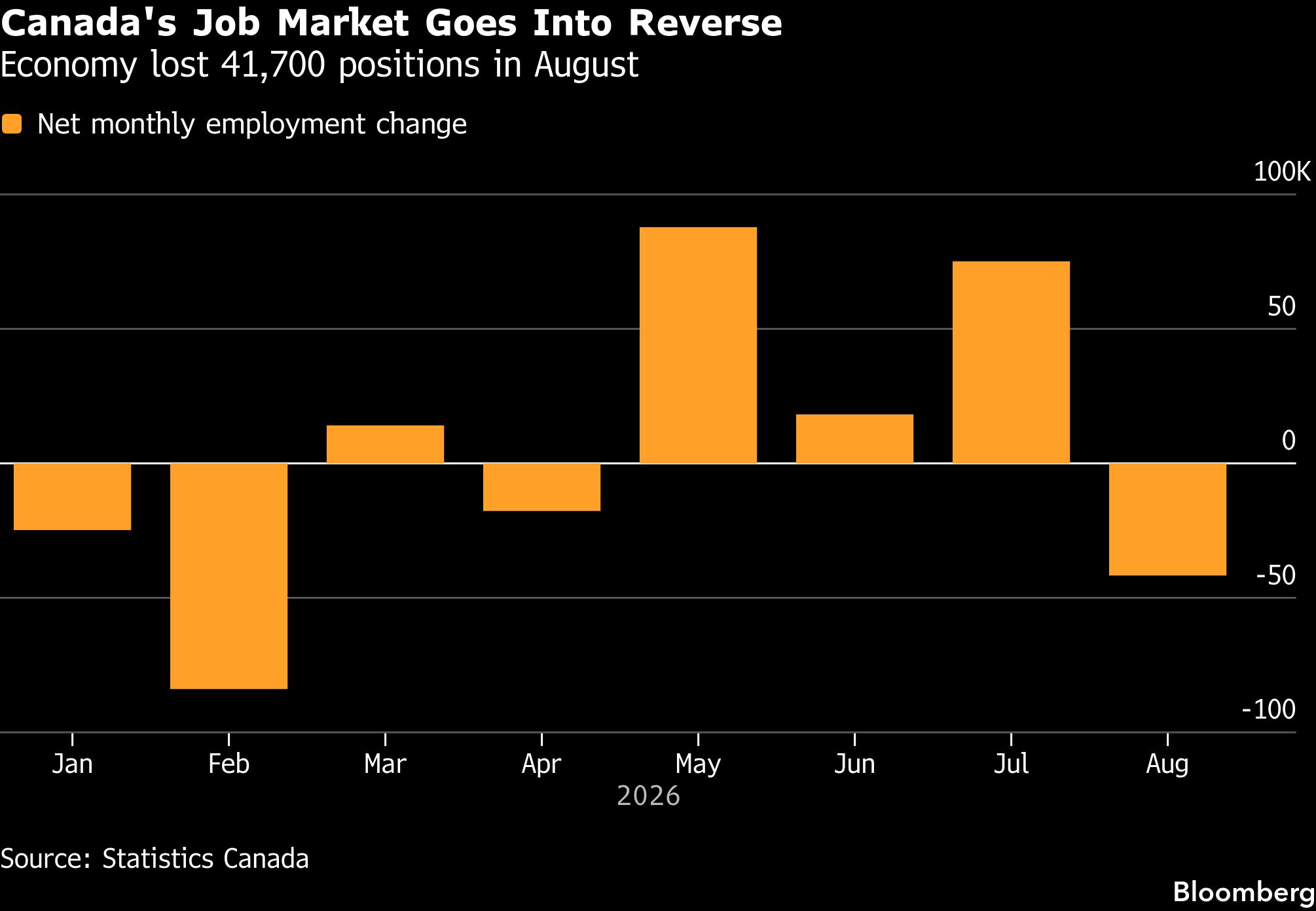
Employment in Canada fell by 41,700 in August, reversing some of the labor market momentum seen in recent months as the manufacturing sector posted the only significant increase.
The jobless rate held steady at 6.4% while job losses were concentrated in Ontario and Quebec, Statistics Canada reported on Friday [Sept. 4].
The finance, insurance and real estate category lost almost 10,000 jobs. Employment also declined in the retail, wholesale trade and hospitality industries. The number of public sector workers fell for a third straight month, declining by 20,000 in August and 78,000 since May.
Meanwhile, manufacturing jobs increased by 22,100, with most of that gain concentrated in Ontario.
Nationally, it was the first employment decline since April. “After a run of surprisingly hearty job results, it seemed Canada was almost due for a reality check,” Bank of Montreal Chief Economist Doug Porter said in a note to investors. The soft report is “far from a shock, and in part reflects the ongoing sag in the labor force population.”
Economists surveyed by Bloomberg expected total employment to increase by 15,000 and for the jobless rate to remain unchanged.
Two-year Canada bonds, which fell after the Bank of Canada governor made hawkish comments about inflation this week, rallied to trade at a yield of 3.076% as of 10:29 a.m. in Ottawa.
The Canadian dollar dropped sharply against the US dollar, which was buoyed by a strong employment report. US nonfarm payrolls increased 162,000 last month, topping all economists’ estimates.
“Today’s print seems to tally with other evidence (exports, monthly GDP) that the economy is slowing again,” Andrew Grantham, an economist with Canadian Imperial Bank of Commerce, wrote in a report to investors.
“With heightened uncertainty regarding US trade, we continue to think that the Bank of Canada will remain on hold even after policymakers expressed greater concern over the inflation outlook earlier this week,” he added.
While hiring stalled across most sectors last month, the longer-range trend shows the economy chugging along. Employment in August was up 217,000 from a year earlier, helped by the addition of about 181,000 jobs in the three-month period from May through July.
Canada’s unemployment rate had edged down to 6.4% in July, marking the lowest level in two years. The job market recovery is part of a broader economic rebound following a slump brought on by US tariffs and slower immigration. Real gross domestic product in the second quarter also increased at an annualized rate of 3.3%.
However, the escalation of the trade war is now bringing Canada’s economic recovery into question. The US imposed 50% tariffs on $20 billion of Canadian goods after negotiations failed on Aug. 21, and Canadian counter-duties on hundreds of US items are set to take effect next week.
Rate-Hike Talk ‘Premature’
Bank of Canada Governor Tiff Macklem said this week that while Canada entered the latest trade tensions on a better footing, “uncertainty about the sustainability of the rebound has increased.”
Although the broader economy is expected to withstand these latest levies, the pain from the tariffs is expected to be concentrated in some sectors, Macklem said.
“If the bank’s intention was to signal imminent rate hikes, these employment numbers clearly suggest the warning might have been premature,” said Dominique Lapointe, senior director of macro strategy at Manulife Investment Management. “The economic backdrop is still fragile.”
Friday’s report shows the layoff rate in industries dependent on US demand for exports averaged 0.9% in the 12 months to August, compared to 0.7% in other industries.
The unemployment rate also ticked up for core-aged men in August, rising to 6% from 5.8% as more men between 25 and 54 years old looked for work. Meanwhile, students returning to school this fall enjoyed a more favorable job market this summer, with their unemployment rate down on average 2 percentage points between May and August, compared to last year.
Average hourly wages for full-time permanent employees increased by 2% on an annual basis, down from a 3% pace the previous month and below economists’ estimate of 2.9%.
Photograph: A worker at a Manac semi-trailer manufacturing facility in Saint-Georges, Quebec, Canada, on Thursday, March 13, 2025; photo credit: Graham Hughes/Bloomberg
Related:
Was this article valuable?
Here are more articles you may enjoy.
 Europe’s Insurers Cut Coverage of Weather Losses, Report Says
  Business Interruption Claims Approach $1M Average, Says Allianz
  Supervisor’s Punching of Employees Enough for Tort Suit, NC Appeals Court Says
  Eastern States’ Grocers Shut Online Systems After Cyberattack

