

Banks under pressure from European regulators to manage extreme weather risks are bumping up against client data-privacy barriers that are complicating efforts to guard against losses.
In countries at the epicenter of Europe’s latest heat waves, banks are now privately voicing their frustrations. That’s as regulators declare their intention to step up scrutiny of the sector’s exposure to wildfires, droughts and floods, with credit risk and pricing models in particular focus.
To meet regulators’ demands, banks say they’d need access to more granular data on clients’ insurance coverage as well as data on the physical condition of properties insured. For now, though, such information is often off-limits due to both the EU’s General Data Protection Regulation and national laws. A representative from one major European lender, speaking on condition of anonymity, said that given the restrictions, they can’t accurately assess the loss risks they face.
Read more: Europe’s Credit Markets Shrug Off Climate Risks Despite Devastating Droughts
Tensions are set to mount as Europe, the world’s fastest-warming continent, faces unprecedented weather risks. The financial regulator in France, large parts of which were ravaged by deadly wildfires over the summer, says it expects banks to step up their management of such risks.
The “main area for improvement” that regulators want to see is for banks to better understand “the detailed geographic breakdown of their exposure,” said Jean Boissinot, director of risk and research at the French financial regulator, Autorite de Controle Prudentiel et de Resolution (ACPR).
That includes knowing “where the assets they finance are located, or where the assets are that underlie the loans taken out by a customer or a company,” he said in an interview. The losses banks face “depend heavily on assumptions regarding insurance coverage,” and “insurance is generally the first line of defense in managing these types of risks.”
However, client data-privacy rules are adding “a layer of complexity” to gathering the information, particularly when it comes to residential real estate, a paper published by the European Central Bank concluded earlier this year.
A spokesperson for insurance Europe, the umbrella association representing insurers across the region, declined to comment.
Blind SpotDirk Broeders, senior lead financial risk expert at the ECB, says the task is far from straightforward. That’s because such risks tend to be idiosyncratic in their nature, highly dependent on a specific geographic location, on the type of weather shocks in question, and on the condition of the property at risk.
“The assessment that you have to make there is quite complicated,” Broeders said in an interview.
The difficulty of the task is compounded by the considerable gap in risk time-horizons used by insurers and banks, a mismatch that the ECB says has the potential to create a “blind spot” in the industry.
Insurers can adjust prices — or even drop coverage — based on annual reviews of their clients. Lenders take insurance coverage into account at the point of issuing a loan, but then generally lock into maturities that can run as long as 30 years. The underlying physical risk, meanwhile, can develop in ways that no longer reflect the terms of the original bank loan.
“Insurance protection gaps could shift more wildfire risk toward bank credit,” says Grace Osborne, a sustainable finance analyst at Bloomberg Intelligence. “Unlike floods and droughts, wildfire property damage isn’t covered by state-backed natural-disaster compensation schemes in Spain or France.”
It’s “a very major challenge for banks,” says Adair Turner, the former head of Britain’s financial regulator who’s now the chair of insurer Chubb Europe and the co-chair of the Energy Transitions Commission.
Banks are “on the wrong side” of what has developed into an “asymmetry of duration,” he said in an interview. “The whole insurance industry works on one-year contracts,” whereas banks “are on the hook for more.” That’s particularly true for the residential mortgage space, he said.
For countries now racing to bolster their financial sectors against the extreme weather risks ahead, such issues require attention, Turner said. “Clearly this will be a big wake up call in France,” he said.
The risk of weather-related losses is growing. There’s no single, definitive estimate for the financial cost of Europe’s 2026 heat waves, but Triodos Bank estimated last month that they may end up reducing Europe’s GDP by 1%, or some €180 billion ($208 billion). According to Allianz SE, the June heat wave alone wiped 0.3 percentage point off the region’s economic output.
Tracking Client Risk
Osborne at BI says banks’ “long-dated property books could leave them exposed to rising wildfire risk if future hazards aren’t adequately priced at origination.”
Some banks are developing in-house models to identify their exposure. One major lender, speaking on condition of anonymity, said it’s now trying to establish the precise geo-location of private homes and factories as part of its risk management. The data generated then feeds into other internal processes, it said.
Deutsche Bank AG says it looks at climate-related physical risks when it assesses collateral before granting a home loan. The climate risk of a property’s location can ultimately affect the terms of the loan, the bank said.
Some banks have started setting aside provisions in anticipation of potential loan losses tied to weather shocks. UniCredit SpA said it’s added €100 million to provisions, specifically to shield it from climate-related risks. It’s also working with clients to reduce such exposures, requesting in some cases that corporate clients change their business strategy.
At Groupe BPCE, bankers are working “extensively” with small and medium-sized companies, according to Valérie Combes-Santonja, chief impact officer at France’s second-largest lender. Big corporates are generally better equipped to measure and prepare, while small firms’ prospects “are intrinsically linked to the fate of their territories,” she said.
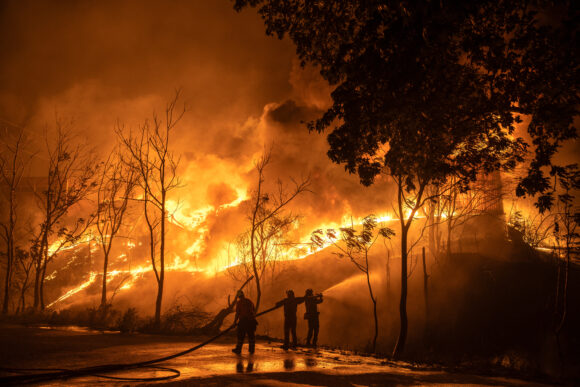
Photograph: Firefighters try to contain a fire at a warehouse facility during a wildfire near Oraiokastro, a suburb of Thessaloniki, Greece, on July. 4, 2026; photo credit: Konstantinos Tsakalidis/Bloomberg
Related:
- Climate Damage: The Next Hit to Europe’s Public Finances
- Heat Morphs Into a Major Economic Shock for an Unprepared Europe
- Banks’ Exposure to Heat-Related Losses Faces Scrutiny in EU
- Europe’s Climate Adaptation Efforts Have Lagged its Net-Zero Drive
Topics Europe
Was this article valuable?
Here are more articles you may enjoy.
 India Insurance Regulator Eyes 2027 Start for Commission Caps
  McDonald’s Hit With Class Action Alleging AI-Powered Menu Price-Fixing
  Alliant Insurance Acquires New Hampshire’s Melcher & Prescott
  AI Bubble Risks Worst S&P 500 Crash Since 2008, Strategist Says

