


French lenders will face heightened scrutiny over turmoil in the country when they present third-quarter earnings this week, with investors focused on their sovereign bond holdings and risks from a potential slowdown in the economy.
BNP Paribas SA, Societe Generale SA and Credit Agricole SA together hold about $60 billion in French sovereign debt, according to data compiled by Bloomberg Intelligence. While most analysts agree that the direct risk from that exposure is limited, rising yields, political instability and social unrest could impact the economy in their home market, where at least one large retailer already cut its outlook.
France has been shaken as months of political wrangling over how to tackle surging public debt spilled over into violent riots, six months before presidential elections. Business activity unexpectedly contracted in October and the country’s bond markets suffered a historic bout of turbulence last week, pushing the spread between French and German yields to the highest since 2011, when the euro-area debt crisis was at fever pitch.
“The potential period of political uncertainty is too long, and the choice of European banks that benefit from higher rates too numerous” for third-quarter results to provide much of an incentive to buy French bank stocks, UBS Group AG analysts including Jason Napier said in a note.
BNP Paribas is expected to report a 3.5% increase in third-quarter earnings when it reports results on Oct. 28, according to analysts polled by Bloomberg. SocGen’s net income, which reports a day later, and Credit Agricole, due on Oct. 30, are both expected to post a 9% gain in net income.
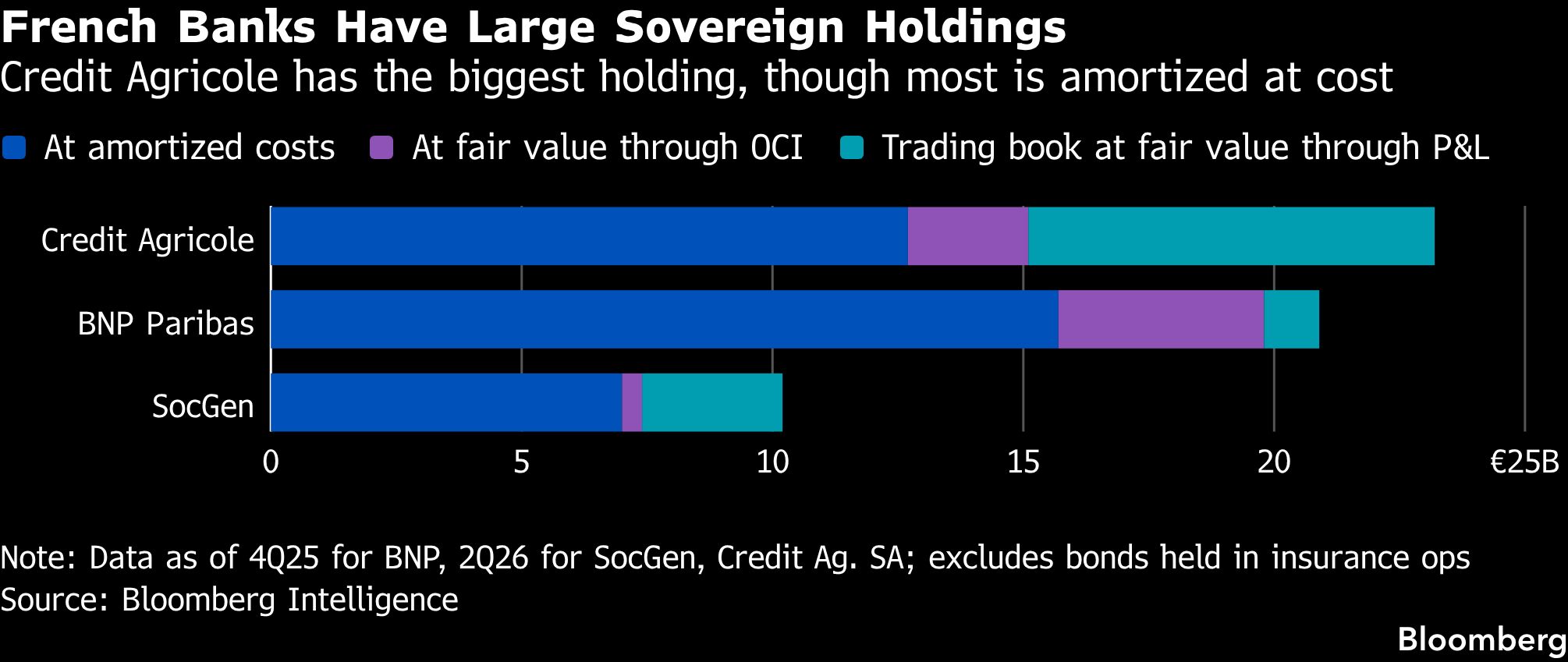
The three lenders hold about €54 billion ($60.5 billion) in French sovereign debt between them, according to data compiled by Bloomberg Intelligence. That rises to around €104 billion when including bonds held within insurance operations, though much of that additional risk lies with insurance policyholders rather than the firms themselves, Bloomberg Intelligence said.
Unlike banks in Italy or Spain, which were at the center of Europe’s sovereign debt crisis, French banks hold significantly less of their country’s debt, with international investors owning more than half. That means there’s no stability risks even as yields on government bonds surge, according to Emmanuelle Assouan, head of the country’s financial regulator ACPR.
That doesn’t mean bond swings don’t have an impact. Banks classify their bond holdings into categories based on whether they plan to hold them until they mature or potentially sell them, for example to manage liquidity or perform their role as market makers. Bonds that are available for sale or trading are typically marked to market, meaning large price movements during the reporting period can affect the bottom line or regulatory capital.
What Bloomberg Intelligence Says
Concerns about the largest French banks’ direct domestic sovereign-bond risk look excessive, even with the OAT-Bund spread at a 15-year high of about 155 bps amid worsening fiscal and political strain, given the protection offered by amortized-cost accounting and potential hedges.
— Philip Richards, senior industry analyst
The CET1 ratios for BNP Paribas, Societe Generale and Credit Agricole at the end of the second quarter were 13.0%, 13.2% and 11.3%, respectively. The reading was comfortably above the regulatory minimum in each case.
Political unrest and higher borrowing costs can also impact French banks in less immediate ways, including through lower loan demand if companies hold back on investments. In addition, the sense of gloom that has settled over France has put off investors more broadly and weighed on share prices across industries. Supermarket operator Carrefour SA slumped last week after warning that protests and looting will weigh on earnings this year.
Deutsche Bank AG Chief Executive Officer Christian Sewing said last week the fiscal and political instability in France was concerning, with volatility likely to continue until the presidential elections. Recent polling indicates the voting may come down to a second-round runoff between the far-right front-runner Marine Le Pen and far-left rival Jean-Luc Mélenchon.
“I wouldn’t call it a debt crisis at this point in time, but I think it’s a wake up call in particular for all public financing that budget disciplinary is key,” Sewing said in an interview.
Investors in the French banks will also look for third-quarter trading performance after many US rivals reported another jump in equities trading revenue while fixed-income trading dropped.
BNP Paribas CEO Jean-Laurent Bonnafe may drop more hints about his future strategy, which he intends to unveil early next year. He said on an earnings call earlier this year that “we clearly see a path towards a cost-income ratio of around 50% over the time.”
Read more: French Riots Seen as Insurance Test Before New Regime Kicks In
Shares of the three French banks are among the worst performers among European lenders since the end of June. Valuations of French insurers including AXA SA have also been hit in recent weeks by investor concern about the situation in the country.
AXA’s group exposure to French government bonds stood at €18 billion at the end of June, according to Jefferies analysts. That’s 11% of the total government bond exposure, analysts Philip Kett and Derald Goh said in a note. The insurer is seen as being more affected by the wave of protests in the country that resulted in a number of property losses, as well as by recent wildfires.
Topics France
Was this article valuable?
Here are more articles you may enjoy.
 Jury Awards $6.8 Million in Nursing Home Understaffing Class Action
 Oaktree’s Deal to Buy A-Cap Insurer Crumbles, Spawning New Talks
 Cyberattack Hits India’s Largest Bank, Exposes Customer Data
 AM Best: Social Inflation Drives Surge in Commercial Auto Liability Claims


