

President Donald Trump’s broad rollbacks of federal greenhouse gas rules since January 2025 have altered the trajectory of US energy use and helped set back cuts to planet-warming pollution by about a decade.
The latest turnabout came on Monday when the Environmental Protection Agency eliminated requirements that fossil fuel power plants install technical controls to curb their emissions. The move came alongside a proposal to permanently release the nation’s largest industrial source of greenhouse gas emissions from federal oversight.
That followed the axing in February of similar EPA climate standards for cars and trucks — another major source of US emissions — and the reversal of the legal underpinning for those rules known as the endangerment finding.
“We are not going to bend the law to climate alarmism or climate radicalism at all at the Trump EPA,” said EPA Administrator Lee Zeldin on Monday at the rollout for power plant rule repeal.
Each of these actions, which come just as data centers are sending US power demand surging, is set to boost emissions by a sizable chunk. For example, the EPA estimates the power plant repeal will result in an additional 533 million metric tons of carbon dioxide emissions by 2040, which is more than most countries’ annual carbon footprint. But it’s the collective effect of these and other administration moves that’s reshaping America’s emissions curve.
The world’s second-largest emitter after China may now see its contribution to climate change rise by roughly 1 gigaton more than it would have otherwise, in 2040, according to one analysis by Energy Innovation, a nonpartisan energy and policy think tank. That’s the emissions equivalent of the energy used by 134 million houses in a year.
Under this analysis, which attempts to take into account the rescinding of climate controls for current and future coal and gas power plants, US emissions will still drop by 2040, but only to the level they would have roughly been in 2030 had previous policies remained in place.
Under Biden’s policies, the US was on track to start dramatically cutting emissions in the next few years, said Robbie Orvis, Energy Innovation’s senior director of modeling and analysis. “The one positive note is we’re still on a downward decline even notwithstanding all of the policy changes — it’s just nowhere near as fast as it was nor is it anywhere close to where we should be going.”
Global warming is accelerating, many scientists now say. The United Nations reported earlier this month that the world’s stretch goal to limit warming below 1.5 degrees Celsius is all but lost. Every metric ton of CO2 contributes to the problem. The EPA said in a statement that power plants have no material impact on global climate change.
The situation could be less dire should US operators of coal and gas-fired plants decide to retire them early for economic reasons. Indeed, despite his efforts to boost coal power generation, Trump has been unable to reverse a long-term trend of plant shutdowns.
US coal consumption has been trending down for years as utilities shift to cheaper and cleaner sources of power. Usage gained last year, climbing 10% from 2024 after Trump took several steps to support coal power, including offering aid to modernize plants and forcing several facilities to remain in service beyond planned retirement dates. However, much of last year’s rebound was tied to high prices for natural gas and cold winter weather that boosted demand for power, and usage this year is expected to decline.
The pre-Trump path of steeper emissions cuts took decades to cobble together from an assortment of policies, from new fuel-economy standards to pre-existing air pollution laws. It solidified with the endangerment finding, EPA’s 2009 landmark scientific ruling that greenhouse gases posed a threat to human health and welfare that serves as the legal underpinning for federal climate rules, said Janet McCabe, who served as President Joe Biden’s deputy EPA administrator.
“The Obama administration and then the Biden administration were very methodical about looking at the biggest sources of greenhouse gas emissions,” said McCabe.
The Biden administration also looked beyond regulation to promote the adoption of clean energy, largely through the US Inflation Reduction Act, which put forward billions of dollars to boost solar panels, wind turbines and electric cars. The EPA and Congress, under Trump’s direction, have now dismantled practically all these measures.
America’s reversal on carbon-cutting policy under Trump comes as China, the world’s top emitter, starts to move in the opposite direction. The Asian economy’s emissions have now been flat or falling for more than two years, driven by a record-breaking renewable energy buildout, which is starting to eat into fossil fuel power generation. The war in Iran has only accelerated that trend, with China’s top refiner saying that oil consumption likely peaked last year, well ahead of the official target. The nation also recently pledged to take a greater role in international climate governance in the wake of Trump’s withdrawal of the US from the Paris Agreement.
If it stands, the Trump pullback on power plants will lock in years of fossil-fuel use, given the kind of investment and planning needed to add pollution controls, such as carbon-capture technology. The now-repealed mandates called for existing coal plants to effectively capture most of their emissions in the 2030s or close. Without that deadline, power companies can decide for themselves how long to run existing plants. Given growing power demand from both data centers and other industrial growth, there’s an incentive to keep them open for longer.
“Rescinding carbon capture and sequestration mandates removes a very expensive, technically uncertain obligation,” said Scott Segal, a Washington DC-based partner at Bracewell LLC, a global energy-focused law firm.
To be sure, government policy isn’t the only influence on the carbon footprint of powering America. The addition of renewable energy has continued at a slower pace despite Trump’s efforts to rein in wind and solar.
But the emissions-cutting rules were set to make a big difference. A separate analysis in September 2025 by Rhodium Group, a research firm, found that if the administration kept the Biden-era power plant, tailpipe and other rules, emissions in 2035 would fall between 7% to 25% more than expected under a repeal scenario.
The rule reversals are “another nail in the regulatory coffin for the clean transition,” said Ben King, a director in Rhodium Group’s energy and climate practice.
Reviving carbon-cutting rules will be tough, experts say, not only due to the political divide in Congress, but because in addition to removing nitty-gritty deadlines and carbon caps, the Trump administration is also attacking the legal basis that underpinned them. For example, the EPA is proposing to throw out a federal determination that greenhouse gases are a significant source of air pollution, which would mean the agency has no obligation to regulate climate pollution from power plants at all.
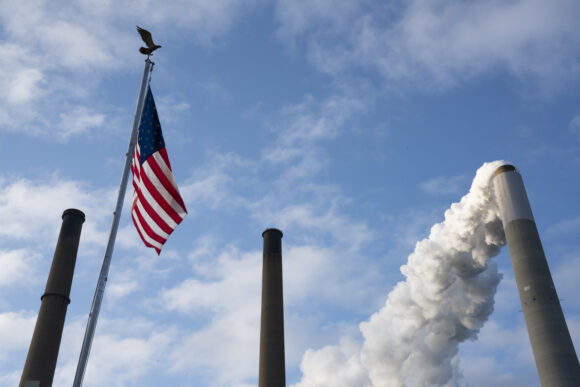
Photo: An American flag flies as emissions rise from a smoke stack at the Conesville Power Plant in Conesville, Ohio. Photographer: Dane Rhys/Bloomberg
Topics USA
Was this article valuable?
Here are more articles you may enjoy.
 Jury Awards $6.8 Million in Nursing Home Understaffing Class Action
  Fisherman Killed by 12-Foot Alligator at Central Florida Lake
  Storm Austen Will Be Stronger Than Forecast Along UK Coasts
  World’s Largest Retirement Community Set to Borrow $180 Million for More Homes

