

California’s wildfire and homeowners insurance crisis were the most read stories in Insurance Journal’s Western region this year.
It was a year that saw several major insurers draw back from writing homeowners policies in the state, prompting the state’s insurance regulator to alter California’s bedrock property/casualty insurance law and offer to fast-track rate hikes. In exchange, insurers agreed to write in riskier parts of the state and consider returning to offering coverage in the stricken state.
It makes sense that wildfire and affordability stories were among the most read in a year began with historic wildfires in Los Angeles, which cost numerous carriers billions of dollars. According to Swiss Re, the L.A. wildfires produced the costliest wildfire event globally with insured losses of $40 billion.
Following were the most popular stories in the region in 2025 (most but not all were on California wildfires):
Will California’s FAIR Plan Have Enough Cash for Its Wildfire Claims?
There was some question about whether California’s insurer of last resort – the FAIR Plan – had enough cash on hand to pay for its share of wildfire claims. As surplus is inadequate and reinsurance has a deductible that exceeds available cash, an industry assessment is inevitable, according to a Fitch analyst.
FAIR Plan doesn’t have enough surplus for this level of loss – the biggest California wildfire loss to date, Gerald Glombicki, senior director at Fitch Ratings, said in an interview with Insurance Journal’s L.S. Howard.
A moth later, the insurance commissioner approved the FAIR Plan request for a $1 billion assessment on admitted market insurers to cover claims from the Los Angeles wildfires.
The FAIR Plan reported it has paid more than $914 million to policyholders, including advance payments, to cover claims related to the Palisades and Eaton fires.
California Wildfires Will Likely Lead to Large Economic and Insured Losses
As the L.A. wildfires blazed in January, readers continued to flock to headlines reporting on the growing losses. Early on in the month, estimates were that more than 1,000 properties had burned, leading J.P. Morgan to estimate insured losses from the wildfires to approach $10 billion, and AccuWeather to deliver a preliminary estimate of more than $50 billion.
The number of properties destroyed topped early fears, and estimates continued to grow.
In the ensuing months, fire lawsuits spread, prompting many to call for sorely needed policy change. And a few of the victims of the wildfires have asked California Gov. Gavin Newsom to call for the resignation of the state’s insurance commissioner over reforms he pushed that were designed to help ease the state’s homeowners insurance crisis.
USAA Becomes 3rd Insurer to Report $1B-Plus in Claims So Far for LA Wildfires
By early February, USAA reported it had paid out more than $1 billion for the L.A. wildfires, making it the third insurer to report $1 billion or more in payouts for the destructive blazes that burned thousands of properties.
The company, among the state’s top homeowners insurers, announced at the time that 86% of wildfire claims have received initial payments to date. The San Antonio, Texas-based company then reported more than 3,500 claims received, and projected it will ultimately pay out $1.8 billion in losses from the wildfires.
Several big insurers continued to report losses in excess of $1 billion from the fires in ensuing months. Insured and total losses from the January wildfires continue to rise. A report out from at the time had indicated that L.A. wildfire losses could be as high as $164 billion.
California Insurance Commissioner Provisionally OKs State Farm’s 22% Rate Request
The fires were also followed by rate requests as the state’s insurance commissioner scrambled to offer quick rate hikes to get insurers to stay.
California Insurance Commissioner Ricardo Lara in March provisionally approved State Farm’s request for a 22% interim homeowners insurance rate hike. State Farm is the largest homeowners insurer in California.
In a statement, State Farm said, “It’s time for certainty in the California insurance market for our customers. The provisional nature of today’s decision does not improve that certainty but it’s a step in the right direction. We are moving forward with implementing this provisionally approved rate and will continue to work with the California Department of Insurance for a sustainable future for the California insurance market.”
The carrier wasn’t done asking for rate. And a report from a climate activist group says State Farm’s rate increases, if approved, would cost the average California homeowner more than $1,000.
State Farm upped its rate request in May, a week after getting the OK for a large rate hike to what the company had originally wanted before being rejected and agreeing to an interim deal for an increase. The wildfire-bitten insurer got approval for a 17% rate increase following billions of dollars in losses from the Los Angeles wildfires and pullback on writing new policies in the state.
Homeowners Suing USAA and AAA Insurers Over LA Wildfires
Some homeowners who lost their homes in the L.A. wildfires filed lawsuits in June against three large carriers over claims payouts they say didn’t cover their losses.
The lawsuits, filed in Los Angeles County Superior Court, say USAA and two AAA affiliated insurers underestimated the replacement cost of their homes and left them underinsured and without enough money to replace or rebuild their homes after the Jan. 7 wildfires.
The lawsuits allege fraud and negligence, and they seek unspecified damages.
Lawsuits against carriers and others over the wildfires have been piling up. A communications contractor for Los Angeles County was blamed in a lawsuit in November for 18 deaths in the Eaton Wildfire over its alleged failure to evacuate residents in the path of the inferno.
Genasys Inc. was accused of “digital redlining” for failing to send timely warnings to residents of a moderate-income, historically African American neighborhood in Altadena where the fatalities occurred during the wind-whipped blaze that started on Jan. 7, Bloomberg reported.
Washington Senate Passes Restitution, Credit Scoring Study Bills
Other news made it on the list of most read articles beside the wildfires in California.
In Washington, the state Senate in March passed three bills with insurance implications on, including a bill giving the insurance commissioner the authority to order restitution to harmed policyholders and a bill studying the impacts of insurance rating factors like credit scores.
Senate Bill 5331 would give the commissioner the authority to order restitution for harmed policyholders. The commissioner can fine insurance entities that violate the law but can’t order them to pay restitution to the people they’ve victimized.
The bill, sponsored by Senator Adrian Cortes (D-Battle Ground), also authorizes the commissioner to fine carriers up to $10,000 per violation, rather than issue a total fine of $10,000.
Senate Bill 5589 was introduced by Insurance Commissioner Patty Kuderer and sponsored by state Sen. Bob Hasegawa, D-Seattle.
Five Charged in Multi-Million-Dollar Insurance Fraud Case
Fraud is often a topic the intrigues Insurance Journal readers.
Five people were charged in April a large-scale insurance fraud scheme involving misrepresented life insurance policies that resulted in fraudulent commissions totaling over $1.4 million.
The five, which include a former insurance agent, reportedly fraudulently obtained more than $1.4 million in commissions by manipulating more than $2 million in insurance premiums from 28 consumers.
More recently, readers took at a story on four people who were convicted of felony insurance fraud and assault for faking an auto collision that involved a rideshare driver in San Bernardino, California.
According to the CDI, during the incident, the suspects reportedly ordered a rideshare, and as they were riding, one suspect drove his vehicle into the rideshare vehicle. The plan was to take advantage use the rideshare driver’s insurance and submit bodily injury claims to collect the insurance payout.
Tesla Slumps Below 50% Share of California’s Electric Car Market
Tesla lost some ground in California this year, where the sleek EV cars have become almost ubiquitous in recent years.
In a state that accounts for nearly a third of all zero-emission vehicle purchases in the U.S. The company’s share of EV sales in the state fell to 43.9% in the first quarter, from 55.5% a year ago, according to the California New Car Dealers Association. Tesla registrations dropped 15%, but sales of all other EVs increased 35% early this year, according to Bloomberg.
Tesla sales may have slumped, but readers still ate up news about the carmaker, with several articles on Tesla garnering large audience engagement.
A California regulator in December deferred an order for Tesla to suspend sales in California, giving the EV maker time to address an accusation of misleading marketing and overstating self-driving capabilities.
The Department of Motor Vehicles ordered the suspension of Tesla’s manufacturing and sales licenses for 30 days, adopting a judge’s proposals, but immediately put it on hold, Reuters reported.
Oregon OSHA Fines Manufacturer for Workplace Safety Violations
OSHA-related news is another big topic with the Insurance Journal audience.
In late December, an Oregon company was charged with intentionally keeping a faulty system in place for storing raw materials, exposing employees to struck-by and crushing hazards, according to the Oregon Occupational Safety and Health Division.
According to Oregon OSHA, Avalon International Aluminum, a maker of metal door and window framing, willfully violated a safety rule by refusing to follow the installation and maintenance requirements set by the manufacturer of its industrial storage racks.
As a result of the decision, hundreds of pounds of raw materials sat unanchored on cantilever storage racks, some with damaged or upside-down baseplates, rising as high as 18 feet. The situation left employees, who reached the raw materials by hand and forklift, exposed to potential bodily harm, according to Oregon OSHA.
California Man Wins $50M in Lawsuit Over Burns From Starbucks Tea
A delivery driver in March won $50 million in a lawsuit after being seriously burned when a Starbucks drink spilled in his lap at a California drive-through, according to the Associated Press.
A Los Angeles County jury found for Michael Garcia, who underwent skin grafts and other procedures on his genitals after a venti-sized tea drink spilled instants after he collected it on Feb. 8, 2020. He has suffered permanent and life-changing disfigurement, according to his attorneys.
The negligence suit blamed the injuries on Starbucks, saying that an employee didn’t wedge the scalding-hot tea firmly enough into a takeout tray.
Lawsuits over wildfires, ridesharing issues and of course Teslas were other popular related pieces. The family of one of three college students who died in a Cybertruck crash in California filed a lawsuit in a bid to gain access to the Tesla pickup and better understand how their daughter died. The driver and two passengers were killed while they were on Thanksgiving break in late November when the vehicle ran into a tree on a residential street and caught fire, Bloomberg reported.
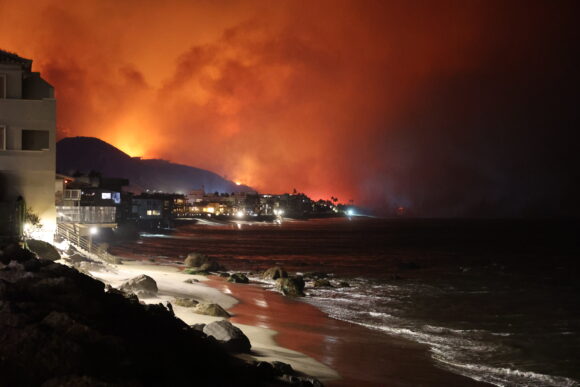
Top photo: The Pacific Palisades Fire. Source: CalFire.
Was this article valuable?
Here are more articles you may enjoy.
 Europe’s Insurers Cut Coverage of Weather Losses, Report Says
  Report: Auto Insurance Total Loss Frequency Climbs, More Drivers Pay Repairs
  World’s Largest Retirement Community Set to Borrow $180 Million for More Homes
  All in the Family: Husband, Wife and Daughter Indicted for Insurance Fraud and Bribery

