

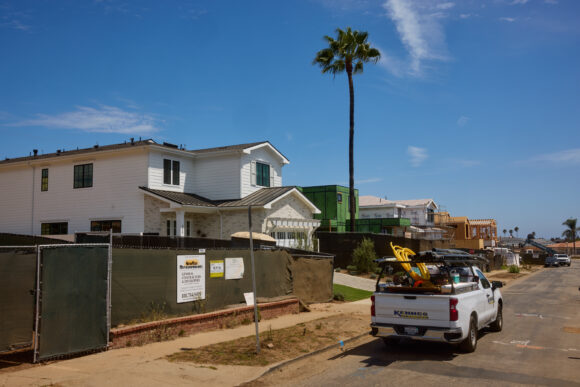
More than a year after wildfires devastated Pacific Palisades, a nonprofit is advancing a plan to tap the public debt market to create housing in the slow-to-recover Los Angeles wealthy enclave.
Uplifters Foundation plans to build new $3 million houses in the disaster area by issuing as much as $250 million in municipal bonds through the California Public Finance Authority. While many nonprofit groups sell tax-advantaged debt to finance traditional affordable housing, the company plans to build multi-million dollar homes for purchase.
“If it works, it becomes a model for other communities to pursue,” said Uplifters co-founder Steven Dietz, a former venture capital executive who also ran a firm that built accessory dwelling units.
Related: A $100 Million Mall Reopening Is a Sign of LA’s Uneven Fire Recovery
The Los Angeles City Council approved a second resolution Tuesday supporting the debt as a community benefit that lessens “the burdens of the government of the City of Los Angeles.”
“We need to be willing to look at creative solutions to a problem that conventional approaches aren’t solving,” said Traci Park, the city council member for the Palisades who sponsored motions to approve the bond issuance. “Even though it represents just 1% of the structures lost, it could offer a return for some families that cannot rebuild on their own. These lots may otherwise remain vacant for years.”
The proposed 60 new homes would restore revenue to the city from property taxes and encourage other owners to rebuild, according to the resolution.
The bond deal requires no financial commitment from the city or other tax-payer-backed agencies, a key consideration in disaster-ravaged areas where government help has been limited and unreliable.
Related: Edison Judge Balks at Holding Utility Liable for LA Wildfire
In January 2025, the Palisades and the Altadena community east of Los Angeles, were hit by simultaneous wildfires that combined killed 31 people and caused an estimated $40 billion in insured losses.
Rebuilding has progressed slowly in the Palisades where more than 5,000 homes were incinerated in January 2025, according to the city of Los Angeles. Construction permits have been issued for about one-third of the destroyed homes. Only 42 addresses have received certificates of occupancy as of Thursday.
Many displaced residents had owned their property for decades and lacked the insurance or financial means to rebuild. Others are daunted by the lengthy process of designing and constructing a house from scratch. A fear among residents and local leaders is that vast stretches of the Palisades will languish as weed-strewn, chain-link-fenced lots.
Vacant lots in the Palisades have been selling at a pace of one a day for an average of approximately $2 million, often to investors who plan to build multi-million dollar McMansions to replace the pre-fire cottages in the neighborhood, where the small town vibe earned it the nickname of “Mayberry by the Sea.”
‘Not for Every Household’
Uplifters is marketing its new homes as “attainable,” said Lee West, the firm’s president. He has been talking to homebuilders about a variety of house designs with three or four bedrooms and bathrooms each, averaging about 2,600 square feet. The size of the new houses is smaller than most of the post-fire construction underway in the Palisades.
While the cost will be less than the area’s nearly $4 million median home price before the wildfire, it will be far out of reach for many. A qualified buyer would need a household income of $747,200 for a $3 million home with a 20% down payment based on July’s average 30-year mortgage rate of 6.54%, according to the California Association of Realtors.
West acknowledged that “these are not government-subsidized affordable homes, and they will not work for every household.”
West and Dietz anticipate completing the bond marketing and closing process late this year with the first homes being move-in ready as soon as 2028.
The houses would initially be leased to residents with an option to buy. Terms of the sales would include price reductions for owners who stay at least three years.
“It is intended to encourage long-term residency and discourage short-term flipping,” Dietz said.
Top photo: New home construction lines Fiske Street in the heart of Pacific Palisades. Photographer: Maggie Shannon/Bloomberg.
Topics Louisiana
Was this article valuable?
Here are more articles you may enjoy.
 Social Engineering: The Analog Threat to Digital Defenses
  Former Trident Reciprocal CEO Ordered to Pay $468K in Attorney and Arbitrator Fees
  Chubb CEO Greenberg: Industry Has to ‘Put Arms Around’ AI Liability
  Yellow Furball Mascot Liberty Biberty Sparks ‘Beautiful’ Protest. Seriously?

