

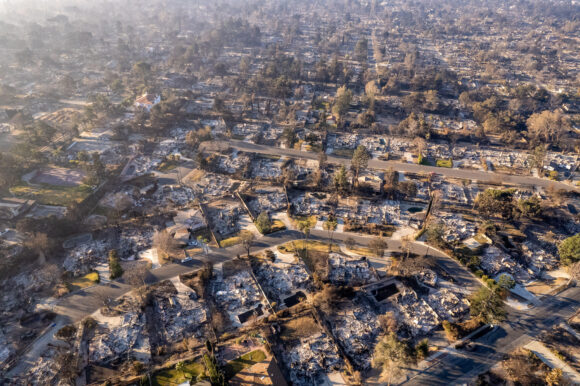
A judge ruled that Southern California Edison cannot escape a trial over a central claim in lawsuits over 2025’s Eaton Fire, the most destructive blaze in the Los Angeles area’s history.
Superior Court Judge Laura Seigle rejected a request by the Edison International unit to rule that property owners who suffered billions of dollars in losses in the January 2025 fire near Pasadena have no recourse under a California law that holds utilities automatically liable when their equipment starts a blaze.
Related: Edison Drops on Willful Misconduct Allegations in Eaton Fire Case
Seigle’s ruling means that Edison and fire victims’ lawyers will spar at an initial trial set for late January over so-called inverse condemnation, a state legal doctrine that can put utilities on the hook for all property damages from fires even if the company didn’t act negligently.
Attorneys for the insurance companies that have paid out damage claims previously tried to get the issue decided in their favor without a trial to recoup their payouts from Edison, but Seigle rejected their request.
David Eisenhauer, a spokesperson for SCE, said the utility disagrees with the court’s latest ruling.
“We will continue through the court process and encourage those directly impacted by the Eaton Fire to file claims through the Wildfire Recovery Compensation Program rather than pursuing lengthy and uncertain litigation,” Eisenhauer said in a statement.
Related: Southern California Edison Chief Warns Wildfire Impasse Risks Higher Customer Bills
A report by the Los Angeles County Fire Department in early August concluded the Eaton Fire was caused by electrical arcing events that took place on an out-of-service tower on a dry hillside. The fire killed 19 people, destroyed or damaged more than 9,000 homes and businesses and burned 14,000 acres.
Edison Chief Executive Officer Pedro Pizarro told investors in late July that “no other viable alternatives have appeared” aside from the company’s equipment that would explain how the wildfire erupted.
Lawyers suing Edison allege that a Jan. 7 power surge on a nearby, active line created a magnetic field that briefly reenergized the dormant cable, setting off the sparks that ignited the blaze.
SCE has argued in court filings that the transmission tower where the Eaton Fire allegedly ignited had been idle for so long, since 1971, that it no longer qualifies as the kind of public infrastructure that triggers California’s strict liability rule for utilities.
In her latest ruling, Seigle cast doubt on Edison’s attempts to shore up its arguments by citing past court cases.
Edison “did not cite any legal authority that a transmission line originally built to serve the public cannot be a public improvement because it was idle and not transmitting electricity at the time of the harm,” she wrote.
Top photo: Homes destroyed by the Eaton Fire in Altadena, California. Photographer: Kyle Grillot/Bloomberg.
Topics California Wildfire
Was this article valuable?
Here are more articles you may enjoy.
 Hacking Attempts Surge as Companies, Governments Rush to Patch PHP Flaws
 PG&E Weighs Gas Business Separation Over California Fire Rules
 Insurance M&A Down 27% in Q3 2026: OPTIS
 Yellow Furball Mascot Liberty Biberty Sparks ‘Beautiful’ Protest. Seriously?


