

The Washington Commanders football team has failed to block a workers’ compensation claim in Maryland by a former defensive tackle injured at the team’s training facility in Virginia just three days after he was signed by the team.
In 2024, the Maryland Workers’ Compensation Commission (MWCC) denied the claim filed by player Curtis Brooks for his ruptured left Achilles tendon, finding that he was not a covered employee under Maryland law and thus not entitled to workers’ compensation benefits.
However, the circuit court in Prince Georges county reversed the MWCC and concluded that Brooks was a covered employee. The Appellate Court for Maryland has now agreed with the circuit court and granted summary judgment in favor of Brooks.
According to the appeals court opinion, a professional football player who has not physically completed any of his job duties in Maryland may nevertheless be a covered employee because he expected to be “regularly employed” in Maryland as a professional football player.
In its ruling, the Appellate Court drew upon two Maryland Supreme Court rulings involving football players for the Washington team.
The Washington Commanders (officially named Pro-Football LLC) is a Maryland limited liability company that plays its home games in a stadium in Landover, Maryland and has a training field in Ashburn, Virginia.
(The team retired its Washington Redskins name in July 2020. It briefly played under the name Washington Football Team, before permanently changing the team’s name to the Washington Commanders in February 2022. The same Maryland corporation, Pro Football, Inc. — now Pro- Football, LLC — has owned and operated the team throughout.)
The Maryland Workers’ Compensation Act says that an individual is a covered employee while working for the employer in the state, or outside of the state on a “casual, incidental, or occasional basis” if the employer regularly employs the individual within the state. Under the law, an individual is not a covered employee while working in the state for an employer only intermittently or temporarily if the individual and employer make a contract of hire in another state; neither the individual nor the employer is a resident of the state; or the employer has provided workers’ compensation coverage under a law of another state to cover the individual.
The courts rejected the Commanders team’s arguments that Brooks’s employment in Maryland needed to be but was not “consistent and predictable” for him to qualify as a covered employee. The team noted that Brooks had only been employed for three days prior to his injury, had never played a game for the Commanders, and was not expected to be signed to the active roster for the 2023-2024 football season. The team maintained that the entirety of Brooks’s career with the Commanders was a “football tryout” in Virginia and his stint outside of Maryland was not employment on a “casual, incidental, or occasional basis.” Furthermore, the injury did not take place in Maryland.
The Appellate Court noted that Brooks signed the standard NFL Player Contract with the Commanders club on August 3, 2023, at the training facility in Ashburn, Virginia. The contract began on the date of execution and was to end on the last day of the league year in 2024, unless extended, terminated, or renewed. The contract required that the player “must report promptly for and participate fully in” the club’s official mandatory minicamps, official preseason training camp, all club meetings and practice sessions, and all preseason, regular season and postseason football games scheduled for or by club.
Brooks argued that at the time of his injury, he was under that NFL player contract and that the “express purpose” of his employment was to play professional football games in Maryland. Whether he had actually played a game in Maryland at the time of his injury did not affect the purpose of his employment. Furthermore, whether his performance for the Commanders took place entirely at practices in Virginia was incidental.
Citing the employment contract, the Appellate Court concluded “there is no doubt” that Brooks was a covered employee at the time of his injury and the pre-season activities at the training center in Virginia were part of his employment.
The appeals court found support for its position in two Maryland Supreme Court cases involving the team. One involved Thomas Tupa, a punter who signed a four-year contract and sustained a back injury during a pre-game warmup for a pre-season game at Fed-Ex Field in Maryland. After the MWCC approved Tupa’s claim, the Redskins fought it, arguing that Tupa was not a “covered employee” because he did not work regularly in Maryland but rather worked “primarily” in Virginia and only “intermittently” in Maryland since he only played 10 games per year in Maryland.
The high court upheld the MWCC, finding that Tupa was a covered employee, noting that despite the fact that Tupa likely spent more time at the practice facility in Virginia than playing in games at FedEx Field or elsewhere, the purpose of his employment was to play in professional football games in Maryland and at other stadiums around the country. Accordingly, the site of employment inquiry “requires more than simply tallying up the quantity of time the employee spends in each jurisdiction” and “because the purpose of Tupa’s employment was to play in games, not to practice,” all of the time he spent in Virginia “was geared towards improving his performance at the games.”
Even if Tupa’s employment in Maryland was only incidental, he could not be excluded from coverage under the Maryland Workers’ Compensation Act.
The Maryland Supreme Court again entered the workers’ compensation field with Pro-Football Inc. to consider whether wide receiver Darnerian McCants was covered. Over three football seasons, McCants filed workers’ compensation claims for six injuries sustained on four separate occasions. The injuries were allegedly sustained during a home game at FedEx Field in Maryland; an away game in Philadelphia; an away game in Buffalo; and at the club’s practice facilities in Virginia.
The MWCC dismissed all of McCants’s out-of-state claims for lack of jurisdiction and only considered the claim for the injury sustained at the home game in Maryland. The circuit court affirmed the MWCC’s dismissal of the out-of-state claims and McCants appealed.
The Maryland Supreme Court overruled, holding that McCants was a covered employee entitled to workers’ compensation and remanding the case to the MWCC to proceed with the out-of-state claims. Although McCants spent significant time in Virginia, this did not determine the issue because “practicing is incidental to the main purpose of the employment: to play in football games.” Accordingly, McCants “was regularly employed in Maryland because he had an ongoing relationship with his employer, a Maryland corporation, for the purpose of playing in football games, more of which took place in Maryland than in any other state.”
For similar reasons, the appeals court said that the Prince Georges court did not err in finding that Brooks was a “covered employee” in Maryland and remanded his case to the MWCC.
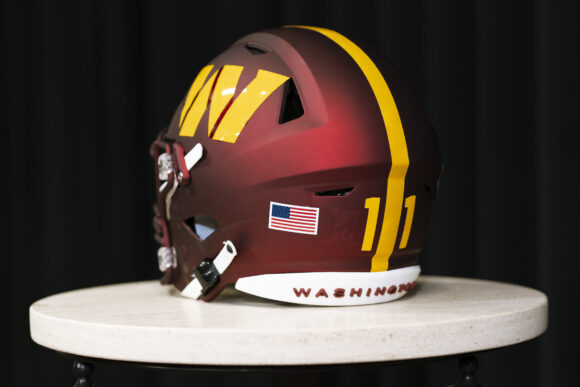
Photo: A Washington Commanders helmet is displayed at an NFL football news conference in Ashburn, Va., Thursday, March 17, 2022. (AP Photo/Manuel Balce Ceneta, File)
Was this article valuable?
Here are more articles you may enjoy.
 Fisherman Killed by 12-Foot Alligator at Central Florida Lake
  Insurer Rolls Out Policy to Protect Data Centers Against Growing Backlash
  How Federal Ban on Intoxicating Hemp Products Will Reshape Risk, Coverage
  World’s Largest Retirement Community Set to Borrow $180 Million for More Homes

