

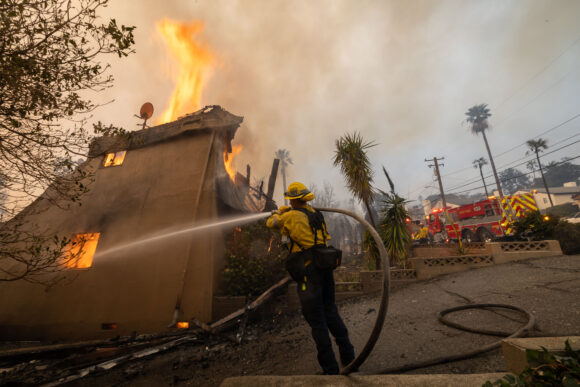
Alternative investment managers are starting to take a serious interest in catastrophe bonds tied to wildfires, moving into a risk category that just a few years ago was seen as too difficult to model.
More than $5 billion of cat bonds with some level of exposure to wildfire risk were issued by insurers and sold to investors this year, according to Artemis, a specialist in insurance-linked securities that tracks market trends. That’s more than twice the level in 2024, with previous years seeing just a smattering of individual bond sales in the tens of millions of dollars.
Though still small, wildfire bonds helped drive a record $23 billion bounce in overall 2025 cat bond issuance, Artemis says, putting the total market on track to end the year at around $60 billion. Acrisure Re, a reinsurance broker, says the shift in bond investor sentiment toward wildfire risk follows improvements in modeling, which it says have encouraged fund managers to move into a “once untouchable” risk category.
Read more: Catastrophe Bonds’ Huge Market Gains Put Reinsurers on Backfoot
Dirk Schmelzer, senior fund manager at Plenum Investments AG, says the development may point to a more fundamental shift in how some catastrophe bonds get structured in the years ahead, with the ferocity of wildfires leaving the insurance industry ever more reliant on capital markets.
“Historically, wildfire exposure was included within a mix of earthquake and hurricane risk,” Schmelzer said. “Now it’s become such a big peril in the market, it’s worth placing that risk on a standalone basis.”
Interest in wildfire cat bonds has been fueled in large part by developments in California, where severe back-to-back fire seasons have made reinsurance against such blazes prohibitively expensive. The flames that swept through Los Angeles in January destroyed more than 16,000 buildings and caused a record $40 billion in insured losses.
The LA fires were a major reason global insured losses from natural disasters soared past $100 billion in 2025, marking the sixth consecutive year in which that threshold has been exceeded.
Hardly any of those losses affected cat bond investors, however, with Fitch Ratings’ initial estimate indicating the setback they absorbed was less than $250 million in total.
But as climate-fueled urban fires become a more regular occurrence, insurers and utilities are increasingly looking for ways to offload their risk to capital markets.
Notable examples include a debut wildfire cat bond issued by the California FAIR Plan Association, the state’s insurer of last resort. The bond, which priced this month, is set to raise $750 million in wildfire cover, triple the initial target, according to a person familiar with the deal who asked not to be identified discussing confidential information. It’s the largest pure wildfire cat bond ever brought to market, the person said.
Other wildfire-prone regions are also weighing the use of cat bonds. Colorado lawmakers have put forward legislation that would open the door to using such financial instruments to manage growing wildfire risks in the state.
In Europe, where the fire season is also expanding, the European Central Bank and the region’s insurance authority have backed using cat bonds to complement insurance facilities and provide “prompt liquidity” for reconstruction after disasters.
The ability to structure financial products around wildfire risk is improving thanks to upgrades to models produced by firms including Moody’s Corp., Verisk Analytics Inc. and Karen Clark & Co. Artificial intelligence is also helping modelers crunch data to come up with more reliable loss estimates.
“For cat bonds, it translates to more informed pricing and broader investor participation, which we have clearly observed in the surge of 2024-2025 wildfire-exposed deals,” Acrisure Re said.
For now, though, risk premiums on wildfire cat bonds are considerably higher than those on more traditional bonds based on risks such as hurricanes. In 2025, wildfire cat bonds priced at six to eight times the estimated loss probability, compared with a multiple range of two to four for bonds targeting better understood risk categories such as wind storms in the US, according to Acrisure Re.
The models being used “remain less mature and less empirically calibrated than those for major wind or quake events,” according to Dirk Lohmann, vice chairman of ILS at Schroders. This holds “particularly true” for wildfire risk, he said.
The Broader Market
More broadly, cat bonds are expected to see tighter spreads in 2026, which partly reflects the fact that investors didn’t suffer any major losses. Hurricane Melissa, which ripped through Jamaica and triggered the island’s $150 million cat bond, missed the US and left the main market unaffected.
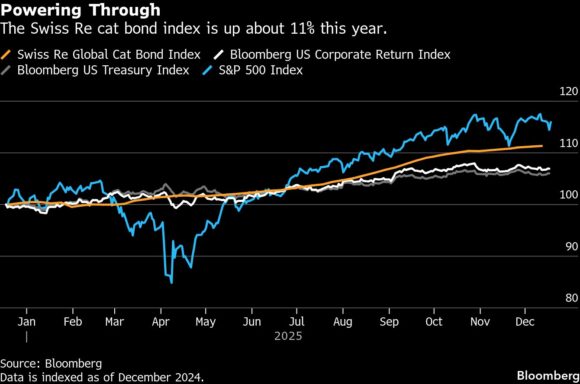
The Swiss Re Global Cat Bond Performance Index is up roughly 11% in 2025, compared with about 7% in a Bloomberg index tracking US corporate bonds, and 6% in US Treasuries. The S&P 500 Index is up about 15% this year. Continued demand for cat bonds also rests in their ability to act as a diversifier in portfolios. When markets tanked in response to tariff announcements in April, for example, cat bonds sailed through unscathed.
Primary issuance in 2026 is expected to be “heavy,” as lower spreads reduce the cost of issuance, according to Twelve Securis, an asset manager focused on insurance-linked securities and cat bonds.
The reinsurance market is also expected to push additional risks and so-called secondary perils into the capital markets, says Etienne Schwartz, chief investment officer of liquid strategies at Twelve Securis.
“Whether we like it or not is a different question,” he said. “But that is the trend for 2026.”
This year also saw the launch of the world’s first cat bond exchange-traded fund. The Brookmont Catastrophic Bond ETF (ticker ILS), which failed to get a lead market maker when it went public in April, has since started drawing in client money. Assets in the ETF have risen to about $30 million, according to Bloomberg data, exceeding the break-even mark of $25 million.
“I think by the end of the first quarter we should comfortably be at $50 million,” said Ethan Powell, chief investment officer of Texas-based Brookmont.
And King Ridge Capital Advisors is now planning to launch a cat bond ETF in Europe. According to Rick Pagnani, co-founder and chief executive officer of King Ridge, it’s an “opportune time to pursue a European ETF.”
Photograph: A firefighter hoses down a burning house during the Eaton Fire in Altadena, California on Jan. 8, 2025. Photo credit: Michael Nigro/Bloomberg
Related:
- LA Fires and US Severe Convective Storms Drive Insured Losses of $107B in 2025
- Europe’s Farm Sector Loses €28 Billion a Year From Climate Risks
- Hedge Fund Fermat Sees 20% Surge in Catastrophe Bond Market
- European Central Bank Pitches Plan to Boost Insurance Coverage for Climate Losses
Topics Catastrophe Natural Disasters Wildfire
Was this article valuable?
Here are more articles you may enjoy.
 ‘Unusual’ Isaias Brings Winds, Downed Trees But Fewer Claims Than Expected
  Reuters: DXC in Advanced Talks to Sell Insurance Software Unit for $2.4 Billion
  How Federal Ban on Intoxicating Hemp Products Will Reshape Risk, Coverage
  Fisherman Killed by 12-Foot Alligator at Central Florida Lake

