

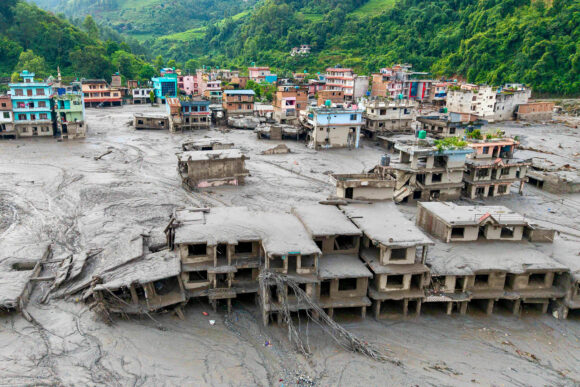
Scientists are pointing to a glacier collapse and rock landslide as the cause of a devastating flash flood that killed at least 350 people and left many more missing near Nepal’s border with China, a mountainous region that’s increasingly imperiled by the effects of man-made climate change.
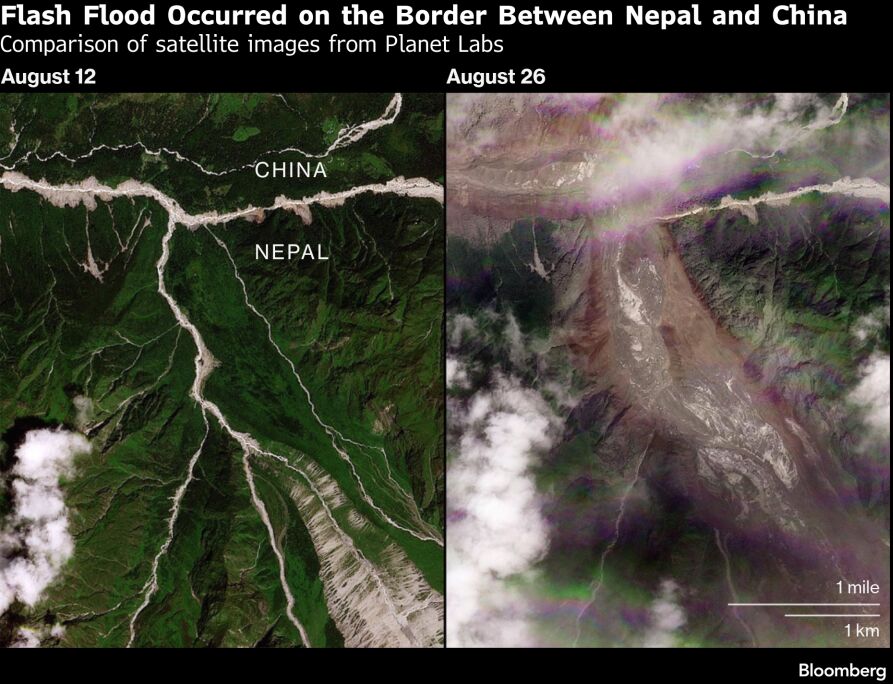
Initial assessments based on seismic and satellite data, as well as videos of the event, indicate that a very large section of a glacier detached and collapsed after the bedrock below it gave way. That in turn caused seismic waves equivalent to a 5.2 magnitude earthquake, according to the US Geological Survey. Ice from the glacier and rockfall may then have blocked the Lhende Khola river, causing water to quickly accumulate and ultimately surge downstream.
“What we’ve certainly confirmed — there was a large ice avalanche, probably a mixture of ice and rock, which detached and then became fluid and then transformed into this devastating flood,” said Simon Allen, a research associate at the University of Zurich who studies glacial hazards in the Himalayas. Allen said Thursday that early analysis of satellite images and field photos indicates the bedrock beneath the glacier failed.
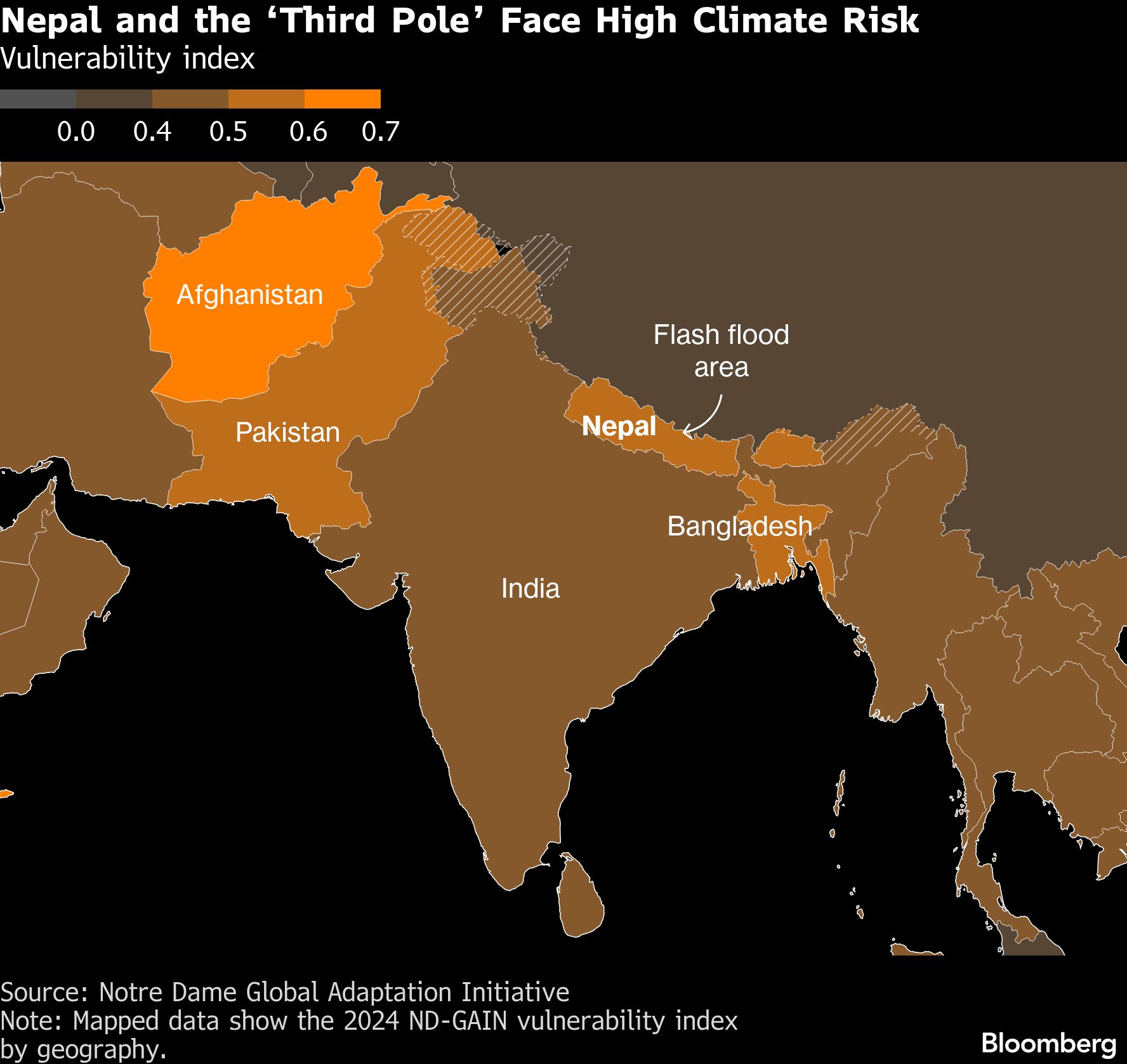
Nepal is particularly vulnerable to flash floods because of its mountainous terrain and rapidly melting glaciers. Such events are becoming more frequent as global warming accelerates the ongoing thaw in the Himalayas, an area that holds more snow and ice than any place on Earth besides the Arctic and Antarctica. The development has a cascading effect — from mudslides to water scarcity — for the nearly 2 billion people living downstream from Himalayan-fed rivers, according to the United Nations.
Himalayan glaciers melted 65% faster between 2010 and 2020 than during the previous decade, the UN said, while the risk of glacial lake-related flooding across the broader Hindu Kush Himalaya region is expected to roughly triple by the end of the century.
“When you put together all the physical understanding that the glaciers are retreating, permafrost is thawing, it certainly adds up,” said the University of Zurich’s Allen. Experts are concluding “that we are seeing and we are expecting these events to become more frequent,” he said.
While a definitive cause of the Aug. 26 floods has yet to be established, analysis so far indicates the snout of a glacier at an elevation of roughly 5,200 meters broke away and began to make a steep descent to the valley floor, melting ice and gathering sediment as it did so, said Dan Shugar, a geomorphologist and an associate professor at the University of Calgary. The mountains have been shrouded in clouds, meaning the precise chain of events is likely to be better understood once satellites can do a clearer examination.
“When you have a lot of rock falling a great distance it generates a lot of heat and that can melt a lot of ice, so that could explain part of the water that we see in the absolutely horrific videos,” Shugar said.
“At the moment we’ve got the hydrology data, have some seismology data, we’ve got some remote sensing data, we have the videos,” he said. “We don’t yet have eye-witness accounts from right in the valley, or a helicopter flyover of the source area.”
Separately, scientists at the Nepal-based International Centre for Integrated Mountain Development are working to confirm a preliminary assessment that a large volume of ice and rock debris entered the Lhende Khola, a tributary of the Bhote Koshi River, causing an event that triggered an abrupt surge of water, sediment and boulders downstream. The same area was impacted last July by a major flood, according to the center.
“It operated like an inland tsunami, traveling nearly 170 kilometers (106 miles),” and impacting a major highway, said Ruth Gamble, director of La Trobe Asia and lead author of Rivers of the Asian Highlands: from Deep-Time to the Climate Crisis. “It is a popular route for international tourists travelling from Kathmandu to Lhasa.”
The high-altitude region is warming nearly twice as fast as the global average, with higher temperatures leading to a rapid glacial retreat. Glaciers across the globe have been shrinking every year for more than three decades, according to the World Glacier Monitoring Service. The recent acceleration in ice loss leaves no doubt that global warming caused by man-made emissions of greenhouse gases into the atmosphere is a leading cause, according to the UN-backed research group.
As the Nepal disaster struck, many experts in the field were convening in Chengdu, China, for an annual summit to discuss how to mitigate these very risks.
Wednesday’s incident follows a pattern of similar events which have hit the Himalayan region in recent years, including a landslide that triggered a flood in Chamoli, India, in 2021, which left about 200 people dead or missing. While records in the region don’t extend back long enough to say with statistical certainty whether ice avalanches like the one that occurred on Wednesday are becoming more frequent, researchers say that’s the pattern they are observing.
“The increasing frequency of cryosphere hazards is now visible more than ever,” said Mohd. Farooq Azam, a senior cryosphere specialist at the ICIMOD. “The pace is so fast that our ongoing efforts are not able to cope with this rapid change.” Regional governments should “take some joint, consolidated steps to react to such cross-border hazards,” he said.
Communities have been evacuated ahead of the collapse of other glaciers, including the major slide that buried the Swiss village of Blatten, in recent years.
“The Himalayan Region has had a history of deadly flash floods. The event appears to have occurred without warning, catching those downstream unaware,” said Andrew Gissing, chief executive officer of Natural Hazards Research Australia. “Early warning saves lives, and there are efforts globally to improve early warning systems.”
Such evacuations could have spared lives on Wednesday had the right equipment and communications been in place, according to Allen.
“This is looking like it will be the biggest Himalayan disaster that we’ve seen,” Allen said. “So I really hope this will be a turning point — that there will be more focus, more emphasis now on reducing the risks for these communities.”
Photograph: Flash floods inundated villages and swept away buildings and people in Nepal; photo credit: Prabin Ranabhat/AFP/Getty Images
Related:
Topics Flood Climate Change
Was this article valuable?
Here are more articles you may enjoy.
 Gronkowski Now Pitchman for eMaxx, a Reciprocal With a Different Playbook
  Large Commercial Property Rates Drop 14.5% in Q2 to Highlight Latest Willis Report
  Hackers Breached Propulsion System of US-Bound Oil Tanker
  Agency Network SIAA Acquires MGA Canopy Specialty Insurance

