

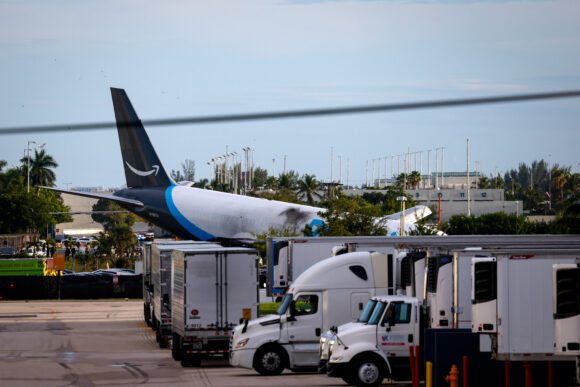
When the cargo plane came to rest 1,300 feet past the end of the runway at Miami International Airport, its nose sat flush with the ground, the tail — and the billboard-sized Amazon.com Inc. smile painted on it — jutting awkwardly into the air as an engine smoldered.
Like the logos emblazoned on thousands of blue Amazon delivery vans ferrying packages around the US, the plane smile was something of a contrivance — a branding opportunity. The e-commerce giant doesn’t own the plane or employ the pilots who fly it. The jet was operated by 21 Air, a North Carolina-based cargo carrier that flies eight aircraft for Amazon.
Federal regulators typically examine who had “operational control” of the aircraft that crashed, which usually comes down to the cargo carrier, said Steven Marks, an aviation attorney with the Miami-based firm Podhurst Orseck, who has handled thousands of claims.
Most air crashes are complex events typically caused by multiple contributing factors rather than a single isolated failure. On Tuesday, US National Transportation Safety Board said the Boeing 767 increased thrust seconds before overshooting the runway, a maneuver pilots typically use to abort a landing and reposition the aircraft for another attempt. The agency said it planned to interview the two pilots.
If 21 Air is found liable, the company should have adequate insurance coverage, and most claims in these instances are settled privately between insurance carriers and plaintiffs, Marks said. “Only time will tell if there’s a manufacturing or maintenance component to it,” he said.
Amazon’s arms-length relationship with 21 Air is a familiar playbook for the company, which has outsourced swathes of its logistics operation to independent companies, including the mom and pops who operate most of those blue delivery vans. Contracting out the work helps Amazon get packages to customers quickly while offloading much of the liability of operating trucks and aircraft to someone else.
Other major cargo carriers sometimes rely on contractors. Though FedEx Corp. and United Parcel Service Inc., the largest global cargo airlines, operate their mainline fleets themselves, FedEx uses contract carriers for smaller routes. DHL runs its network with a mix of its own fleet and planes flown by partners.
Amazon and 21 Air both offered condolences to the families and loved ones affected by the accident and pledged to cooperate with the investigation. “We’ll also continue to coordinate with 21 Air, which operated the flight,” Amazon spokesperson Kelly Nantel said in a statement.
The Miami incident occurred on Sunday after a flight from Puerto Rico. The plane cut through a road just outside the airfield perimeter, killing five employees of an aircraft cleaning company who had been driving in a Ford Econoline van, federal investigators said.
The flight was one of at least 208 flown that day on behalf Amazon Air, by a total of eight contracting companies, according to data from Flightradar24. About a third of those flights were to or from the company’s major hub in Cincinnati and nearby Wilmington, Ohio.
Amazon Air, often branded as Prime Air, got its start in the mid 2010s, when the company decided to build its own operation to move packages rather than hand them off for delivery. Executives believed carriers like UPS or FedEx wouldn’t be able to digest Amazon’s growth without passing on big cost increases.
So the company laid the groundwork for an enormous last-mile delivery operation, contracting with local delivery firms to take packages from warehouses to shoppers. It eventually began equipping those contractors with Amazon-branded vans, and their employees with Amazon vests.
Though the company often gives drivers turn-by-turn direction to delivery stops, the legal separation between Amazon and what it calls Delivery Service Partners can shield Amazon from claims from drivers about pay or treatment, or from people injured in collisions with the ubiquitous blue vans.
Amazon also started routing packages by plane from a little-used former air cargo hub in southern Ohio. The company went public with the effort in 2016, flying a converted former 767 passenger aircraft newly painted with a Prime Air logo in Seattle’s Seafair festival, an annual air show that also features the Blue Angels. That same aircraft — called Amazon One and registered as N1997A, for the year of the company’s initial public offering — crashed in Miami on Sunday.
Amazon went on to lease and buy dozens of planes, built its own airport cargo-handling infrastructure at hubs in Cincinnati and San Bernardino, California, and tested routes in Europe and India. That growth petered out with the end of the pandemic-era surge in online shopping and as Amazon built more warehouses closer to shoppers, according to Joseph Schwieterman, a researcher with DePaul University who has tracked the development of Amazon’s fleet. Data from Planespotters show the company has 103 aircraft, with nine in storage or undergoing maintenance.
The Miami incident was potentially a blow to Amazon’s image, but finding the company liable for the crash would require determining that it had operational control of the aircraft. That’s a very difficult legal threshold, according to Mary Schiavo, head of the aviation practice at Motley Rice, a law firm based in Mount Pleasant, South Carolina.
In 2019, an Amazon Air freighter operated by Atlas Air crashed near Houston, killing the two-member crew and another pilot hitching a ride. The NTSB ultimately blamed pilot error for the incident.
“Prime was emblazoned on the plane,” said Schiavo, whose firm represented survivors of the pilot passenger. “But Atlas Air was to blame.”
Photo: Photographer: Eva Marie Uzcategui/Bloomberg
Was this article valuable?
Here are more articles you may enjoy.
 AI’s Water Strain Includes Surging Demand From Electricity Use
  Europe’s Insurers Cut Coverage of Weather Losses, Report Says
  Broad AI Exclusions in Insurance Policies Could Create Uncertainty, Marsh CEO Says
  Reuters: DXC in Advanced Talks to Sell Insurance Software Unit for $2.4 Billion

