


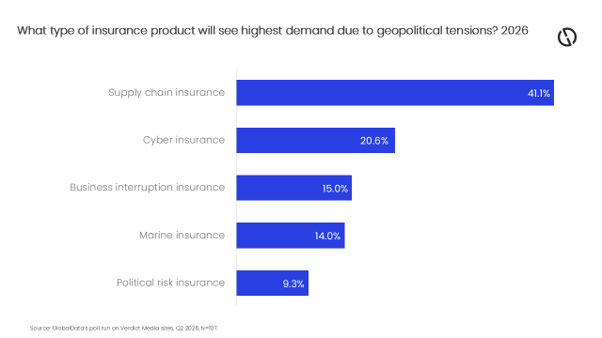
Supply chain insurance is seen by businesses as must-have protection during periods of geopolitical tensions — in order to safeguard their daily commercial operations, according to GlobalData, the London-based data and analytics company.
Supply chain insurance was the product identified by 41.1% of respondents as seeing the highest demand in times of geopolitical tensions, with cyber insurance as the second most sought-after product at 20.6%, revealed a GlobalData-sponsored survey.
“Organizations are deeply concerned about business continuity amid the cascading risks linked to a highly volatile geopolitical landscape,” commented Beatriz Benito, Iead insurance analyst, GlobalData, in a statement.
Read more: Japan Earthquake Halts Auto and Chip Plants, Testing Supply Chain Resilience
“In contrast, demand for specialist transport and direct asset protection is lower. This highlights that organizations are deeply concerned about trade route blockages, state-sponsored cyberattacks, and collateral revenue losses that can have a cascading effect on operations, threatening day-to-day business continuity,” Benito added.
Ongoing conflicts in the Middle East and Eastern Europe are creating specific trade bottlenecks such as those in the Suez Canal and Strait of Hormuz, leading to widespread shipping reroutes, while alternative maritime corridors are emerging, said GlobalData.
Meanwhile, the U.S. shift toward economic nationalism—marked by sudden tariff hikes, export restrictions, and sanctions—is pressuring international trade supply networks, the report continued.
“Insurers struggle to adapt to the rapidly changing risk landscape, compromising product availability. Although demand exists, insurance capacity is paradoxically constrained as many insurers pull products from the market, fearing the risks are unquantifiable,” Benito said.
“Only insurers with the most risk appetite are willing to adapt their underwriting strategies and product offerings,” he added. “This requires providers to tighten policy wordings and exclusions around tariffs and sanctions, as well as to stress-test products to avoid catastrophic losses from a single event. In addition, real-time geospatial tracking is gradually gaining traction as a way to assess risks accurately and improve underwriting.”
GlobalData said its poll was run on Verdict Media sites during the second quarter of 2026, in Q2 2026, garnering 107 responses from industry practitioners.
Source: GlobalData Plc
Related:
- War Overtakes Civil Unrest as Top Political Violence Exposure for Global Businesses
- Iran War Could Raise Exposures for Global Terrorism, Political Violence Underwriters
- Supply-Chain Stress That Peaked in COVID Heads Higher Again
- Iran War Could Raise Exposures for Global Terrorism, Political Violence Underwriters
- Tariffs Stoke Supply Chain Worries for US Businesses, Gallagher Survey Shows
- Key Emerging Risks: Cascading Effects of Natural Disasters, Supply Chain Resilience
- Real-Time Tech: Supply Chain Analysis Tools
- Taming Global Supply Chain Risks, Holistically
Was this article valuable?
Here are more articles you may enjoy.
 AI’s Water Strain Includes Surging Demand From Electricity Use
  All in the Family: Husband, Wife and Daughter Indicted for Insurance Fraud and Bribery
  EU Cyber Agency Warns Websites May Go Dark as PHP Prepares Critical Fix
  How One Hacker Used AI Agents, a Few Thousand Dollars to Break Into Websites

