

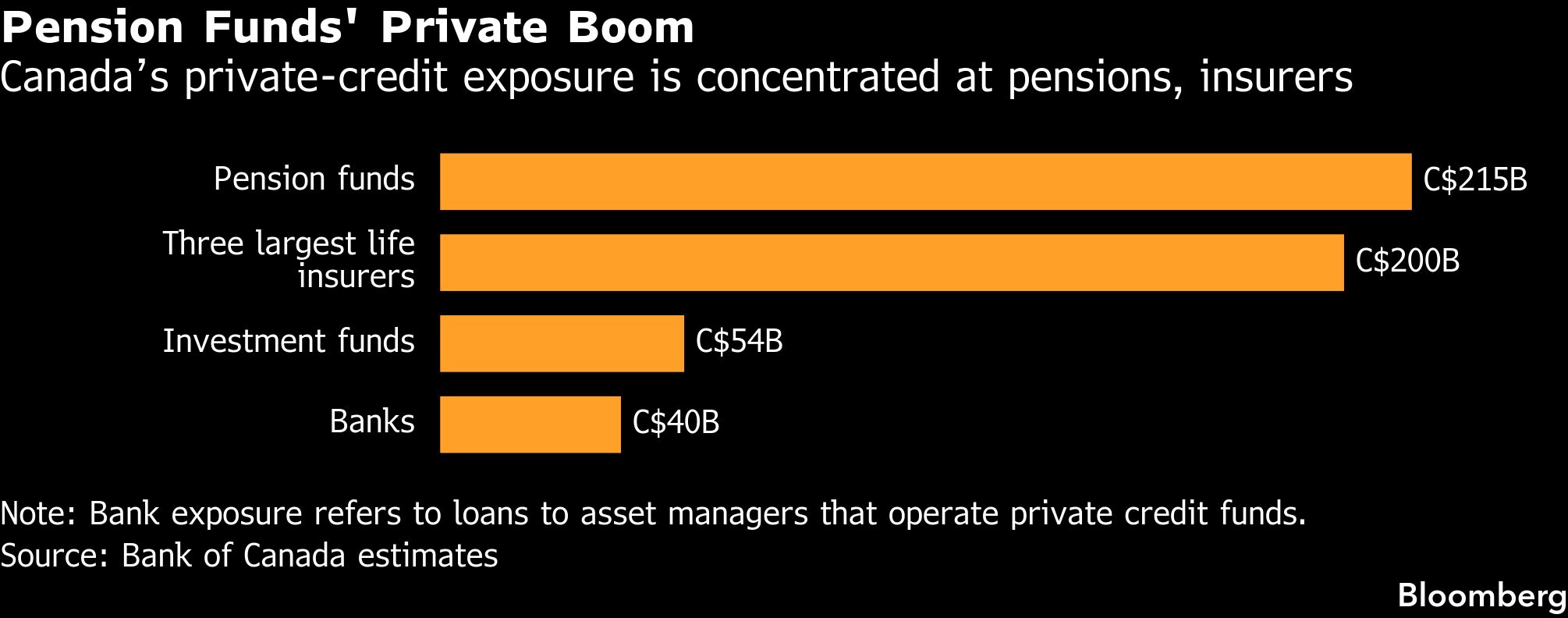
Canadian financial institutions and funds have amassed roughly C$500 billion ($360 billion) of exposure to private credit, most of it outside the country, according to new research from the central bank.
The bulk of the activity is in the US and is driven by pension funds and insurers, the Bank of Canada paper said. The data underscores how the nation’s biggest investors have become increasingly significant players in lending directly to companies abroad, but they haven’t displaced traditional sources of corporate financing at home.
Large Canadian pension funds held C$215 billion of private credit at the end of last year, or roughly 9% of their invested assets, while the three largest life insurers held just over C$200 billion in the first quarter of this year, equivalent to about 22% of their invested assets, according to authors Wendy Chan, Cameron MacDonald and Geneviève Vallée. They used a broad definition of private credit that includes any loan or similar credit product from non-banks to businesses.
Read more: Wall Street Leans on Insurance Pools for $16 Billion Kuwait Deal
Non-bank loans account for about 15% of the credit liabilities of Canadian private non-financial companies, the paper said. That percentage that has been roughly stable for a decade and is slightly lower than at the time of the 2008 financial crisis, according to the BOC’s research. Banks and debt markets provide more than three-quarters of the financing for those firms.
That’s in contrast to the US, where private credit firms have increasingly competed with banks and broadly syndicated loan markets to finance leveraged buyouts and other corporate transactions.
Canadian investment funds held about C$54 billion of private credit in 2025, an increase of more than 60% since 2020, according to the BOC — though the authors say their estimate is probably too low. More than two-fifths of those holdings were tied to real estate.
Despite that growth, private credit represents only about 1.5% of Canadian investment funds’ total net assets.
Banks provide another connection between Canada and global private credit markets. Canadian lenders had at least C$40 billion of loans outstanding to asset managers running private credit funds in the first quarter, with most of that lending going to US-based funds.
The central bank sees those exposures as relatively well-protected. Banks frequently provide subscription facilities secured by investors’ commitments to private credit funds, and fund investors typically absorb losses before the banks do.
Still, the scale of Canada’s offshore exposure is drawing increased scrutiny as regulators assess how problems in the fast-growing private credit industry might spread through the financial system. The Bank of Canada warned in its Financial Stability Report earlier this year that private credit’s complex structures, limited transparency and lack of history in severe economic downturns make it difficult to determine where vulnerabilities are building up.
Stress in private lending in other countries may reach Canada through several channels — including loan losses at pension funds and insurers and, more generally, tighter financial conditions.
But the BOC sees the direct risks to Canada as manageable. Pension funds and insurers generally have long investment horizons and don’t depend heavily on short-term financing, reducing the likelihood they would be forced to sell assets during periods of market stress. Their direct lending usually gives them greater information about borrowers and more control than investors in private credit funds have.
For insurers, the 22%-of-assets figure overstates their exposure to the riskier corner of private credit associated with leveraged buyouts. Life insurers have invested in privately placed corporate debt for decades because long-dated loans can be matched against long-term insurance liabilities, while often providing higher yields and stronger covenants than comparable public bonds.
In the US, private placements had already grown to about 20% of life insurers’ bond portfolios by 2022, according to industry data that cites Federal Reserve estimates.
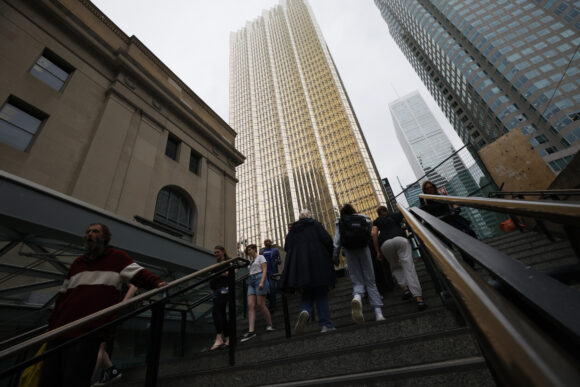
Photograph: Pedestrians in the financial district of Toronto; photo credit: Cole Burston/Bloomberg
Was this article valuable?
Here are more articles you may enjoy.
 Home Insurance Tops Property Taxes in Squeeze for US Households
  AI Models May Soon Self-Replicate Across Smart-Home Devices, Anthropic Warns
  NYC Restaurants Shut Off Air Conditioning, Close on Sundays as Costs Surge
  All in the Family: Husband, Wife and Daughter Indicted for Insurance Fraud and Bribery

